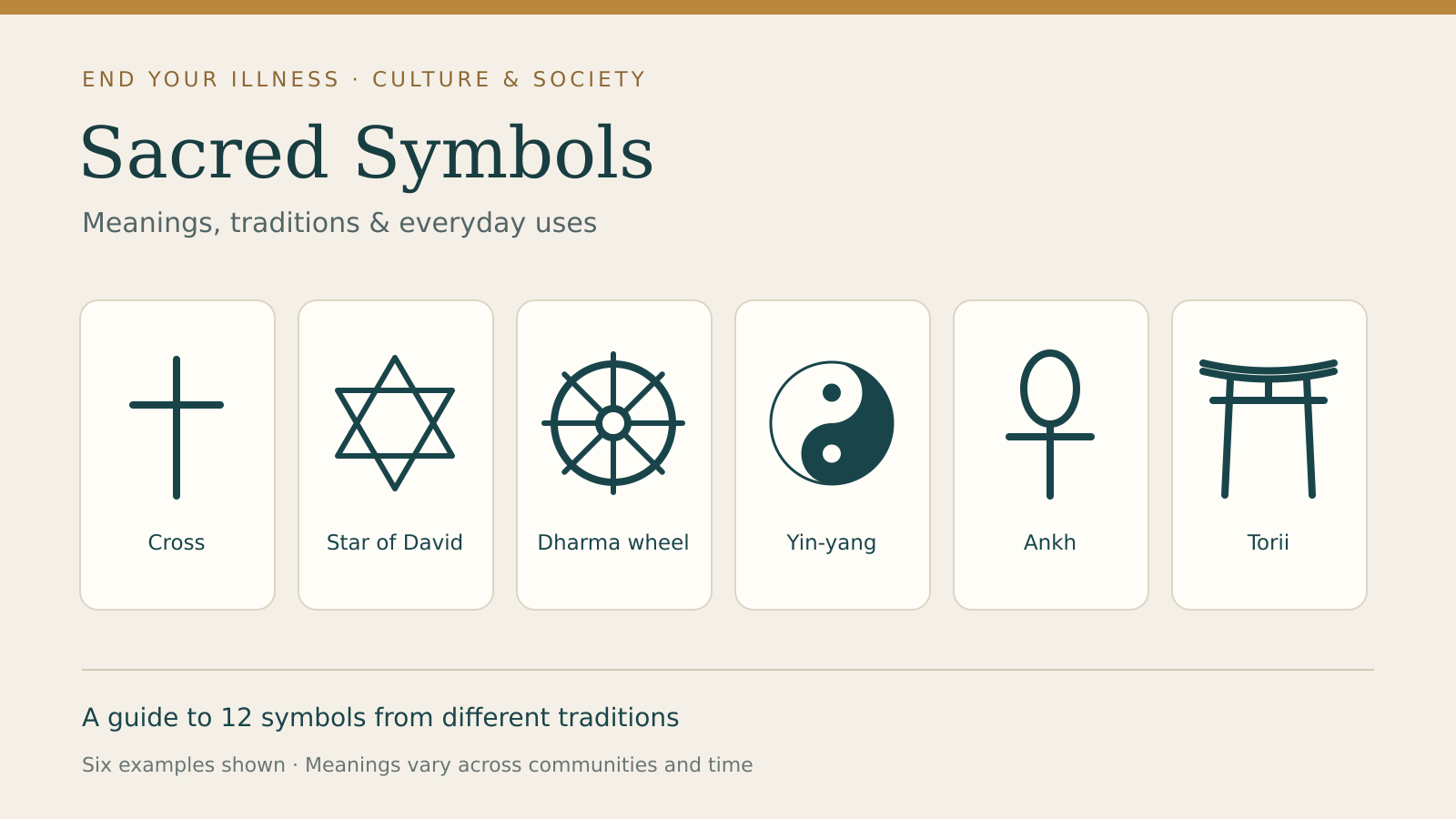
A symbol can carry a story, a prayer, a memory or a sense of belonging in a single shape. A wheel may recall a path of practice. A flower may express spiritual growth. A gateway may tell a visitor that they are entering sacred space.
The chart below introduces 12 examples from different traditions. Some are sacred signs used in worship; others are cultural emblems, philosophical diagrams or architectural forms. Their meanings can vary across communities and periods, so no short chart can speak for every believer. Inclusion in Myths, Controversies & Society is a way to explore stories and cultural meaning, not a judgment that a religion is false.
Sacred symbols at a glance
The forms shown are simplified. Where a symbol is difficult to reproduce in plain text, its shape is described.
On a smaller screen, swipe or scroll sideways within the table to see every column.
| Symbol and form | Tradition or context | Meaning in brief | How it is used |
|---|---|---|---|
| ✝ Cross | Christianity | Recalls Jesus’ crucifixion and, for Christians, the hope of resurrection and salvation. A crucifix includes a representation of Jesus’ body; a plain cross does not. Different churches emphasize different forms. | Appears in churches, worship, devotional art and personal jewellery. Many Christians also make the sign of the cross as a prayerful gesture. Johns Hopkins University |
| ✡ Star of David (Magen David) | Judaism and Jewish identity | A six-pointed star formed by two overlapping triangles. It is widely recognized as a Jewish emblem today, although the shape predates its widespread use as a Jewish communal symbol. It has religious, cultural and national associations. | Used on synagogues, community emblems, ritual objects and jewellery. It also appears on Israel’s flag, but wearing it does not by itself identify a person’s political views. Smithsonian Magazine |
| ☪ Crescent and star | Some Muslim societies and Islamic cultural settings | Commonly associated with Islam through historical and political use, particularly the Ottoman tradition. It is not a universally prescribed sacred emblem of Islam, and Muslim views on its use differ. | Appears on some mosques, flags and community designs. It identifies a cultural or religious setting for many people; it does not mean that Muslims worship the moon. Federal Territories Mufti’s Office, Malaysia |
| ॐ Om (Aum) | Especially Hinduism; also present in other Indian religious traditions | A written form of a sacred sound or syllable. In Hindu traditions it can express the divine, ultimate reality and the relationship between sound and existence. Interpretations are layered and vary between schools. | Chanted in prayer, meditation and recitation, and written on sacred texts, shrines and devotional objects. It is more than a decorative sign for relaxation. Hindu American Foundation |
| ☸ Dharma wheel (Dharmachakra) | Especially Buddhism | Represents the Buddha’s teaching, or Dharma. An eight-spoked form is commonly associated with the Noble Eightfold Path, which joins understanding, ethical conduct and mental cultivation. Other wheel designs have different numbers of spokes. | Used in Buddhist art, temple decoration and teaching materials. The expression “turning the wheel of Dharma” refers to teaching, rather than to a physical wheel that grants spiritual power. The Buddhist Centre |
| Lotus flower | Buddhism and Hinduism, with distinct interpretations | In Buddhist art, the flower rising from muddy water commonly expresses purity and awakening. Hindu images also associate lotuses with divinity and particular deities. Meaning depends on the figure, text and setting. | Forms seats or pedestals for sacred figures, appears in religious paintings and textiles, and serves as a teaching image. Colour meanings are not identical in every tradition. Rubin Museum |
| ☬ Khanda | Sikhism | Combines a central double-edged sword, a circular chakar and two curved kirpans. Common explanations connect these elements with divine knowledge, the eternal Divine, and the relationship between spiritual life and responsibilities in society. | Appears on Sikh emblems and many Nishan Sahib flags at gurdwaras. It expresses religious identity and ethical responsibility, rather than simply celebrating warfare. Sikh Coalition |
| ☯ Yin-yang (taijitu) | Chinese philosophy; prominent in Daoist and other Chinese traditions | Represents complementary, interdependent aspects of a changing whole. The familiar dark-and-light form should not be reduced to “evil versus good.” Yin and yang describe relationships rather than two permanently separate substances. | Used in philosophical teaching, diagrams, religious art and cultural designs to explain patterns of interaction and change. It is not exclusive to one religious community. Columbia University, Asia for Educators |
| ☥ Ankh | Ancient Egyptian religion and writing | A loop-topped sign used in hieroglyphs for life, living or being alive. In religious imagery it expresses life and its divine bestowal. Modern spiritual interpretations should be distinguished from documented ancient uses. | Appears in temple and tomb imagery and on ceremonial objects. A surviving example from the tomb of Thutmose IV is held by the Metropolitan Museum of Art. The Met |
| ⛩ Torii gateway | Shinto, Japan | A gateway marking entry to a sacred area. Its meaning comes partly from its actual role in a place, not only from its outline as an icon. Designs and materials vary. | Stands at shrine approaches and sometimes within shrine grounds to mark sacred boundaries. A simplified torii also identifies Shinto shrines on maps. Kokugakuin University, Encyclopedia of Shinto |
| Nine-pointed star | Bahá’í Faith | A widely used emblem associated with the number nine, including ideas of completeness and unity. It is not the only Bahá’í symbol; the tradition also has a five-pointed star and other sacred forms. | Used in community identification, publications and art. The nine points should not be presented as a definitive list of “the world’s nine religions.” Bahá’í Reference Library |
| Ahimsa hand: an upright palm with a wheel | Jainism | Expresses ahimsa, or nonviolence toward living beings, a central Jain ethical commitment. The hand-and-wheel motif is also part of the larger modern Jain emblem, which contains additional elements. | Used in Jain educational materials and community emblems as a reminder to consider harm in thought, speech and action. It is a call to ethical practice, not merely a good-luck sign. Harvard’s Pluralism Project |
What symbols do in everyday life
They help people remember. A symbol can bring a teaching or sacred story to mind without retelling the whole story. The Dharma wheel and Jain ahimsa hand are useful examples of a visual form pointing toward a way of living.
They express belonging. A symbol on a building, flag or necklace can connect someone with a community or heritage. That connection may be deeply religious, mainly cultural, or both. A symbol alone cannot tell us everything about the person who uses it.
They shape sacred space and practice. The torii marks a threshold. The cross may focus prayer. Om is spoken as well as seen. Treating every symbol as a picture on a page misses these lived uses.
Three misunderstandings to avoid
“Every symbol has one fixed meaning.” Meanings change across time and place. Even members of the same religion may explain a symbol differently. The lotus and crescent-and-star are especially useful reminders to ask about context.
“Similar shapes prove that all traditions teach the same thing.” Circles, stars and flowers appear widely, but resemblance alone does not establish a shared origin or identical beliefs. Historical claims need evidence from texts, objects and the communities involved.
“A sacred symbol guarantees protection, healing or luck.” Some traditions attach protective or devotional significance to objects. That is a statement about religious belief and practice, not clinical evidence that a design or amulet treats illness. Spiritual support can be meaningful without replacing medical care.
A respectful way to learn and use symbols
Before wearing, displaying or adapting a sacred symbol, learn its name, the tradition it belongs to and the setting in which it is normally used. Ask a knowledgeable member of that community when the intended use could be sensitive. Local guidance matters, especially for tattoos, commercial products, ritual objects and photography in sacred places.
This selection is an introduction, not a ranking or a complete catalogue. Traditions not represented here have rich symbolic languages of their own, and some communities prefer words, practices or relationships over a single emblem. The most useful question is often: What does this symbol mean to the people who live with it?
Further reading
The links in the chart lead to museum collections, university resources and religious or community explanations. For additional visual examples, see The Met’s lotus-patterned Buddhist robe, Japan Tourism Agency’s guide to a torii gate and Jainpedia’s overview of holy symbols.
#SacredSymbols #Symbolism #ReligionAndCulture #CulturalHistory #MythsAndSociety #EYI
