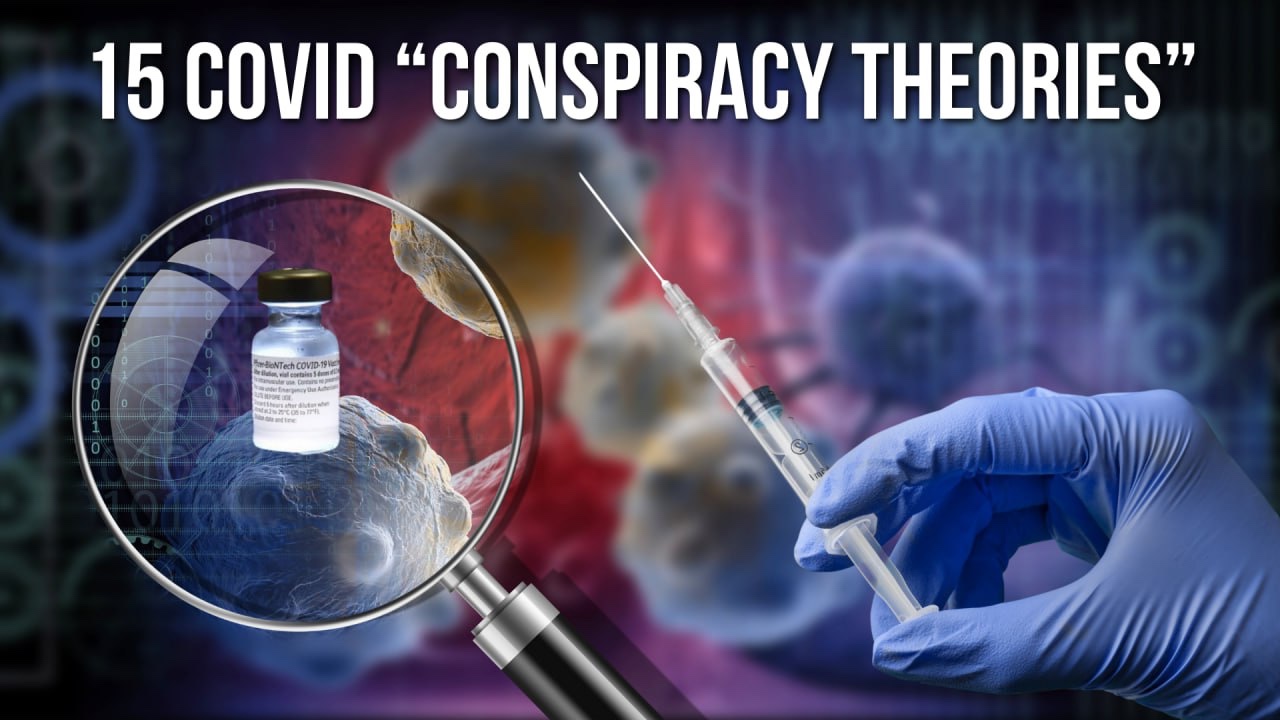
The original list brought together fifteen claims about COVID-19 treatment, vaccination, masks and public accountability. They do not all have the same evidential standing. Some refer to real research or official statements; others turn an association, laboratory result or allegation into a conclusion that the underlying evidence does not establish.
The original headline and retained graphic reflect the earlier presentation. This updated review does not endorse their blanket claim that all fifteen points were proved true. The original shortened links remain below for attribution, but their destinations could not all be independently verified. The assessment instead identifies the primary evidence that can be checked.

What the fifteen claims actually establish
15. Repeated vaccination and the immune system
Researchers have observed a shift toward the IgG4 subclass among antibodies directed at the coronavirus spike protein after repeated mRNA vaccination. That finding concerns a particular immune response and deserves further study. It does not, by itself, demonstrate general immune-system failure or establish that recipients become less able to fight every infection.
14. Ivermectin and COVID-19 deaths
A large percentage from an observational comparison is not enough to prove that a drug prevented deaths. Treatment selection, differences between groups and other care can distort the result. The randomized TOGETHER trial did not demonstrate the claimed clinical benefit, and the FDA states that available clinical-trial data do not demonstrate ivermectin’s effectiveness against COVID-19. Do not substitute veterinary products or self-prescribed ivermectin for medical care.
13. Blame directed at unvaccinated people
Whether a population was unfairly blamed is partly a question about public messaging and ethics. It is not a clinical finding that can be inferred from a study’s title. Vaccination never guaranteed that an individual would not become infected. Its effects on infection, severe illness and transmission must be examined separately, with attention to variant and time since vaccination.
12. Mask use and infection rates
An observational association between mask use and infection cannot establish that masks caused infection. People with greater exposure may be more likely to wear them. Fit, material, consistency of use and the comparison group matter. CDC guidance describes well-fitting masks as an additional protective layer, rather than an absolute barrier.
11. Immunity after infection
Previous infection can provide immune protection. Its strength changes over time and across variants, so a single “seven times” comparison cannot describe everyone’s risk. WHO also recognizes hybrid immunity from infection and vaccination. These findings do not make deliberate infection a safe prevention strategy.
10. Ivermectin and cancer mechanisms
Laboratory studies have explored ivermectin’s effects on cancer cells, including colorectal cancer cells. A mechanism observed in a dish is a research lead, not proof that taking the drug safely treats cancer in people. Clinical trials must establish dose, benefit and harms. A list of mechanisms should not prompt someone to delay established cancer treatment.
9. Hospital payments and deaths
Medicare introduced additional payments for eligible COVID-19 hospital admissions. CMS documents describe payment and documentation rules, not a reward for killing patients. Allegations of deliberate killing require case-specific medical and legal evidence. The existence of a reimbursement policy does not establish that accusation.
8. Claims that officials concealed harms
A concealment allegation needs the complete correspondence, dates, what officials knew and what they communicated. The linked claim was not independently established in this review and should not be repeated as a proven finding. Scrutiny of official decisions is appropriate; an allegation and a demonstrated cover-up remain different things.
7. Health effects of wearing masks
Masks can cause discomfort or skin irritation, and individual medical circumstances matter. That does not establish that routine use is generally toxic. The CDC’s evidence review reports little or no clinically meaningful change in oxygen or carbon dioxide in several studied groups using cloth or surgical masks. Someone who cannot tolerate a mask should seek practical, individualized advice.
6. The claimed neurological injury rate
The assertion that nearly one in three recipients suffered neurological harm cannot be accepted without the study’s sampling method and outcome definition. A survey counting temporary headaches is not equivalent to a population study of diagnosed neurological injury. Symptoms deserve care, but a percentage without those distinctions cannot establish a general injury rate.
5. Heart findings after vaccination
Myocarditis and pericarditis are recognized risks of mRNA COVID-19 vaccines, and the FDA strengthened their warnings in June 2025. A separate study of 777 hospital employees detected vaccine-associated myocardial injury using a troponin-based definition in 22 participants after a Moderna booster. That result merits attention, but a laboratory-marker endpoint is not interchangeable with diagnosed myocarditis, heart failure or permanent damage in every recipient.
4. The allegation about hidden trial deaths
The specific accusation that Pfizer concealed almost 80% of deaths was not verified here. The FDA’s December 2020 briefing publicly reported deaths through a stated November 2020 cutoff. Comparing that report with later follow-up requires matching dates, study groups and reporting periods. A larger later count alone does not prove that earlier data were deliberately hidden.
3. Research on persuasion
Researchers did test messages intended to increase vaccination. One published randomized study examined text reminders and easier appointment scheduling. That is evidence of behavioral research, not proof of literal mind control. Questions about transparency, pressure and informed choice can be debated without misdescribing what an experiment tested.
2. Manufacturing changes
Scaling up vaccine production involved manufacturing-process changes. EMA’s public assessment discusses comparisons between the processes and the resulting product. A change in production method does not, on its own, establish an undisclosed substitution. Product quality, comparability and regulator assessments are the relevant evidence.
1. Florida’s announcement about residual DNA
Florida’s surgeon general did call for a halt to mRNA COVID-19 vaccination on January 3, 2024. That verifies the announcement, not its underlying safety conclusion. In its December 2023 response, the FDA described manufacturing controls and said it had identified no safety concern attributable to residual DNA. Residual fragments are not themselves proof of genome alteration.
A better standard for pandemic claims
Accountability includes acknowledging genuine adverse effects and correcting overconfident public messages. It also requires refusing unsupported certainty. Read the full study or official record, distinguish symptoms from diagnoses and events from causes, and discuss personal treatment or vaccination decisions with a qualified clinician who can consider your circumstances.
References
- Irrgang and colleagues: spike-specific IgG4 after repeated mRNA vaccination
- FDA: ivermectin and COVID-19
- Reis and colleagues: randomized TOGETHER ivermectin trial
- CDC: masks and respiratory viruses
- CDC: archived review of mask evidence and physiological studies
- WHO: infection-induced and hybrid immunity
- Primary laboratory study: ivermectin and colorectal cancer cells
- CMS: CARES Act hospital payment rules
- FDA: June 2025 updated myocarditis and pericarditis warnings
- Prospective study of troponin after an mRNA-1273 booster
- FDA: December 2020 Pfizer-BioNTech briefing document
- Dai and colleagues: randomized vaccination reminder trials
- EMA: Comirnaty public assessment and manufacturing comparability
- Florida Department of Health: January 3, 2024 announcement
- FDA: December 14, 2023 response about residual DNA
Original article links, retained for attribution. These links are not endorsements; their destinations and allegations were not all independently verified.
- Original link 15
- Original link 14
- Original link 13
- Original link 12
- Original link 11
- Original link 10
- Original link 9
- Original link 8
- Original link 7
- Original link 6
- Original link 5
- Original link 4
- Original link 3
- Original link 2
- Original link 1

1 comment
Dr. Jane Ruby out of Florida is someone I listen to in great detail on this topic.