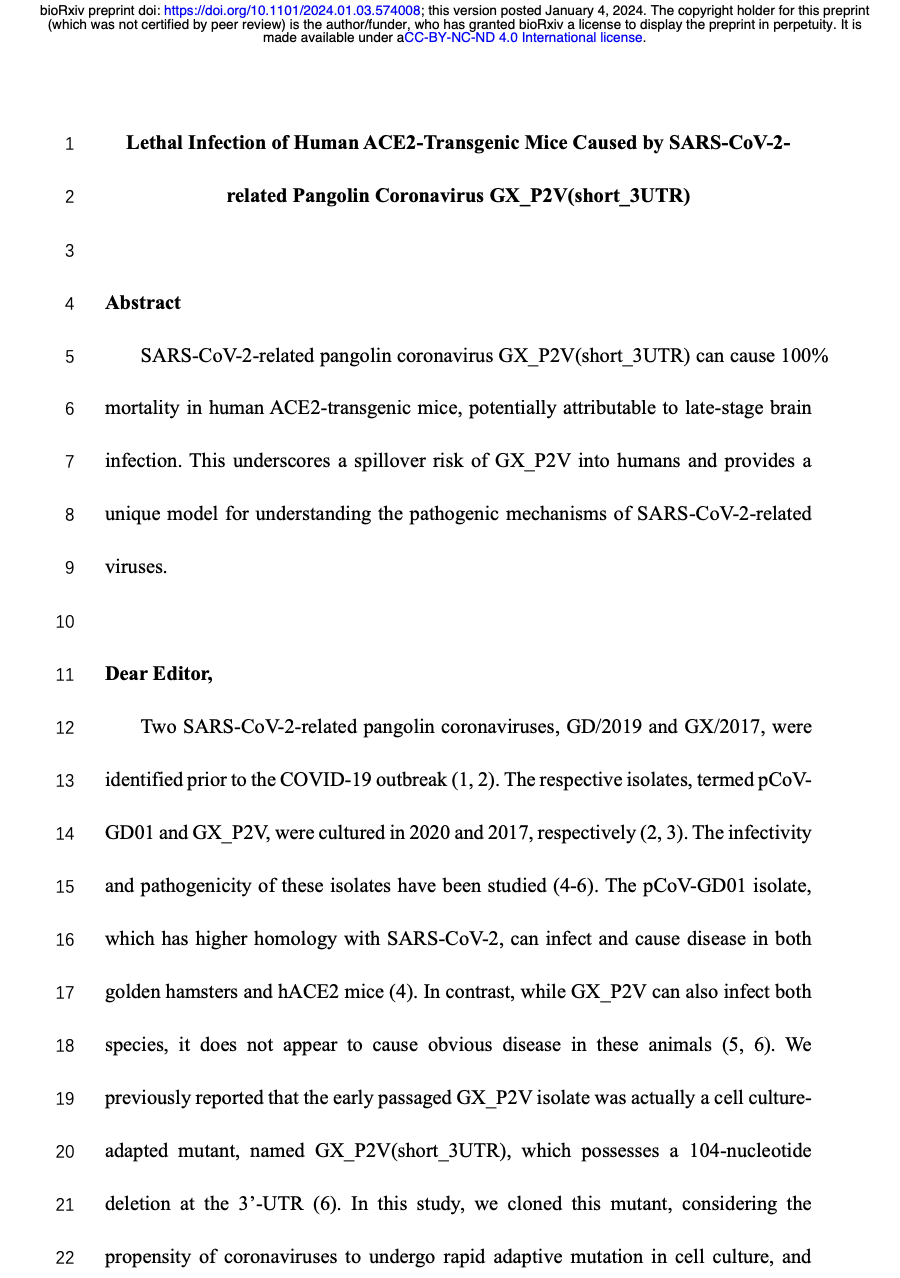
Research update: The reported deaths occurred in a small group of specially modified laboratory mice. They do not establish a 100% fatality rate in humans or predict another pandemic. The original post referred to a January 2024 preprint about a pangolin coronavirus related to SARS-CoV-2. A later peer-reviewed version was published in mLife in March 2026, making it possible to discuss both the early report and its subsequent publication.

Original attribution: The Epoch Times, as stated in the original headline. The retained image shows the January 4, 2024 bioRxiv preprint. No verified Epoch Times article link was supplied in the original post.
What the mouse experiment showed
The research concerned GX_P2V(short_3UTR), a pangolin-coronavirus variant, rather than a newly discovered circulating human variant of SARS-CoV-2. In the published survival comparison, four mice received the live virus, with separate control groups. The fatal outcome in that experimental group is the basis for the widely repeated 100% figure. Expressing the result as four out of four makes the sample size visible.
The animals were engineered to express human ACE2, a receptor relevant to viral entry. That makes them a research model, not small human beings. A disease outcome in a selected mouse model depends on the model’s biology as well as the virus. It cannot be transferred directly to people with different tissues, immune responses and exposure circumstances.
The published paper describes the virus as highly attenuated while reporting mortality in this particular model, and presents the model as a possible way to evaluate vaccines and drugs. Those statements are compatible: the effect of a virus can differ greatly between experimental hosts. They do not establish that the virus is harmless in every setting, or that it would cause comparable fatal disease in humans.
What would be needed to assess human risk?
Human disease severity, the ability to infect people and the ability to spread efficiently between people are separate questions. A lethal mouse experiment does not answer all three. Assessing a public-health threat requires evidence directed at those questions, rather than extrapolating a percentage from four animals. The study also does not demonstrate that an outbreak has occurred or that one is imminent.
Why oversight remains a legitimate concern
Questions about whether research is necessary, how benefits are assessed and how accidental or deliberate misuse is prevented deserve substantive answers. WHO’s framework for responsible life-sciences research calls for shared responsibility across researchers, institutions, funders, publishers and regulators in managing biological risks. That is a basis for scrutiny without treating a speculative human fatality estimate as established fact.
The original Epoch Times attribution and preprint image are retained as source history. Readers should distinguish the observed animal result, the researchers’ proposed use of the model and the broader ethical debate. Keeping those separate makes it possible to question the work seriously without presenting an unsupported forecast of catastrophe.
References
- Wei et al., original January 4, 2024 preprint
- Wei et al., published mouse-model study, mLife, March 30, 2026
- WHO, responsible life-sciences research and dual-use governance framework (2022)
