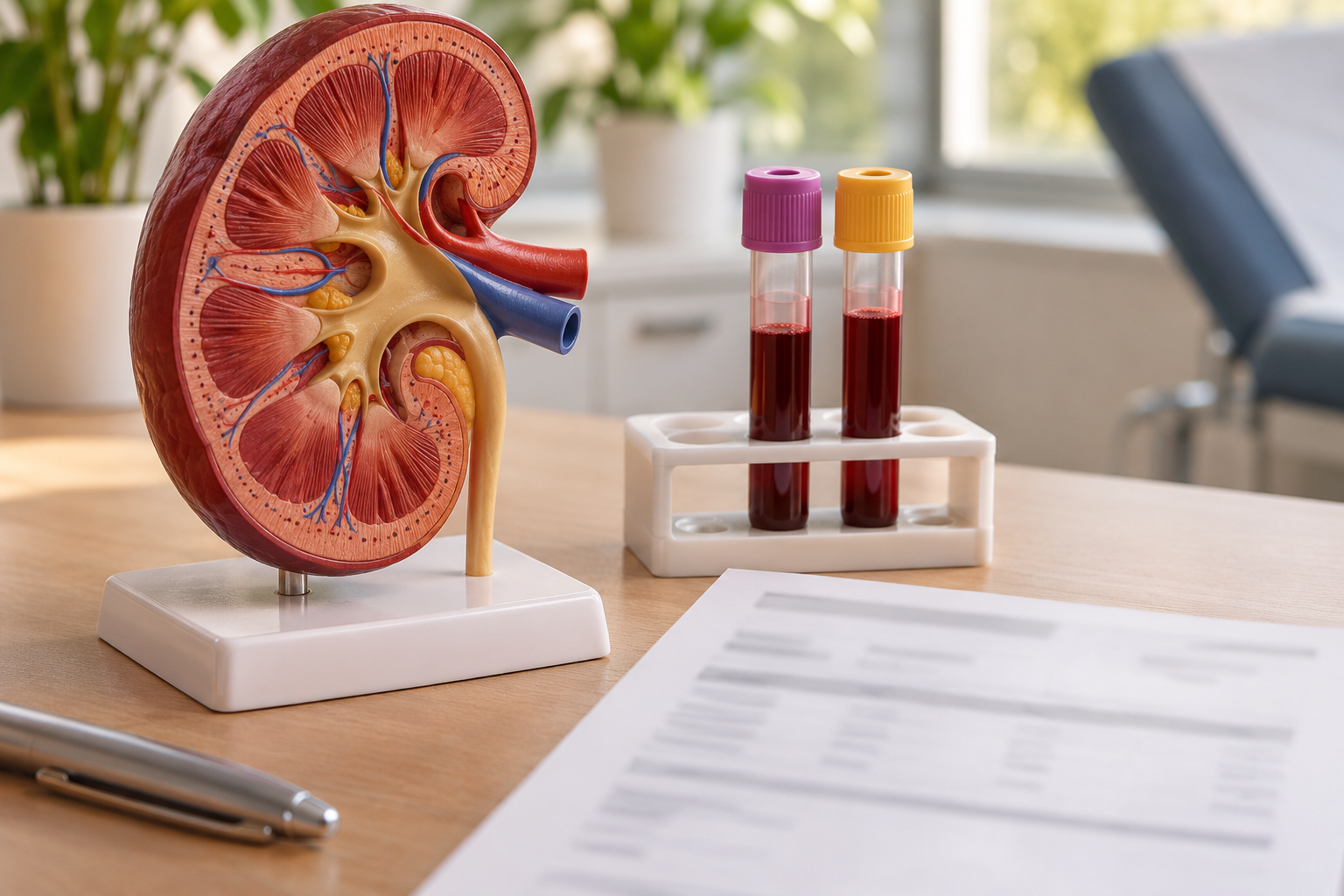
The eGFR printed on a kidney report is a calculation of filtration, usually based on a blood creatinine result together with age and sex. It helps guide care, but an estimate can be influenced by factors outside the kidneys. When that uncertainty could affect a clinical decision, a second blood marker called cystatin C may help.
What the 2026 research adds
A study published in The BMJ on 19 March 2026 compared estimated kidney function with measurements obtained using iohexol clearance. Researchers recruited adults with moderate chronic kidney disease at six centres in England; 875 had the paired measurements needed for the three-year analysis.
Equations using creatinine and cystatin C together followed measured changes more closely than equations using a single marker. Agreement was roughly 78–80% for the combined equations, compared with 73% for one commonly used creatinine equation, using the study’s specified margin of agreement.
There was an important limitation: all the equations underestimated the decline in kidney function at group level. Their sensitivity for identifying the study-defined disease progression was below 55%, so a reassuring estimated trend could miss some progression. The study supports better estimation; it does not show that adding a test prevents kidney failure or produces identical accuracy in every population, including patients in India.
Why two markers can be useful
Creatinine comes partly from muscle metabolism. Someone with very little muscle may have a low creatinine result despite impaired filtration. High muscle mass, strenuous exercise, cooked meat and creatine supplements can push creatinine upwards without an equivalent fall in filtration. Medicines can also affect the result. These possibilities deserve discussion rather than being used to dismiss an abnormal report.
Cystatin C offers another view because it has different sources of error. It can be useful when creatinine-based estimates are difficult to interpret, but untreated thyroid conditions and steroid treatment can affect it. Combining the markers can reduce some uncertainty without eliminating it.
Ask what would change in your care
Bring earlier reports and details of medicines and supplements. Ask whether cystatin C would clarify a diagnosis, monitoring plan or medicine-dose decision. The answer depends on your circumstances; an extra test is not automatically needed for everyone.
Kidney assessment also uses urine albumin-to-creatinine ratio, which checks for albumin leakage. Evidence lasting at least three months helps establish chronic kidney disease, but a newly abnormal or rapidly changing result should be assessed promptly. Do not wait three months before seeking advice.
For the other measurements commonly reported alongside eGFR, read our guide to KFT results. A clinician should interpret the complete picture and agree on follow-up with you.
References
- The BMJ: Accuracy of GFR estimation for monitoring moderate CKD
- National Kidney Foundation: Creatinine
- National Kidney Foundation: Cystatin C
- National Kidney Foundation: Best practices for CKD identification, risk stratification and management
