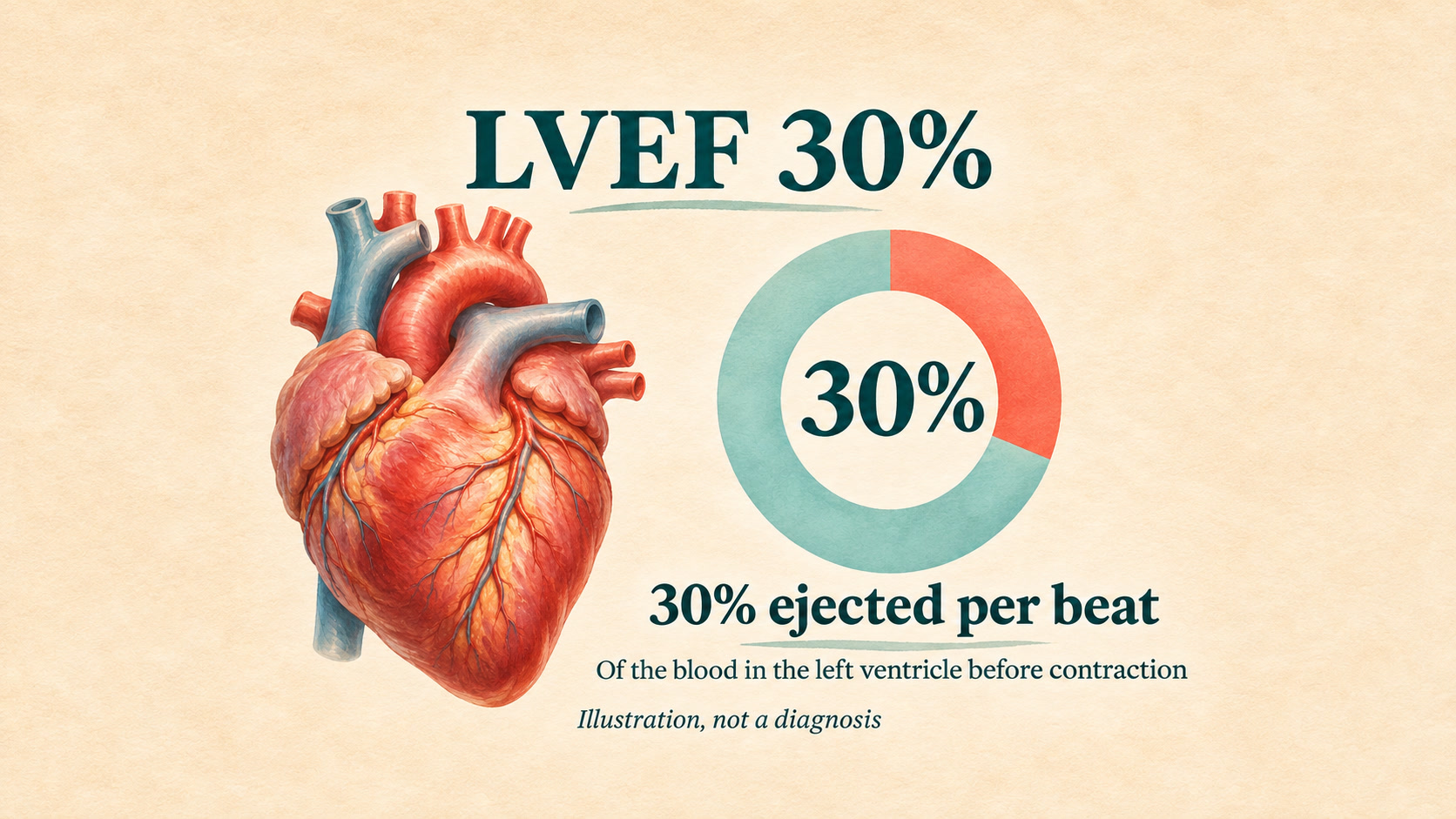
An LVEF of 30% means the heart’s main pumping chamber pushes out about 30% of the blood it contains just before each contraction. It is significantly below the usual range and needs prompt medical review, especially if it is a new finding.
It does not mean that only 30% of the heart is working, that someone has a 30% chance of survival, or that 30% of their life remains. The number alone cannot predict an individual’s future.
What does LVEF stand for?
LVEF means left ventricular ejection fraction. The left ventricle is the chamber that pumps oxygen-rich blood around the body. Ejection fraction compares the amount pumped out in one beat with the amount in that chamber immediately before it squeezes, called its end-diastolic volume.
For a simple illustration, if the left ventricle contains 100 mL before a beat and pumps out 30 mL, the LVEF is 30%. Those volumes are an example, not an estimate of any particular person’s heart.
A healthy heart normally leaves some blood in the chamber after each beat. It does not need an EF of 100%. LVEF also does not measure blood oxygen saturation or the heart’s overall efficiency.
How does 30% compare with the usual range?
The American Heart Association describes a typical normal EF as 55% to 70%. Reference limits can vary with the laboratory and measurement method, so the report’s reference range matters. AHA: ejection fraction.
For people being assessed for heart failure, commonly used categories are:
- 40% or below: reduced ejection fraction.
- 41% to 49%: mildly reduced ejection fraction.
- 50% or above: preserved ejection fraction.
These are heart-failure classification thresholds, not a diagnosis by themselves. A clinician considers symptoms, examination and other tests. For mildly reduced or preserved EF, the AHA/ACC/HFSA framework also requires evidence of increased pressure as the heart fills to confirm heart failure. ACC guideline summary.
An LVEF of 30% falls in the reduced range and indicates substantially weakened pumping. Some people have few symptoms despite a low EF. Equally, a normal or preserved EF does not rule out heart failure: the heart may have difficulty relaxing and filling.
Is LVEF a blood-test result?
No. LVEF is usually measured on an echocardiogram, an ultrasound scan of the heart. Cardiac MRI and certain other imaging tests can also measure it. You may see “EF,” “LVEF” or “LV systolic function” on a heart scan report.
Blood tests such as BNP or NT-proBNP can help assess possible heart failure, but they do not directly measure LVEF. Understanding the type of report is an important first step when interpreting a medical result.
What can cause a low LVEF?
Possible causes include:
- Damage from a heart attack or coronary artery disease.
- Long-standing high blood pressure.
- Disease of the heart muscle, called cardiomyopathy.
- Heart-valve problems.
- Certain persistent abnormal heart rhythms.
- Inflammation of the heart muscle, sometimes following an infection.
Finding the cause helps guide treatment. A figure of 30% cannot identify that cause on its own.
What should happen after a result of 30%?
A new or unexplained LVEF of 30% should be discussed promptly with the clinician who ordered the scan or a cardiologist, even if the person feels well. Someone already receiving care should follow their agreed heart-failure plan and discuss any change from previous results.
Assessment may include reviewing symptoms and medicines, examining the heart and lungs, checking an ECG and blood tests, and reviewing the full scan. Depending on the findings, clinicians may investigate the coronary arteries, heart rhythm or heart muscle further.
Useful questions to take to an appointment include:
- What is the likely cause of the reduced LVEF?
- Do the other findings show heart failure or another heart condition?
- What treatment and activity plan is appropriate?
- Which symptoms should trigger a call, and who should be contacted?
- When should the scan be repeated?
Can an LVEF of 30% improve?
It can improve in some people, particularly when the underlying cause is treatable and the treatment plan is followed. Recovery is not guaranteed, and the amount and timing of improvement vary.
For heart failure with reduced EF, clinicians commonly use a combination of medicines: an ARNI, ACE inhibitor or ARB; an evidence-based beta blocker; a mineralocorticoid receptor antagonist; and an SGLT2 inhibitor, where suitable. Diuretics may relieve fluid build-up. Selection and doses depend on blood pressure, kidney function, potassium levels and other individual factors.
Some people need treatment for a valve or coronary artery problem, or assessment for an implanted heart device. An EF of 30% alone does not mean a device or operation is automatically needed.
A care plan may also include cardiac rehabilitation, suitable physical activity, stopping smoking and advice on alcohol, salt and fluids. Follow individualized recommendations rather than starting strenuous exercise or strict fluid restriction independently. Do not stop or change prescribed medicines without medical advice, even if a later EF improves.
Why small changes need careful interpretation
LVEF is an estimate. Image quality, the measurement technique and the person interpreting the scan can affect the result. Different imaging methods may give different values.
A change from 30% to 32%, for example, may reflect measurement variation rather than definite recovery. Clinicians look at the size and consistency of a change alongside symptoms and the rest of the scan. Ask what change would be meaningful in the individual treatment plan.
When to get urgent help
Call your local emergency number immediately for severe breathlessness at rest, new or persistent chest pain, collapse or unresponsiveness, blue or grey lips, or coughing up frothy pink sputum with breathing difficulty. Do not drive yourself to hospital.
Seek urgent medical advice for worsening breathlessness, difficulty breathing when lying flat, new or increasing swelling, or sudden weight gain. Severe or rapidly worsening symptoms need emergency help.
The urgency depends on the person’s symptoms and clinical condition, not just the EF number.
The key message
LVEF of 30% is a serious finding, but it is not a prediction of lifespan. Understanding the cause, getting appropriate treatment and keeping follow-up appointments are more useful than interpreting the percentage in isolation.
This article provides general health information and does not replace an individual medical assessment.
Sources and further reading
- American Heart Association: Ejection Fraction Heart Failure Measurement
- American College of Cardiology: AHA/ACC/HFSA Heart Failure Guideline Summary
- NHS: Heart Failure, Symptoms and When to Get Help
- National Heart, Lung, and Blood Institute: Heart Failure Diagnosis
- National Heart, Lung, and Blood Institute: Heart Failure Treatment
- American Heart Association: Improving a Low Ejection Fraction
- British Society of Echocardiography: Normal Reference Intervals for Cardiac Dimensions and Function
Hashtags: #LVEF #EjectionFraction #HeartHealth #HeartFailureAwareness #Echocardiogram #UnderstandYourReports #EndYourIllness
