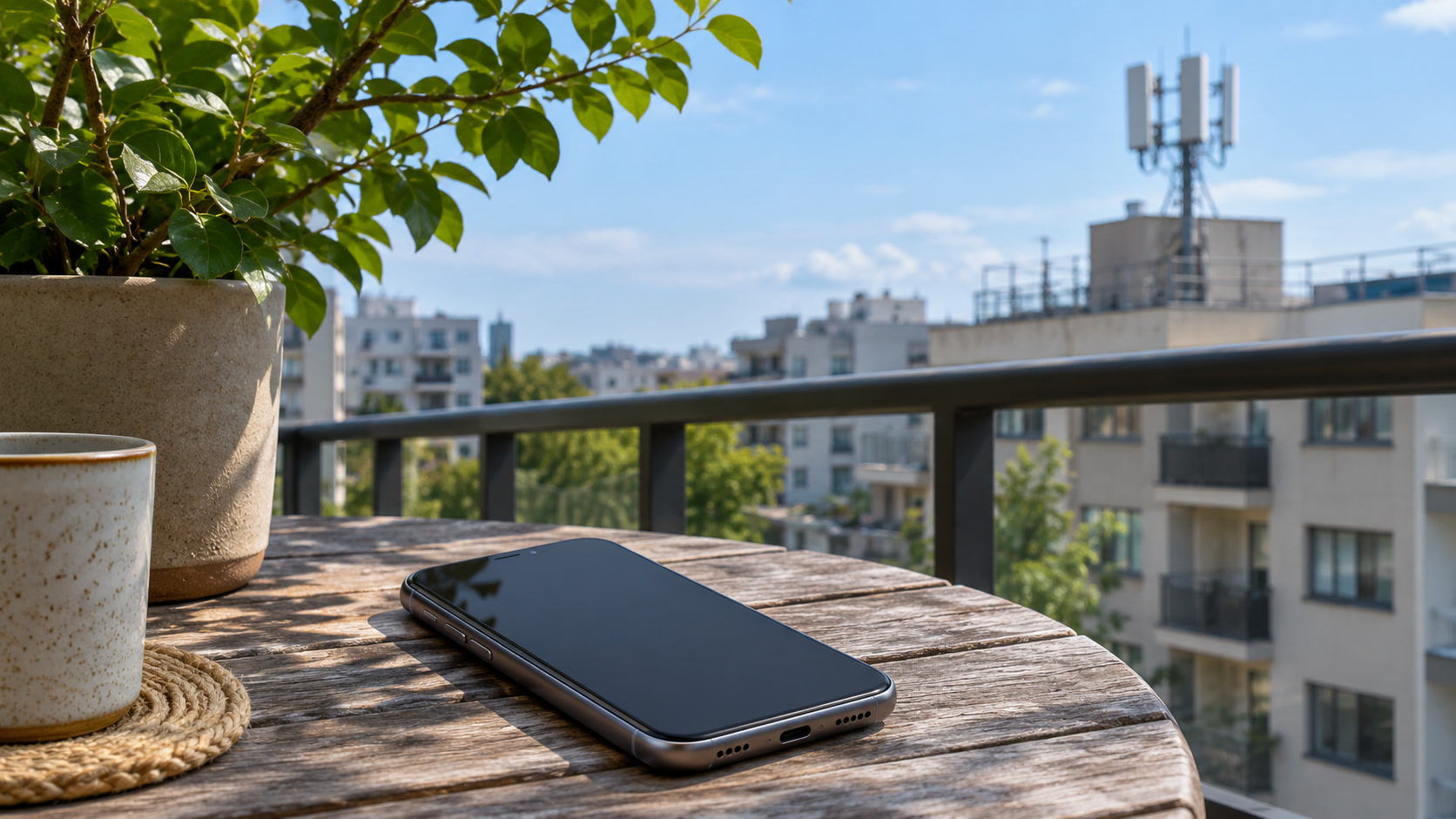
Image: AI-generated illustrative scene of wireless technology, not a measurement of exposure or evidence of health effects.
Mobile phones, Wi-Fi routers and wireless networks are part of everyday life. Questions about their health effects deserve careful answers, particularly when headlines claim either that all wireless radiation is dangerous or that every possible risk has been ruled out.
Research in people is reassuring for the cancers most often studied. However, it does not prove that every wireless technology, exposure level and long-term health outcome is risk-free. Radiofrequency energy can harm tissue at sufficiently high intensities through heating. Some animal experiments have also raised questions that scientists continue to investigate.
Understanding the difference between an established effect, an uncertain finding and a claim unsupported by evidence makes the discussion more useful.
What wireless radiation actually means
Wireless communication uses radiofrequency electromagnetic fields, often shortened to RF or RF-EMF. These are part of the electromagnetic spectrum, alongside visible light, infrared, ultraviolet and X-rays, but their physical properties differ.
Radio waves used by mobile phones are non-ionizing. Individual radiofrequency photons do not carry enough energy to knock electrons out of atoms in the way that X-rays can. This explains why it is misleading to treat a phone signal as though it were an X-ray exposure. It does not establish that radio waves are harmless at every power level. The amount of energy absorbed by tissue still matters. National Cancer Institute explanation.
5G means the fifth generation of mobile-network technology. It is not one single frequency or a new category of radiation. Networks can use different frequency bands, including higher frequencies than earlier mobile systems. At higher frequencies, energy generally penetrates less deeply and is absorbed closer to the body surface. A higher frequency therefore does not automatically mean deeper penetration or a greater health risk. UK Health Security Agency guidance.
Wi-Fi and cellular networks both use radiofrequency signals, but findings from one particular exposure cannot simply be transferred to every other device or network.
What is firmly established
At mobile-communication frequencies, tissue heating is the main established interaction relevant to health protection. Sufficiently intense RF exposure can heat tissue enough to cause harm. Exposure guidelines therefore limit the energy absorbed by the body and the resulting heating.
The International Commission on Non-Ionizing Radiation Protection published updated guidelines in 2020 covering frequencies from 100 kilohertz to 300 gigahertz, including those used by 5G, Wi-Fi and mobile phones. The limits incorporate reduction factors to account for uncertainties and variation between people and exposure conditions. Journal reference 1.
Compliance with a guideline is an important protection measure. It should not be described as proof that every conceivable delayed effect has been excluded. The evidence and the standards both need continuing review.
Real-world exposure also needs measurement. UK research around 5G base stations found public exposure well below the guideline levels used there, with 5G contributions generally lower than or similar to those from 4G. Those findings describe the locations and conditions studied, rather than certifying every installation worldwide. UKHSA research summary.
What studies in people say about cancer
A large systematic review commissioned and partly funded by the World Health Organization was published in 2024. It evaluated 63 articles involving participants in 22 countries.
The authors found moderate-certainty evidence that mobile-phone use likely does not increase the risk of several commonly studied tumours, including glioma, meningioma and acoustic neuroma, as well as pituitary and salivary-gland tumours in adults and brain tumours in children and young people. For the most investigated tumours, the combined results did not show increasing risk with longer time since starting mobile-phone use or more cumulative calling. Journal reference 2.
A companion review published in 2025 examined less-researched cancers. It found no increased risk for the combinations it could assess, but confidence was lower. For example, the evidence concerning mobile-phone use and leukaemia, non-Hodgkin lymphoma or thyroid cancer was rated low certainty. Some exposure-and-cancer combinations had too little research for a conclusion. Journal reference 3.
These findings are reassuring, but their scope matters. Much of the research concerns earlier generations of mobile technology. It cannot provide decades of direct follow-up for 5G, especially its higher-frequency applications.
Why the animal findings still matter
Animal experiments allow researchers to control exposure more precisely than is usually possible in everyday human life. They can identify hazards worth investigating, although translating their results into human risk requires care.
A WHO-commissioned review published in 2025 rated the evidence for increased glioma and malignant heart schwannoma in male rats as high certainty under the experimental conditions assessed. These are tumours involving brain cells and nerve-supporting cells in the heart. Its authors also emphasized the difficulty of translating RF animal-cancer results into human risk. A correction to the paper was published in 2026. Journal reference 4 and correction 5.
Other results have differed. A Korean study published in 2026 exposed male rats to a particular 900-megahertz mobile-phone signal over a long period. It found no statistically significant increase in tumour incidence and no detected damage to genetic material under its tested conditions. Journal reference 6.
The responsible interpretation is to take concerning findings seriously, examine conflicting results and test whether effects are reproducible. An animal tumour finding does not by itself show that ordinary 5G use causes human cancer. A negative animal experiment likewise cannot settle every possible exposure or outcome.
What the IARC classification means
In 2011, the International Agency for Research on Cancer, the WHO’s cancer agency, classified radiofrequency electromagnetic fields as possibly carcinogenic to humans, or Group 2B.
That assessment reflected limited evidence, particularly concerning glioma and acoustic neuroma in wireless-phone users. A causal explanation was considered credible, but chance, bias and other factors could not be confidently excluded. The classification did not quantify an individual’s risk from using a phone. IARC’s original assessment announcement.
A hazard classification asks whether an exposure might be capable of causing cancer. Estimating risk also requires knowing how much exposure occurs and under what conditions. New WHO-commissioned reviews do not automatically change an IARC classification, and they should not be described as a blanket declaration that 5G is either dangerous or completely safe.
Headaches, sleep problems and other symptoms
People who experience headaches, poor sleep or other symptoms deserve appropriate care, whatever they suspect the cause may be.
A 2024 systematic review of controlled human experiments did not find consistent increases in headache, sleep disturbance or combined symptom scores from the RF exposures tested. These studies mainly address short-term exposure under experimental conditions. They cannot answer every question about years of exposure or every individual circumstance. Journal reference 7.
Symptoms alone cannot identify RF exposure as their cause. Persistent or worsening symptoms should be assessed by a qualified healthcare professional rather than assumed to be caused by a nearby router or tower. A lack of evidence for that proposed cause does not make the symptoms unimportant.
How to judge a striking research claim
Before accepting a headline, look for several basic details:
- What was studied? Human illness, an animal outcome and a change in cells grown in a dish answer different questions.
- What exposure was used? Frequency, absorbed energy, duration and the part of the body exposed all matter.
- Was heating controlled? An unnoticed temperature difference can complicate a claim that an effect occurs without heating.
- Were there proper comparison groups and blinded assessments? Researchers need safeguards against expectations influencing results.
- Has the result been independently repeated? A finding becomes more persuasive when other teams reproduce it.
A review of research above 6 gigahertz found no confirmed evidence of health hazards from the low-level exposures it assessed, but highlighted weaknesses in measuring absorbed energy, controlling temperature and repeating results independently. Those limitations are reasons to improve experiments, rather than reasons to declare all findings meaningless or all technologies proven safe. Journal reference 8.
In human observational studies, an association also needs scrutiny. People may remember past phone use inaccurately, and users may differ in other ways that influence health. Statistical adjustment can help, but it cannot remove every uncertainty. NCI discussion of study limitations.
Practical choices without alarm
If you would prefer to reduce your exposure, simple steps are available:
- Use speakerphone or a wired headset for longer calls, keeping the handset away from your head.
- Shorten calls when convenient, particularly in areas with poor reception where a phone may transmit at higher power.
- Follow the device manufacturer’s instructions and respect barriers or warning signs around transmitting equipment.
- Be cautious about stickers, pendants and other products claiming to neutralize wireless radiation. Claims of protection need good evidence. Some phone shields can interfere with reception and cause the phone to increase its transmitting power.
These are optional ways to reduce exposure, not treatments for illness or evidence that everyday use causes disease. ARPANSA exposure-reduction advice and FTC consumer warning.
Current human evidence is reassuring in several well-studied areas. Continued monitoring, better experiments and honest communication about uncertainty remain necessary. Neither fear-based claims nor promises of absolute safety give readers the full picture.
Disclaimer
This article summarizes publicly available scientific research and health guidance and is provided “as is” for general information and education. It is not individualized medical advice, diagnosis or treatment and does not replace assessment by a qualified healthcare professional. It is not intended to target, disparage or endorse any particular company, network, device or product. Exposure conditions and individual circumstances differ. Observational associations and laboratory findings should not be treated as proof of disease causation in everyday human use. Scientific evidence and guidance may change as further research becomes available.
Hashtags
#5G #WirelessTechnology #Radiofrequency #ElectromagneticFields #PublicHealth #CancerResearch #ScienceLiteracy #EvidenceBasedHealth #EndYourIllness
Journal references
- International Commission on Non-Ionizing Radiation Protection. Guidelines for limiting exposure to electromagnetic fields (100 kHz to 300 GHz). Health Physics. 2020;118(5):483–524. doi:10.1097/HP.0000000000001210.
- Karipidis K, et al. The effect of exposure to radiofrequency fields on cancer risk in the general and working population: A systematic review of human observational studies. Part I: Most researched outcomes. Environment International. 2024;191:108983. doi:10.1016/j.envint.2024.108983.
- Karipidis K, et al. The effect of exposure to radiofrequency fields on cancer risk in the general and working population: A systematic review of human observational studies. Part II: Less researched outcomes. Environment International. 2025;196:109274. doi:10.1016/j.envint.2025.109274.
- Mevissen M, et al. Effects of radiofrequency electromagnetic field exposure on cancer in laboratory animal studies, a systematic review. Environment International. 2025;199:109482. doi:10.1016/j.envint.2025.109482.
- Mevissen M, et al. Corrigendum to “Effects of radiofrequency electromagnetic field exposure on cancer in laboratory animal studies, a systematic review” [Environ. Int. 199 (2025) 109482]. Environment International. 2026;214:110368. doi:10.1016/j.envint.2026.110368.
- Kim HS, et al. The International Collaborative Animal Study of the carcinogenicity and genotoxicity of mobile phone radiofrequency radiation: the Korean study. Toxicological Sciences. 2026;209(3):kfag001. doi:10.1093/toxsci/kfag001.
- Bosch-Capblanch X, et al. The effects of radiofrequency electromagnetic fields exposure on human self-reported symptoms: A systematic review of human experimental studies. Environment International. 2024;187:108612. doi:10.1016/j.envint.2024.108612.
- Karipidis K, et al. 5G mobile networks and health—a state-of-the-science review of the research into low-level RF fields above 6 GHz. Journal of Exposure Science & Environmental Epidemiology. 2021;31:585–605. doi:10.1038/s41370-021-00297-6.
