Before treating a chart as a timetable for your life, identify who produced it and what question it was designed to answer. This one accompanies Absolute Zero, a 2019 report from the UK FIRES research collaboration.
Cambridge announced the report on 29 November 2019. The researchers explored how the UK might reach zero emissions by 2050 using technologies that could be deployed at scale within the available time, alongside changes in resource use. The chart is part of that proposed pathway. It should not be presented as an enacted government schedule.
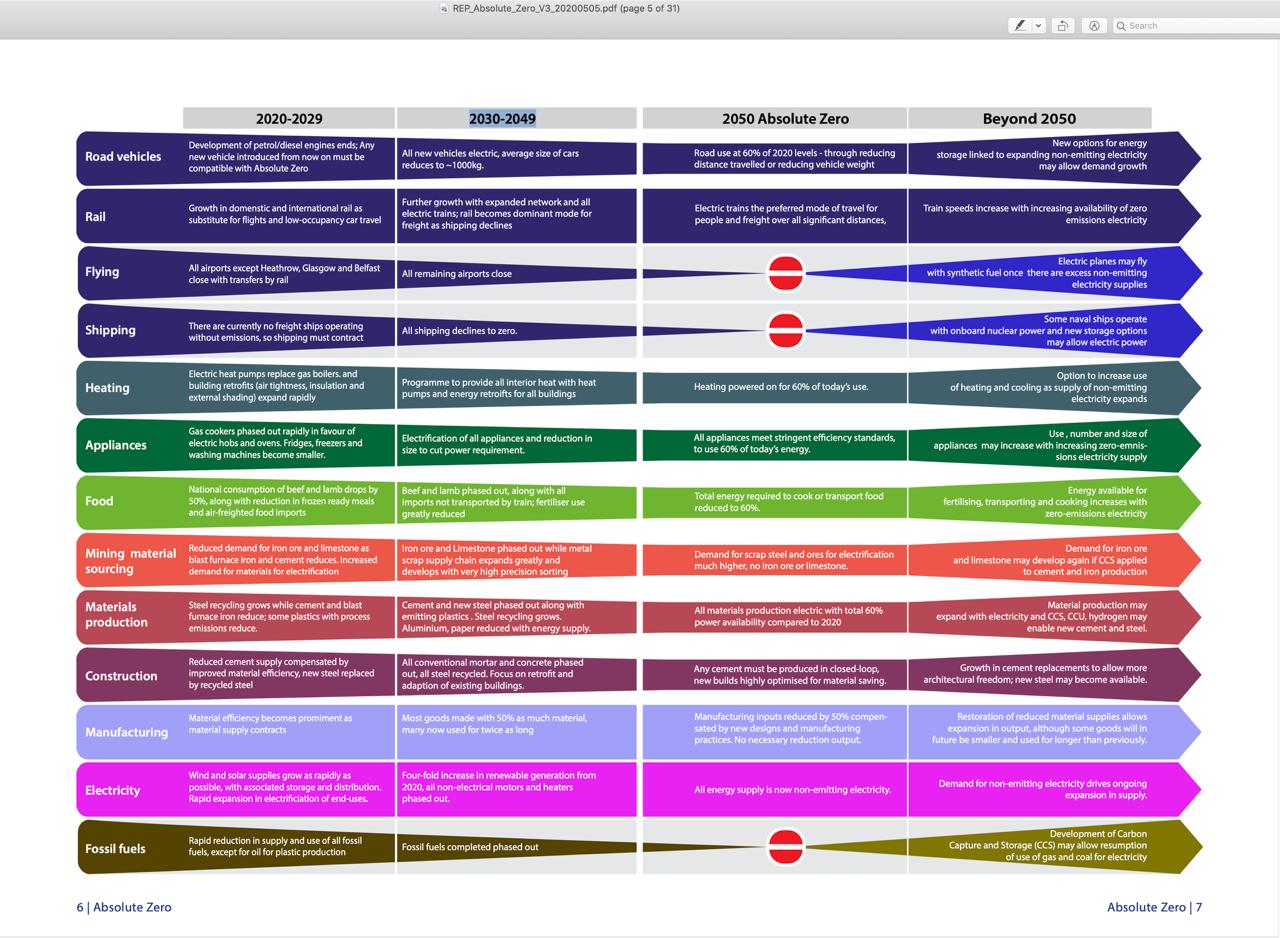
Chart from Absolute Zero, UK FIRES; ©2019 University of Cambridge. User-supplied screenshot.
Its proposals for transport, food, buildings and industry follow from the report's assumptions. Readers can reasonably question those assumptions, the practical costs or the distribution of burdens. To do so fairly, read the explanation alongside the timeline: a sectoral proposal is not the same thing as a law already requiring everyone to comply.
The useful discussion is about the choices the analysis makes. Which technologies are counted as available? Which emissions are included? What would change if an assumption proved wrong? Those questions help separate an academic scenario from claims that a screenshot reveals a settled programme of restrictions.
References
- UK FIRES: Absolute Zero, original report
- University of Cambridge: report announcement and publication date
