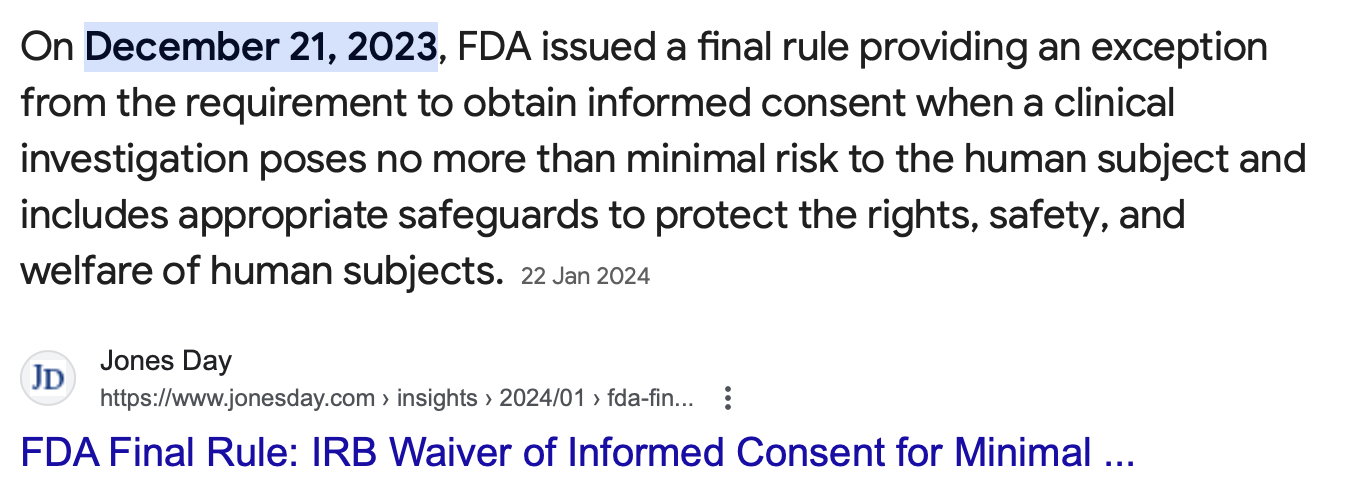
The FDA did create a limited pathway for some clinical investigations to proceed with an institutional review board’s waiver or alteration of informed consent. It did not remove consent requirements from clinical research generally. The final rule was published on 21 December 2023 and took effect on 22 January 2024.
Five findings are required
Under 21 CFR 50.22, the reviewing institutional review board, or IRB, must find and document that all relevant criteria are satisfied. A research sponsor cannot grant itself an exemption merely by describing a study as low risk.
- The investigation presents no more than minimal risk to participants.
- It could not practicably be conducted without the requested waiver or alteration.
- If identifiable private information or identifiable biological samples are involved, the research could not practicably be conducted without using them in identifiable form.
- The waiver or alteration does not adversely affect participants’ rights and welfare.
- Additional relevant information is provided afterwards when appropriate.
“Minimal risk” is a defined regulatory threshold. It compares the likelihood and seriousness of anticipated harm or discomfort with ordinary daily life or routine physical or psychological examinations. It does not mean that researchers may ignore privacy, accept any risk they consider worthwhile, or substitute public benefit for the required findings.
Why this distinction matters
The FDA explained that the change implements authority provided by the 21st Century Cures Act and aligns this part of its rules with the Common Rule framework used in other federally regulated research. Waiving some consent elements and dispensing with consent entirely are different possibilities under the provision; the IRB must assess the actual request.
The rule should also be distinguished from exceptions for emergency research and from a waiver of a signed consent form. Those are separate regulatory questions. The existence of this provision alone does not establish that any particular drug trial, vaccine study or hospital research programme qualifies.
Ethical scrutiny remains important. Readers evaluating a study can ask which IRB reviewed it, what consent exception was used, how minimal risk was assessed and what privacy protections apply. A headline about an exception is the beginning of that inquiry, not evidence that all participants can now be enrolled without safeguards.
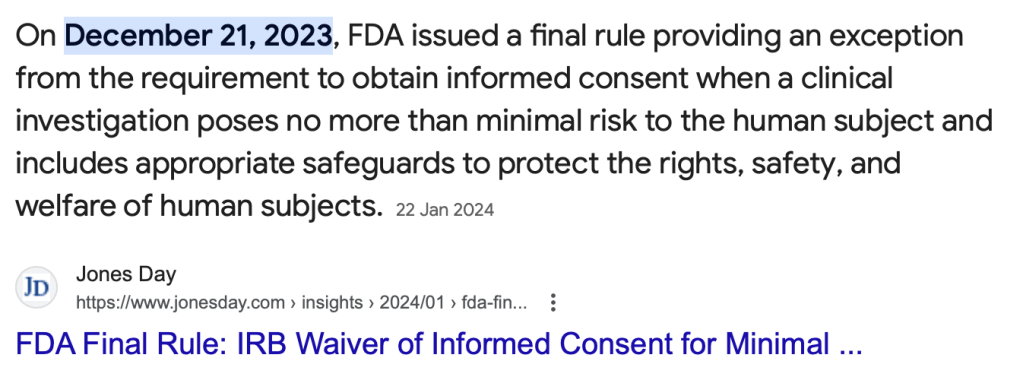
Source credit: the original image shows a search-result excerpt from Jones Day’s January 2024 legal alert. The explanation above is an original summary checked against the federal regulation and rulemaking record.
References
- eCFR: 21 CFR 50.22, minimal-risk consent exception
- eCFR: 21 CFR 50.3, definitions including minimal risk
- Federal Register, 21 December 2023: final rule, pages 88228–88248
- Jones Day: FDA Final Rule: IRB Waiver of Informed Consent for Minimal-Risk Investigations
