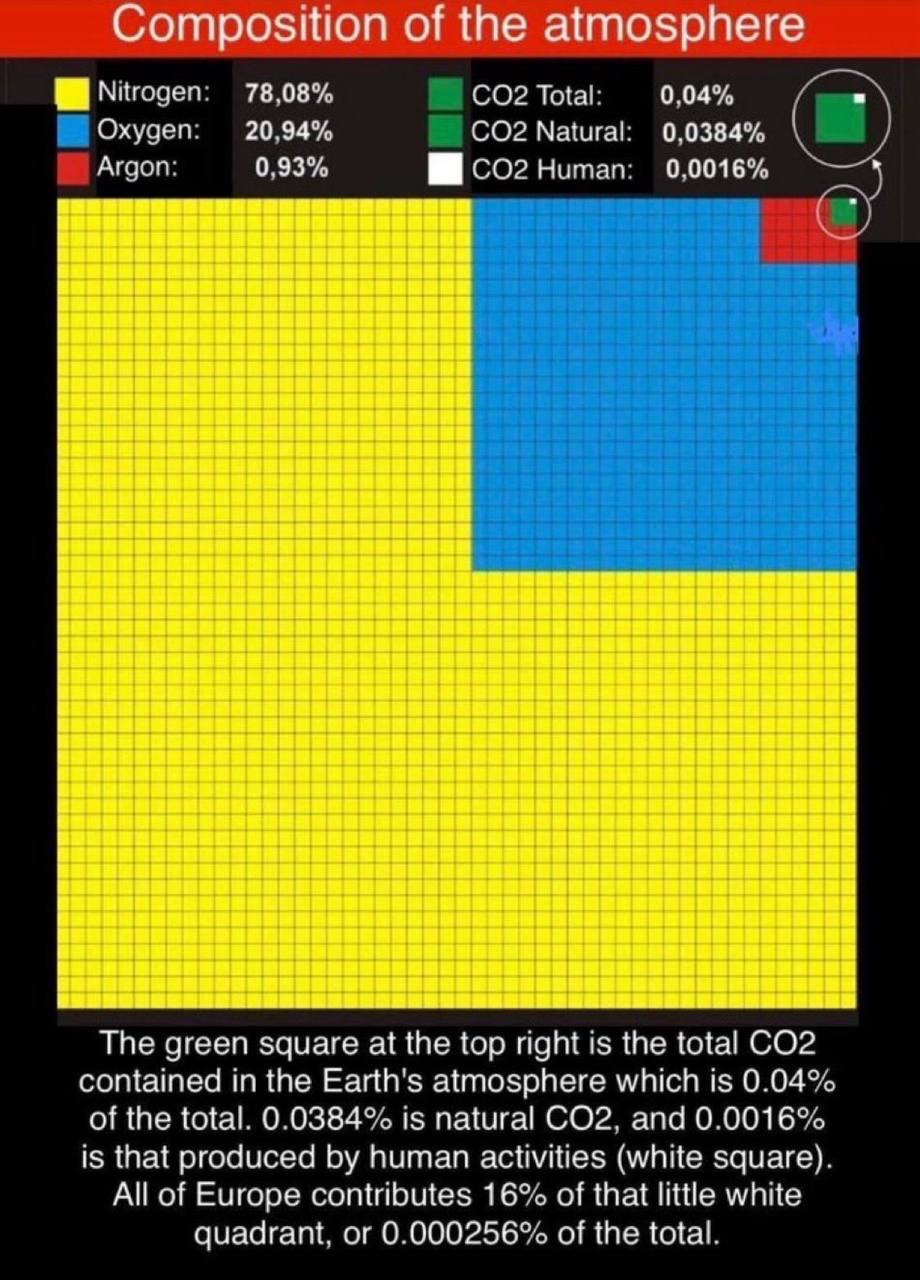
Correction: The graphic’s claim that human-produced carbon dioxide accounts for just 0.0016% of the atmosphere is not a sound measure of humanity’s effect on atmospheric CO₂. It confuses the large natural exchanges of carbon with the additional carbon that has accumulated because of human activity.
The original graphic is preserved below so its numbers can be examined. A small square may communicate a proportion, but it cannot establish where the increase came from or how strongly a gas affects Earth’s energy balance.
Start with the measured concentration
NOAA reports a global atmospheric CO₂ concentration of about 422.8 parts per million for 2024. That is approximately 0.0423% of dry air. Before industrialisation, the concentration was about 280 parts per million, or 0.028%. The rise is therefore roughly 143 parts per million, equivalent to about 0.0143 percentage points of the atmosphere.
This is an increase of approximately 51% relative to the earlier CO₂ level. It is not a claim that half of all air is carbon dioxide. Nor does the subtraction identify the origins of individual molecules, which are continually exchanged among the atmosphere, oceans and living things.
Why natural emissions do not cancel the human contribution
Plants, soils and oceans release and absorb large amounts of carbon each year. Comparing human emissions with only the natural releases leaves out the natural uptake. What determines atmospheric accumulation is the balance between additions and removals.
Human activity adds carbon through fossil-fuel combustion and land-use changes. Natural sinks remove part of that addition, but not all of it. NASA explains that chemical evidence, including the distinctive carbon signature of fossil fuels, supports the human origin of the modern rise.
The graphic assigns 4% of its stated total CO₂ concentration to humans: 0.0016 divided by 0.04. It supplies no evidence that this is the correct share of the accumulated atmospheric change. An estimate about annual flows cannot simply be used as a percentage of the atmospheric stock.
Small concentration does not mean small effect
A gas’s climate effect depends on its physical properties as well as its abundance. CO₂ absorbs outgoing infrared radiation, so increasing its concentration changes how energy leaves the Earth system. The size of a coloured square does not measure that effect.
When assessing this kind of diagram, ask what is being counted, which year the numbers describe and whether the conclusion follows from those numbers. Here, the central human-versus-natural division is misleading.
Original graphic

References
- NOAA Global Monitoring Laboratory: Annual Greenhouse Gas Index.
- NASA: Carbon Dioxide, Earth Indicator.
- NOAA Global Monitoring Laboratory: Carbon-cycle questions.
- NASA: Why Milankovitch cycles cannot explain current warming.
- NASA: Climate and Earth's Energy Budget.
