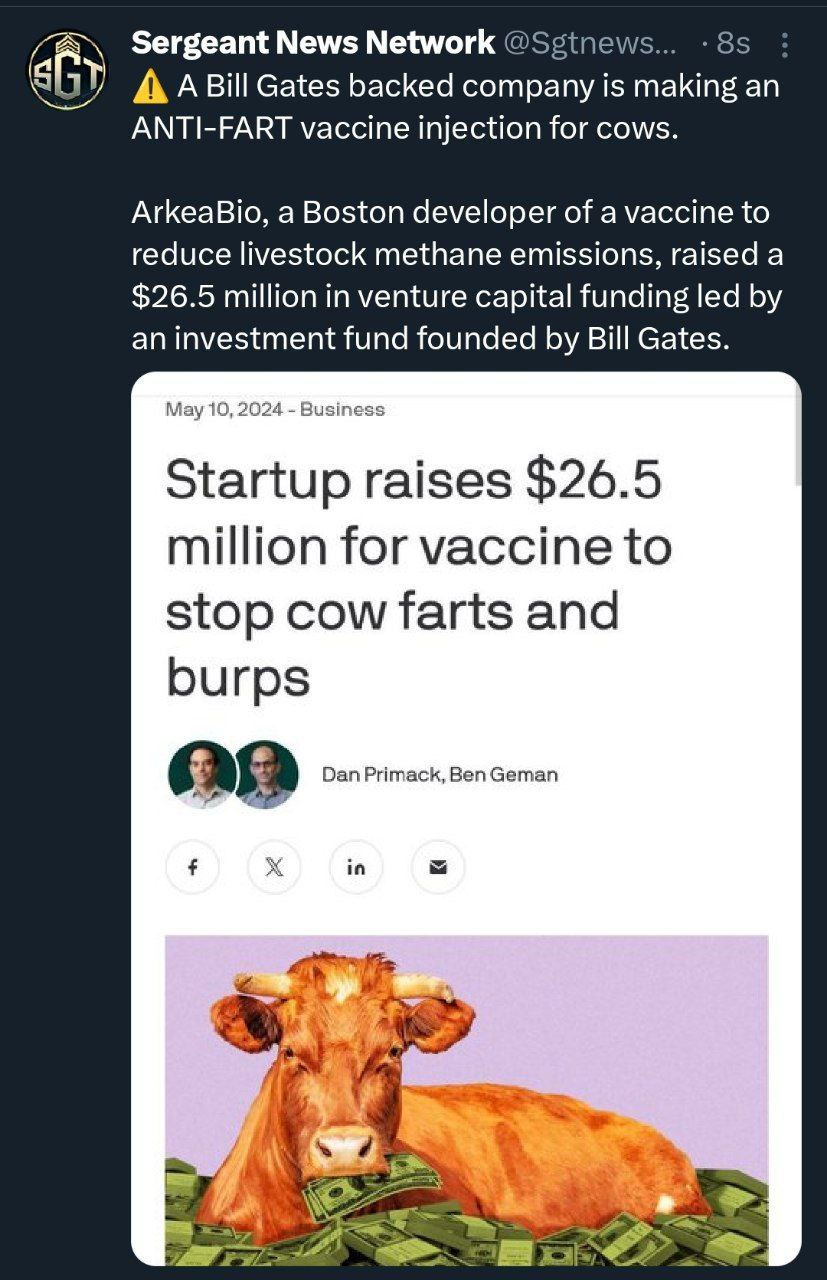
ArkeaBio is developing a vaccine intended to reduce methane released by cattle. The funding story behind this May 2024 post is real: the company announced a US$26.5 million Series A round led by Breakthrough Energy Ventures, the investment organisation associated with Bill Gates. Funding a project, however, is different from proving its effectiveness or requiring farmers to use it.
The target is methane from digestion
Cattle are ruminants. Microorganisms in the rumen help process their feed, and methane-producing microbes generate gas during that process. Much of this enteric methane leaves through the animal’s mouth, including belching. Describing the proposed product simply as an “anti-fart” injection obscures the biological target.
Methane is a greenhouse gas. Livestock also produces emissions through manure and other parts of farming, so an intervention aimed at rumen methane would address one part of the overall footprint. It would not make all agricultural emissions disappear.
How the proposed vaccine is meant to work
The developer describes an approach that stimulates an immune response against methane-producing microbes in the rumen. The aim is to reduce their methane output without undermining digestion or animal health. That is the intended mechanism, not a guarantee that every formulation will achieve it on every farm.
ArkeaBio’s September 2025 company update described continued research, farmer pilots and progress towards commercialisation. Its statements are useful evidence about the project’s plans and financing, but they remain statements from an interested developer. A funding announcement is not a regulatory approval, a completed independent safety review or a government vaccination mandate.
What would make the evidence persuasive?
Useful trials would measure methane over time, compare vaccinated and control animals, and report animal health, digestion, productivity and adverse effects. Results should be tested across diets and production systems. Farmers would also need to understand cost, dosing, duration of effect and any verified benefit.
Other approaches, including feed and management changes, are also studied. The relevant comparison is how well each option works under practical conditions, with transparent trade-offs.
There is room to question the technology, its economics and its oversight. Those questions are stronger when directed at actual data and proposed rules rather than assuming that an investor’s identity proves either safety or harm.
Original accompanying image retained for context; its assertions should be assessed against the explanation above.

References
- ArkeaBio: Company news and 2024 financing announcement.
- ArkeaBio: September 2025 funding and development update.
- ArkeaBio: Proposed methane-reduction approach.
- US EPA: Agriculture-sector emissions.
- US EPA: Enteric fermentation in the greenhouse-gas inventory.
