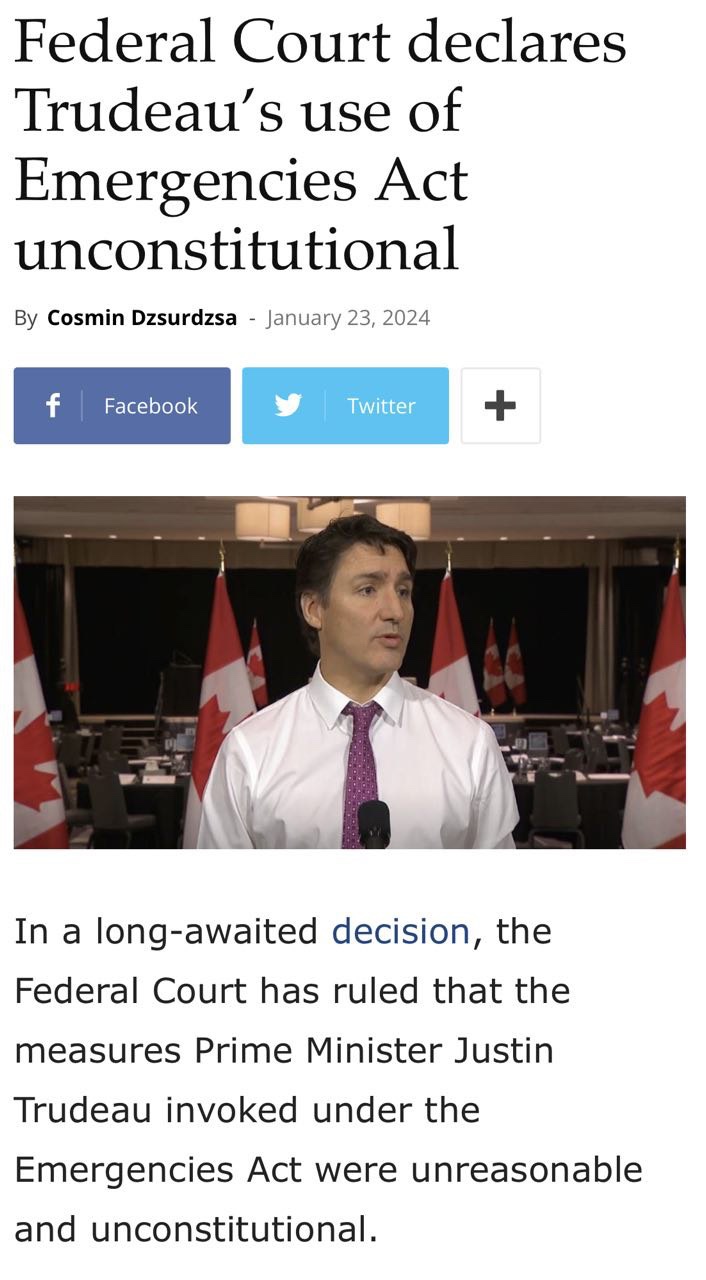
Canada’s courts found that the federal government’s February 2022 use of the Emergencies Act exceeded the statute’s limits and that certain measures infringed Charter rights. The original headline refers to Justin Trudeau, who was prime minister at the time. “Justin Castro” is a political epithet, not the name used in the court proceedings.
What the courts decided
The government invoked the Act on 14 February 2022 amid the Ottawa convoy protest and border blockades. The resulting measures included restrictions on certain public assemblies and requirements affecting the financial accounts of designated people. Judicial-review applications challenged the government’s legal authority and the effects on protected freedoms.
In January 2024, the Federal Court ruled that the invocation was unreasonable and beyond the authority conferred by the Act. It also found unjustified infringements of freedom of expression under section 2(b) of the Canadian Charter of Rights and Freedoms and protection against unreasonable search or seizure under section 8.
On 16 January 2026, the Federal Court of Appeal dismissed the appeals and cross-appeals. Its official summary explains that the government had not established reasonable grounds for the statutory national-emergency and national-security thresholds, including why existing laws were insufficient. The court treated the Act’s demanding requirements as substantive safeguards against overuse of extraordinary executive power.
The Supreme Court stage
A further application for leave to appeal appears in Supreme Court of Canada file 42261. The official docket reviewed on 20 October 2026 records the government’s application in March 2026 and submission of leave materials to the judges on 14 September 2026. It does not record a decision granting or refusing leave in the entries reviewed. Accordingly, this update should not be read as announcing a completed Supreme Court appeal.
The decisions concern the legality of specified government actions. They are not a criminal conviction of a politician, a declaration that every protest activity was lawful, or a general prohibition on emergency legislation. Those distinctions matter both to critics of the measures and to readers evaluating what remedies follow.
The original clipping captured the first court ruling. Keeping that historical account useful requires adding the appellate outcome and identifying what remains unresolved, rather than continuing to present the January 2024 news as a new event.
Source credit: the original image and wording came from Cosmin Dzsurdzsa’s True North report. The updated procedural account is based on the courts’ own publications.

References
- Federal Court of Appeal: 2026 FCA 6, official decision summary
- Supreme Court of Canada: case 42261 docket and lower-court history
- Cosmin Dzsurdzsa, True North: original 23 January 2024 report
