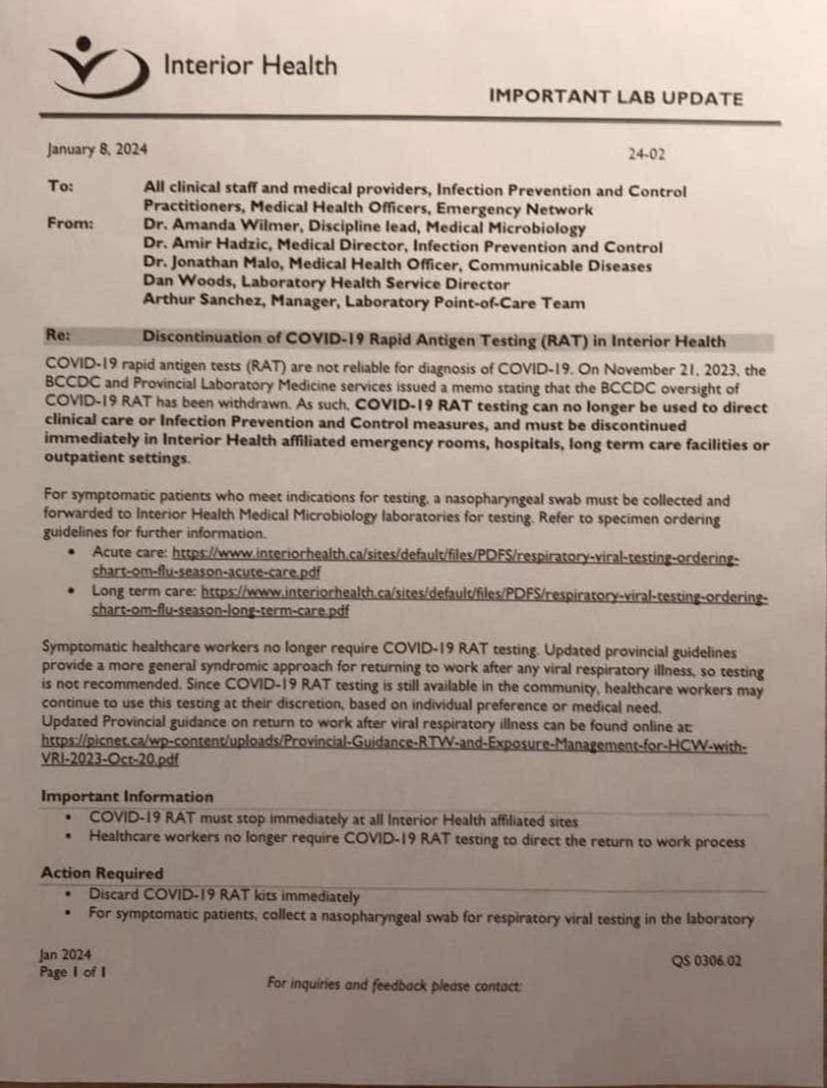
Context matters: The January 2024 Interior Health memo shown in this post changed testing practice within its health-care facilities. It did not establish that all rapid antigen tests were useless or that the public should discard every home test. Interior Health issued a clarification the following day distinguishing community testing from decisions about clinical treatment and infection control.

Original document image retained: Interior Health, Important Lab Update 24-01, January 8, 2024.
What the notice actually said
The January 8 document directed Interior Health facilities to stop using rapid antigen tests to guide clinical care or infection-prevention measures. For symptomatic patients who met testing criteria, it instructed staff to collect a sample for laboratory respiratory-virus testing. It also discussed return-to-work arrangements for health-care workers. Those instructions had a defined institutional audience and purpose.
Even the displayed memo said that community rapid testing remained available. That qualification is important when assessing the original headline’s sweeping claim. A hospital choosing a more sensitive diagnostic method is not the same as finding that a faster community screening tool never detects infection.
In its January 9 clarification, Interior Health said rapid antigen tests could help people in the community identify possible COVID-19 infection and reduce spread. It explained that PCR testing was preferred in health-care settings because consequential treatment and infection-control decisions required greater accuracy, and laboratory testing could also identify influenza and RSV.
Why different settings use different tests
A test’s value depends on the question being asked. A quick result at home may help someone decide to avoid exposing others. A negative result used to decide a vulnerable patient’s treatment or hospital placement carries different consequences if it misses an infection. More sensitive laboratory testing can be preferable when the cost of a false negative is high.
Rapid antigen tests do have limitations. A negative result does not rule out COVID-19, particularly early in an infection. Collection technique and the timing of the sample matter. The US Food and Drug Administration therefore advises repeat testing after a negative home antigen result: generally 48 hours later, with the number of tests depending on whether symptoms are present. Users should follow the specific product’s instructions and local health guidance.
The practical takeaway
The correct reading is a change in how a health authority used tests for particular decisions. It is not a retrospective declaration that all prior testing was invalid. People with symptoms should avoid relying on one negative rapid test as proof they cannot infect others. Those at risk of severe illness, or whose symptoms worsen, should seek advice promptly rather than waiting for repeated home tests to settle the question. Clinical assessment and access to treatment may be time-sensitive.
References
- Interior Health statement on COVID-19 testing, January 9, 2024
- FDA, at-home COVID-19 diagnostic testing questions and repeat-testing guidance
- FDA, first cleared COVID-19 home antigen test and its performance (2023)
