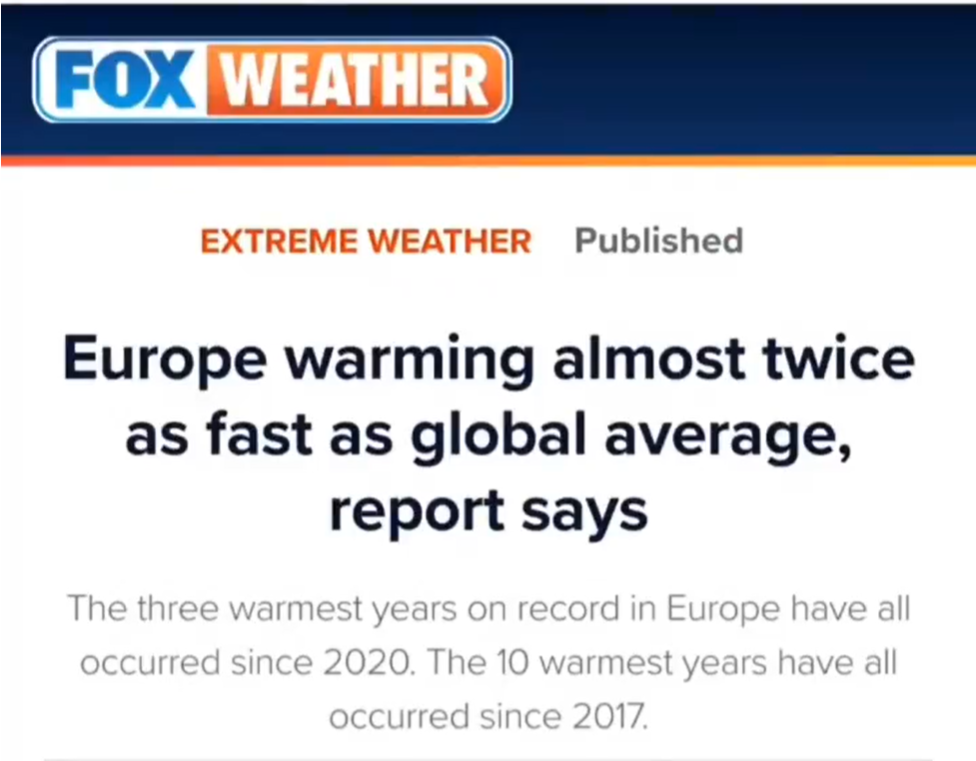
The important distinction: Every country cannot simultaneously warm faster than every other country over the same period. But many countries can warm faster than the global average. These are different comparisons, and confusing them creates a contradiction that the temperature data do not contain.
The video accompanying the original post is retained below. The accompanying suggestion that the figures prove experts are lying is not supported by this mathematical argument.
A global average includes the ocean
The global surface-temperature average is not a simple average of country headlines. It includes land and ocean areas, with their contributions weighted by area. NOAA notes that ocean covers about 71% of Earth’s surface. Country temperature reports commonly describe conditions over land, which has warmed more than the ocean surface.
The IPCC’s Sixth Assessment synthesis provides a useful like-for-like example. Comparing 2011–2020 with 1850–1900, it reports approximately 1.09°C of warming globally, 1.59°C over land and 0.88°C over the ocean. These are changes between specified periods, not the absolute temperatures of those places.
That makes it unsurprising that numerous land areas can exceed the global figure. The large ocean contribution pulls the combined average below the land average. It does not follow that every country actually has the same warming trend, or that every reported comparison is correct.
A simple example makes the logic clearer
Imagine a simplified planet where land occupies 30% of the surface and warms by 2°C, while ocean occupies 70% and warms by 1°C. The area-weighted average is 1.3°C. Every land region in that example could exceed the planetary average without any region exceeding every other region.
This is an illustration of averages, not a replacement for observed climate measurements. Real temperature patterns differ across regions and through time.
How to check a warming headline
First identify the comparison: faster than the global average, the land average or a named region? Next check the dates and baseline. A trend since 1980 cannot simply be compared with a change since the nineteenth century.
Also distinguish annual weather fluctuations from a long-term trend, and a statement about one season from a statement about the whole year. Read the underlying national meteorological report where possible.
Those checks can uncover genuine errors in reporting. The fact that several countries exceed a global land-and-ocean average, however, is not itself an error or evidence of deception.
Original video
References
- IPCC AR6 Synthesis Report: Summary for Policymakers, A.1.1.
- NOAA: Why do scientists measure sea surface temperature?.
