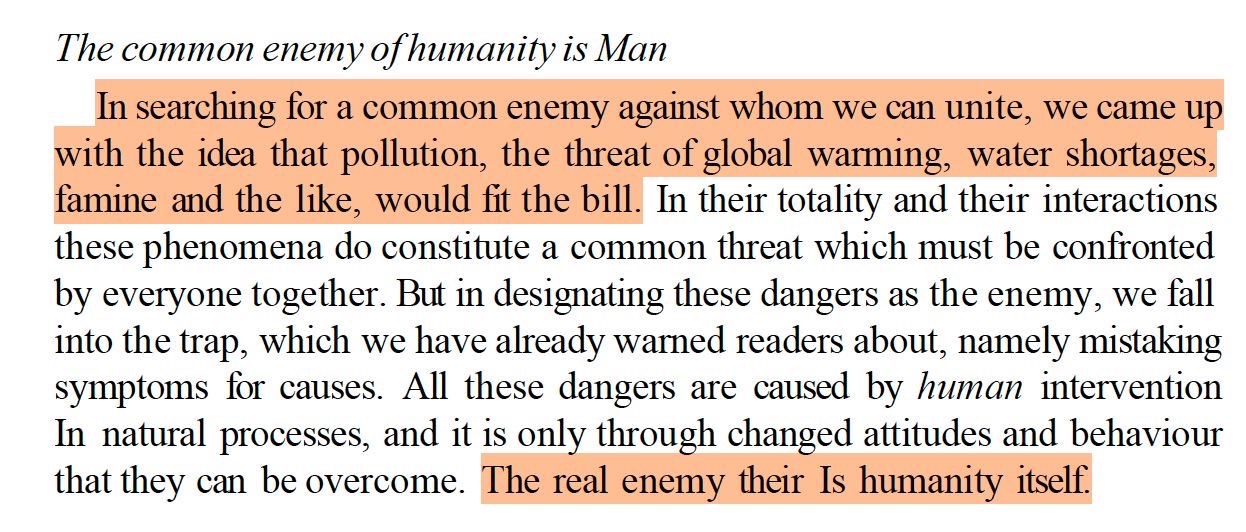
The image below reproduces a passage attributed to The First Global Revolution, the 1991 report by Alexander King and Bertrand Schneider for the Council of the Club of Rome. The passage is real, but its meaning requires more care than a highlighted sentence can provide.
The report was written amid the political changes surrounding the end of the Cold War. It discusses environmental damage, poverty, economic organisation and governance. It is a statement of analysis and proposed priorities, rather than a scientific experiment establishing the causes of climate change.
Read the argument around the excerpt
In the chapter titled “The Vacuum”, the authors examine how societies organise themselves around opponents. They criticise governments’ use of external enemies and scapegoats to distract from domestic problems. They then describe environmental and social dangers as shared challenges.
The reproduced passage shifts from those dangers to the human behaviour contributing to them. Its provocative conclusion, “The real enemy then is humanity itself”, follows an argument for changing attitudes and behaviour. Read in that context, the passage does not say that global warming has been fabricated, or present a plan to eliminate human beings.
Readers can reasonably question the authors’ language. Describing humanity as an enemy is a striking and potentially alienating way to discuss collective responsibility. Criticising that rhetoric, however, is different from treating it as evidence for a claim the text does not make.
Separate political arguments from physical evidence
Whether a proposed environmental policy is fair or effective is a legitimate subject for debate. Whether greenhouse gases warm the planet is a separate question tested through measurements and scientific research. A political report’s wording cannot resolve that physical question.
For the scientific assessment, the IPCC’s Sixth Assessment synthesis concludes that human activities, principally greenhouse-gas emissions, caused the observed global warming. That conclusion should be examined through the underlying evidence, rather than accepted or rejected because of a quotation from a think tank.
How to use an excerpt responsibly
Check the author, publication date, chapter and surrounding paragraphs. Make sure highlighted words have not displaced the argument that connects them. Then distinguish what the author actually states from the interpretation added by the person circulating the image.
The original graphic is retained for transparency. Readers should use the full report linked below when assessing it; this article provides context rather than reproducing the book’s passage at length.
Original excerpt image

References
- Club of Rome: The First Global Revolution, publication record.
- The First Global Revolution: full report, chapter “The Vacuum”.
- IPCC AR6 Synthesis Report: Summary for Policymakers, A.1.
