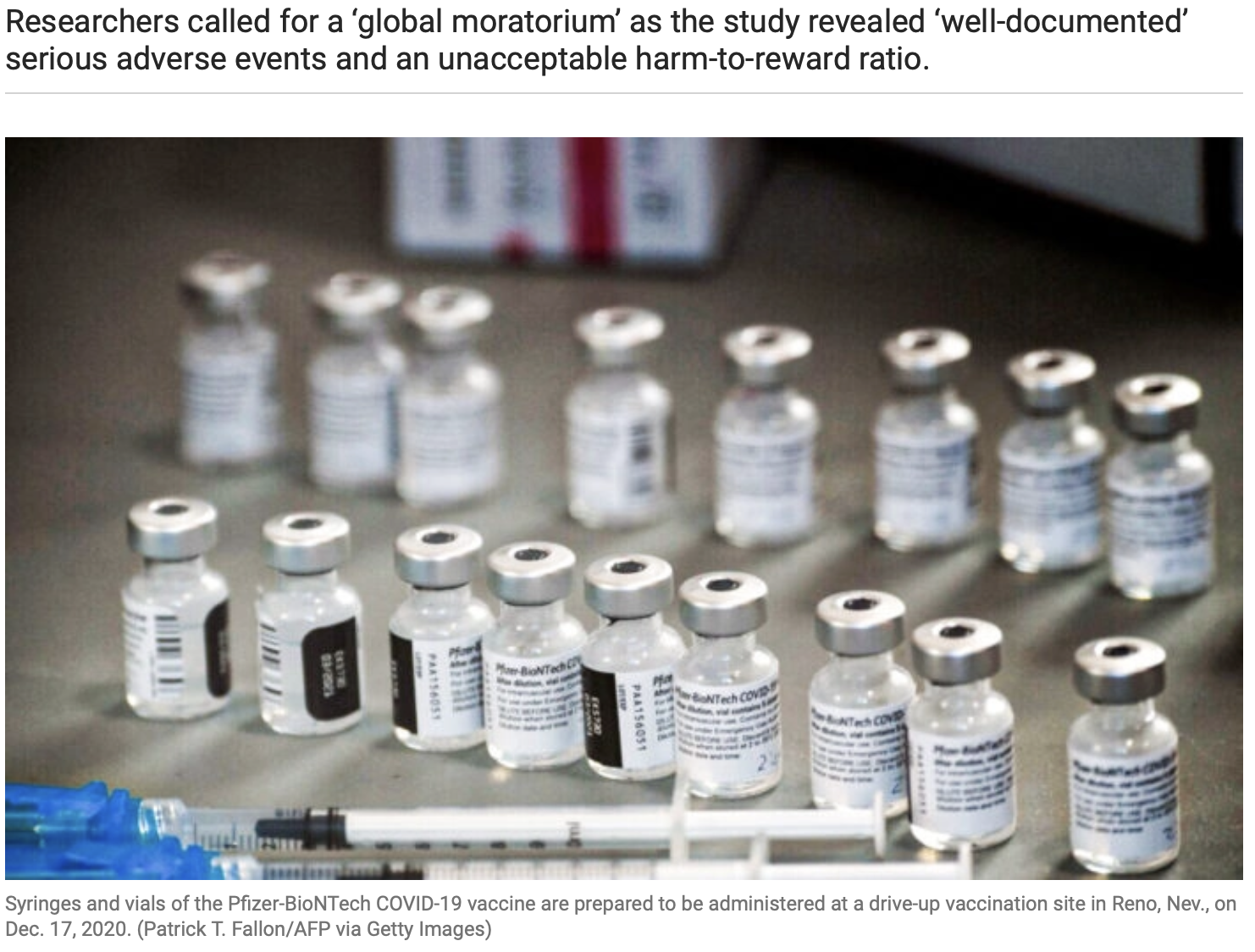
Retraction update: The Cureus review used to support the original headline was retracted on February 26, 2024. The journal’s editors concluded that its conclusions were unreliable because of problems with supporting references and misrepresentation of references and available data. This article should therefore not be read as an established finding that mRNA vaccines killed more people than they saved.

Original article screenshot retained. Photograph credit visible in the image: Patrick T. Fallon/AFP via Getty Images, December 17, 2020.
What happened to the cited paper?
The original post linked a narrative review by Mead and colleagues published on January 24, 2024. A narrative review discusses other publications; it does not itself enroll a new trial population or directly count every vaccine-caused death. Its interpretation depends on the quality of the included evidence and how that evidence is used. The publication’s subsequent retraction is essential context, even though the original article and its initial peer-review history remain part of the record.
Different measures answer different questions
The original Pfizer trial reported eight cases of COVID-19 in the vaccine group and 162 in the placebo group in its principal efficacy analysis. Moderna’s trial reported 11 symptomatic cases in the vaccine group and 185 in the placebo group. Their widely cited efficacy percentages described relative reductions in the specified disease outcome during the trial period. They were not promises that a fixed percentage of everyone vaccinated would avoid death.
Absolute benefit depends on the underlying chance of illness, the outcome measured and the time followed. A smaller absolute difference during a short study does not invalidate a relative-risk calculation. Conversely, quoting a large relative effect without the baseline risk can overstate what an individual should expect. Neither measure alone establishes the overall mortality balance.
The same discipline applies to safety reports. VAERS accepts reports of health events after vaccination even when causation is uncertain. Those reports help detect patterns requiring investigation, but their raw total cannot be relabeled as a count of deaths caused by a vaccine. A credible mortality comparison needs validated outcomes, suitable comparison groups and adjustment for differences in age, health and exposure.
Assess benefits and harms together
Independent research has estimated substantial mortality benefits from vaccination. A global modelling study estimated 14.4 million COVID-19 deaths prevented in the first year using reported deaths, with different estimates when excess mortality was used. These are model-based estimates with assumptions, not directly observed individual lives saved, and they cover vaccination programmes rather than only mRNA products.
Rare serious vaccine harms still require transparent monitoring and appropriate care. Their existence does not validate an unreliable estimate of net deaths. Personal decisions about a current dose should consider current recommendations, age, health, prior immunity and product-specific risks, rather than treat a retracted review as a settled verdict.
References
- Cureus, retraction notice for the review cited in the original post
- Polack et al., original BNT162b2 randomized trial (2020)
- Baden et al., original mRNA-1273 randomized trial (2021)
- CDC, scope and limitations of VAERS
- Watson et al., global impact of the first year of COVID-19 vaccination (2022)
- Original linked review, subsequently retracted
