A road sign becomes hard to read. Small print looks blurred. You find yourself holding your phone farther away. These changes can have different causes, and the glasses that help one person may not suit another.
Myopia, hyperopia and presbyopia all affect how the eye focuses light. An eye examination can identify the cause, check the health of your eyes and help you choose suitable correction.
Myopia: when distant objects look blurred
Myopia, also called short-sightedness or nearsightedness, usually makes distant objects harder to see clearly. Reading nearby may be easier, although this depends on your prescription and whether you have other focusing problems.
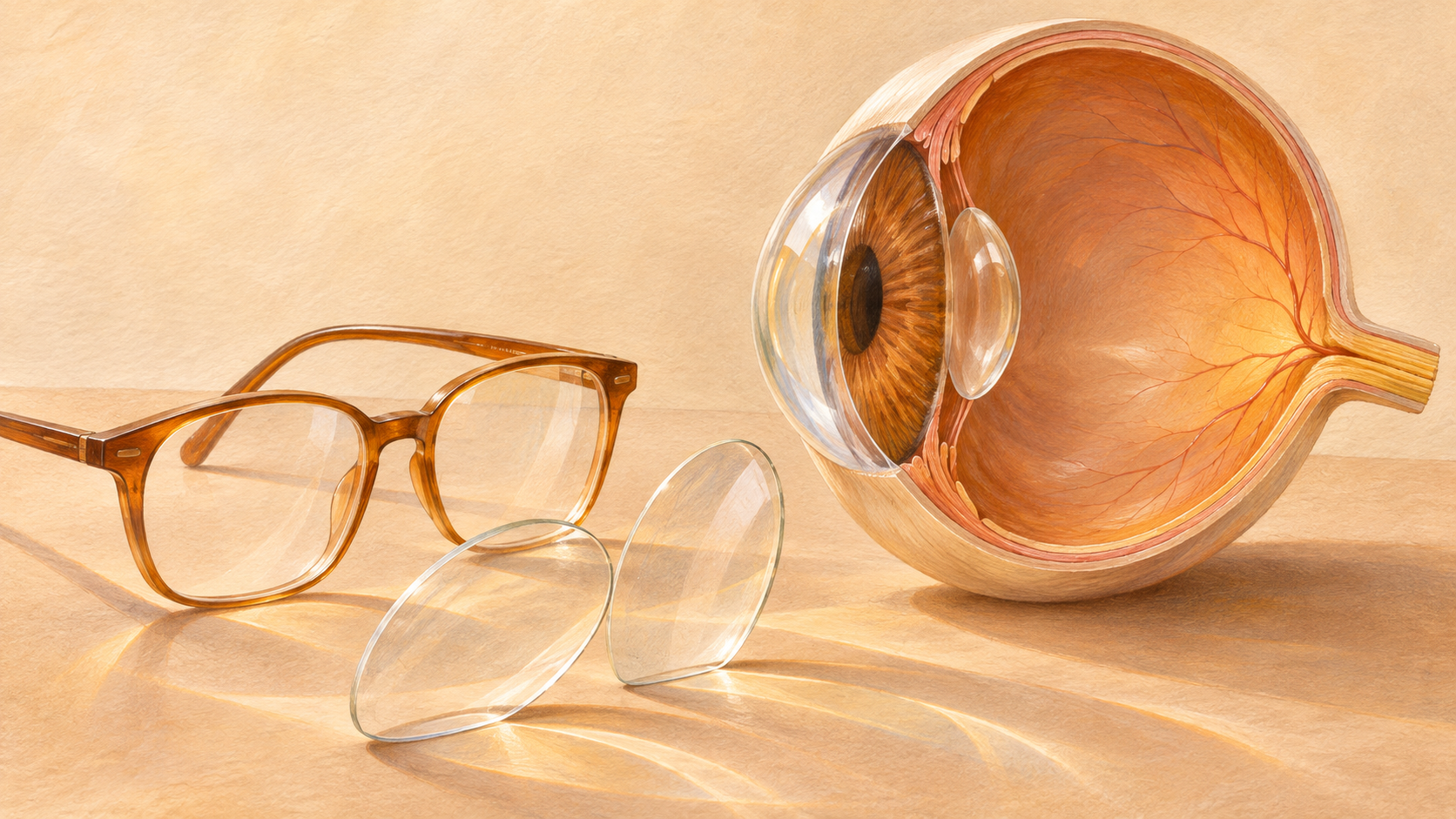
In a myopic eye, light focuses in front of the retina, the light-sensitive layer at the back of the eye. This commonly happens because the eye is too long for its focusing power. People may squint to see a classroom board or road sign, or notice tired eyes.
Myopia often begins during school years, commonly between about 6 and 14, and can progress through the teenage years and into early adulthood. These are typical patterns, not age limits. Stronger myopia also carries a higher risk of certain eye conditions, including retinal detachment, so ongoing eye care matters even when glasses give clear vision. National Eye Institute: myopia
Hyperopia: long sight can affect more than reading
Hyperopia, also called hypermetropia, long-sightedness or farsightedness, means that the eye’s shape would bring light to a focus behind the retina rather than on it when focusing is relaxed. The eye may be shorter than average or have insufficient focusing power.
Close work can become tiring or blurred, sometimes causing headaches. Young people can often compensate by using their eye’s natural focusing system, so mild hyperopia may cause few obvious symptoms. With stronger hyperopia, distance vision can be blurred too. The name “long sight” does not guarantee clear distance vision.
Hyperopia is often present from birth, although it may not become noticeable until later. Children with significant hyperopia may develop an inward eye turn or reduced vision in one eye, which makes appropriate assessment important. National Eye Institute: hyperopia · University Hospitals Sussex: long sight
Presbyopia: why reading changes with age
Presbyopia is the gradual loss of the eye’s ability to focus on nearby objects as its natural lens becomes less flexible. It often becomes noticeable in the 40s, though the timing varies. You may need brighter light, hold reading material farther away or find close work tiring.
Hyperopia and presbyopia can both cause near-vision difficulty, but they have different causes. Hyperopia relates to the eye’s focusing power and shape; presbyopia develops as the natural lens ages. A person can have both. People with myopia can also develop presbyopia.
An examination is the best way to find out why your near vision has changed, rather than assuming that everyone needs the same reading-glasses strength at a particular age. National Eye Institute: presbyopia · College of Optometrists: glasses
How glasses help
Glasses bend light so it focuses more accurately on the retina:
- Myopia: minus-powered, concave lenses are thinner in the centre and thicker towards the edges.
- Hyperopia: plus-powered, convex lenses are thicker in the centre and thinner towards the edges.
- Presbyopia: extra plus power for near work, called a reading addition, is selected in relation to your distance prescription and working distance.
These describe basic optical principles. Your actual lenses may also correct astigmatism, and their thickness and appearance depend on the prescription, lens material and frame. College of Optometrists: glasses · National Eye Institute: eyeglasses
When are progressive or multifocal lenses useful?
Multifocal glasses provide more than one focusing power. Bifocals have separate distance and near sections. Progressive lenses, also called varifocals, change power gradually without a visible dividing line, providing areas for distance, intermediate tasks such as a computer, and reading.
Progressives can be convenient when you need different prescriptions for different distances, especially with presbyopia. They are not automatically necessary for every person with myopia or hyperopia, or the best choice for every activity. Separate reading glasses, single-vision distance glasses, bifocals or task-specific computer glasses may suit some people better. Discuss your work, hobbies, screen position, mobility and comfort with your eye-care professional.
Progressives also have limitations. Side areas can appear distorted, and it may take practice to find the clearest area for each task. National Eye Institute: eyeglasses · American Academy of Ophthalmology: progressive lenses
Good fitting matters
The prescription is only part of the job. Your lenses need to align properly with your eyes, and the frame should sit securely and at the correct height. This is particularly important with progressive lenses.
Ask for a demonstration of how to use the different lens areas. Allow time to become familiar with them in a safe setting, and be especially careful on steps and uneven ground. Do not drive until you can see clearly and use the lenses confidently. If vision remains blurred, the frame slips or you feel unsteady, return for a prescription and fitting check rather than simply struggling on. Adaptation varies; persistent problems deserve review. ABDO: fitting and adjusting glasses · Specsavers: getting used to new glasses
Who should examine your eyes?
An optometrist is usually an appropriate first contact for a routine eye examination, prescription assessment and eye-health check. They can identify problems and arrange referral when needed. Their treatment role varies by country and qualifications.
An ophthalmologist is a medical doctor specialising in eye disease and its medical and surgical treatment. You may need one when an examination finds disease, symptoms are unexplained or specialist treatment is required.
A dispensing optician helps select and fit glasses to an existing prescription. Fitting glasses does not replace a clinical eye examination. AAPOS: eye-care professionals
Symptoms that should not wait
Do not assume a sudden change is simply a need for new glasses.
- New flashes or floaters, or a sudden increase in them: seek urgent eye assessment, particularly if vision is also blurred.
- A dark curtain or shadow across your sight, or sudden loss of vision: seek emergency eye care immediately.
- A newly painful, red eye: seek urgent assessment. Severe pain, reduced vision, light sensitivity, or headache with nausea needs immediate emergency care.
Contact a local urgent eye service or emergency department if you cannot promptly reach an eye-care professional. Do not drive yourself if your vision is affected. NHS: flashes and floaters · Moorfields: curtain or sudden vision loss · NHS: red eye
Clearer vision starts with the right assessment. Bring your current glasses and explain where you struggle most: driving, reading, screens or switching between distances. The aim is a prescription and lens design that fit your eyes and everyday life.
This article provides general health information and does not replace an individual eye examination or medical advice.
#EYI #EyeHealth #Myopia #Hyperopia #Presbyopia #ShortSight #LongSight #ProgressiveLenses #EyeExamination
Sources and further reading
- National Eye Institute: myopia
- National Eye Institute: hyperopia
- University Hospitals Sussex: long sight
- National Eye Institute: presbyopia
- College of Optometrists: glasses
- National Eye Institute: eyeglasses
- American Academy of Ophthalmology: progressive lenses
- ABDO: fitting and adjusting glasses
- Specsavers: getting used to new glasses
- AAPOS: eye-care professionals
- NHS: flashes and floaters
- Moorfields: curtain or sudden vision loss
- NHS: red eye
