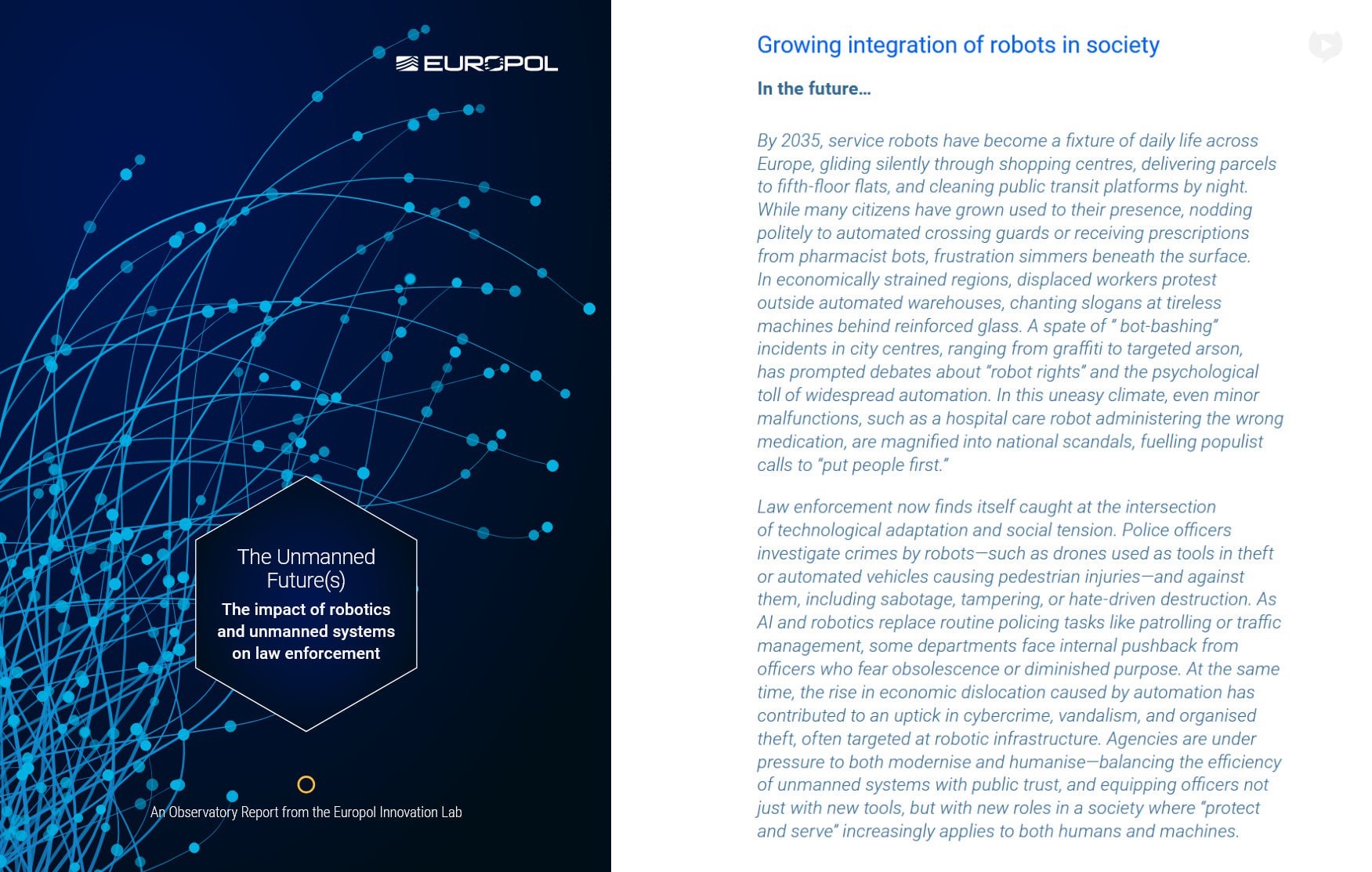
Europol published a 48-page report on robotics and policing on 8 December 2025. The document is real, but the original headline needs an important qualification: its imagined scenes in 2035 are a planning exercise, not a prediction that a human–machine war will happen. The report’s conclusion explicitly explains that exploring possible outcomes is intended to help people influence what happens next.

Retained illustration: the Europol report cover and an excerpt about possible social responses to robots.
What the report actually explores
The Unmanned Future(s) considers how increasingly capable machines could affect crime, policing and everyday life. One imagined future describes resentment over automation, attacks on robots and arguments about whose interests technology serves. Another section considers whether criminals could exploit people’s trust in social robots for deception or grooming. That is a concern about manipulation and personal information, rather than evidence of a demonstrated technology for controlling human minds.
The report also discusses benefits and safeguards. Europol’s publication summary identifies potential improvements in police awareness, safety and operational reach, alongside questions about privacy, regulation and public trust. Reading only the most alarming passage misses that wider purpose.
How to judge a future-risk claim
A useful question is whether a passage describes an observed event, an expert assessment, or an invented example used to explore consequences. Those categories deserve different weight. A date attached to a scenario gives the exercise a setting; it does not supply a probability or a countdown.
Readers can also ask what would have to change for the scenario to become plausible. How capable would the machines need to be? Who would operate them? What access to personal information would they require? Could existing safeguards interrupt the chain of events? Those questions are more informative than treating every possibility as inevitable.
The practical debate is about choices: which uses should be permitted, who remains accountable when harm occurs, and how the public can challenge a deployment. Scrutinising those choices does not require accepting a sensational forecast. It requires keeping the evidence, the assumptions and the unanswered questions visible.
References
- Europol: The Unmanned Future(s), publication record, 8 December 2025
- Europol: The Unmanned Future(s), full report; PDF pages 30, 38 and 44
