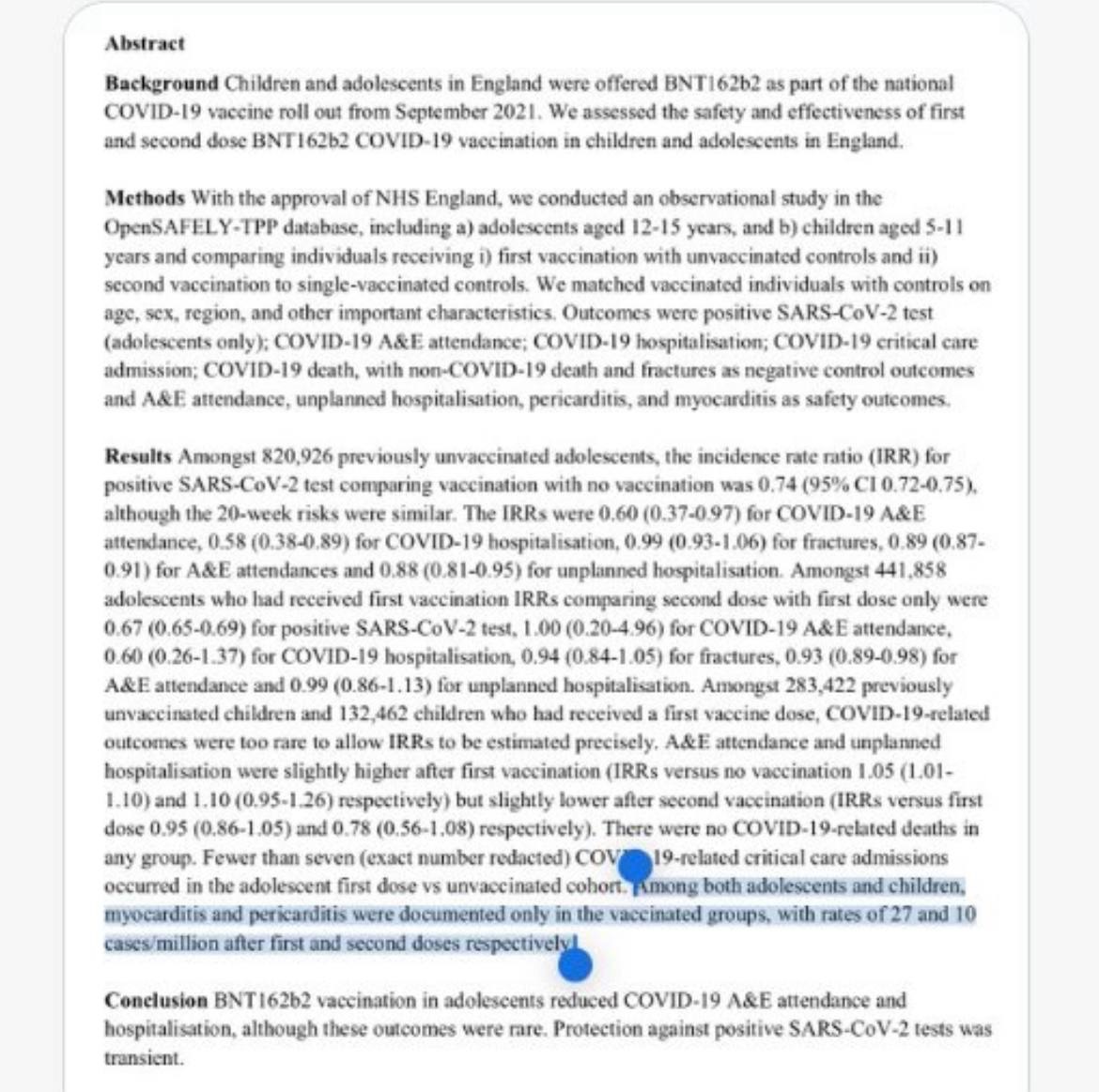
Myocarditis and pericarditis are rare, recognized risks of mRNA COVID-19 vaccination. A widely shared claim about a study involving “1.7 million children” needs an important qualification: its findings describe particular comparison groups, not every possible cause of heart inflammation.

The original post’s illustration is retained. The study’s scope and limitations are explained below.
What the study found
The OpenSAFELY study used linked English health records for ages 5–11 and 12–15. Researchers matched first-dose Pfizer-BioNTech recipients with unvaccinated controls and, separately, second-dose recipients with one-dose controls. Follow-up lasted up to 20 weeks; clinically vulnerable children were excluded.
The authors reported myocarditis or pericarditis only among vaccinated participants in these analyses. Their abstract gives combined rates of 27 per million after a first dose and 10 per million after a second dose. These are study-specific observations, not estimates proving vaccination caused every event. Counts were rounded for privacy.
First vaccination was also associated with lower COVID-19 emergency attendance and hospitalization rates in adolescents. Severe outcomes in younger children were too uncommon for precise estimates. Routine records, missed infections, and differences in healthcare-seeking or diagnostic attention limit interpretation. The authors explicitly warn that their findings do not mean these conditions cannot occur without vaccination. Read the study.
The wider evidence
A separate English study of 5.1 million young people used a self-controlled design, comparing risk periods within individuals. It estimated approximately three and five additional myocarditis hospitalizations per million adolescents after first and second Pfizer doses, respectively. It also found increased myocarditis risk after SARS-CoV-2 infection in previously unvaccinated children and adolescents. Different populations, endpoints and follow-up windows mean these estimates should not be treated as interchangeable with OpenSAFELY’s figures. Read the safety study.
What families should know
Myocarditis affects heart muscle; pericarditis affects the surrounding lining. CDC guidance identifies the post-vaccination risk as rare and most frequently reported in adolescent and young adult males, usually within a week after a second mRNA dose. Chest pain, shortness of breath or palpitations warrant medical assessment. A child’s vaccination decision should consider their medical history, risk of severe COVID-19 and current local recommendations with a qualified clinician. See current safety guidance.
References
- Andrews CD, Parker EPK, Horne E, et al.; OpenSAFELY Collaborative. OpenSAFELY: Effectiveness of COVID-19 Vaccination in Children and Adolescents. Epidemiology. 2026;37(1):141–151. Published online September 23, 2025.
- Copland E, Patone M, Saatci D, et al. Safety outcomes following COVID-19 vaccination and infection in 5.1 million children in England. Nature Communications. 2024;15:3822.
- Centers for Disease Control and Prevention. Safety Considerations for COVID-19 Vaccines. Updated September 23, 2026. Accessed October 20, 2026.
