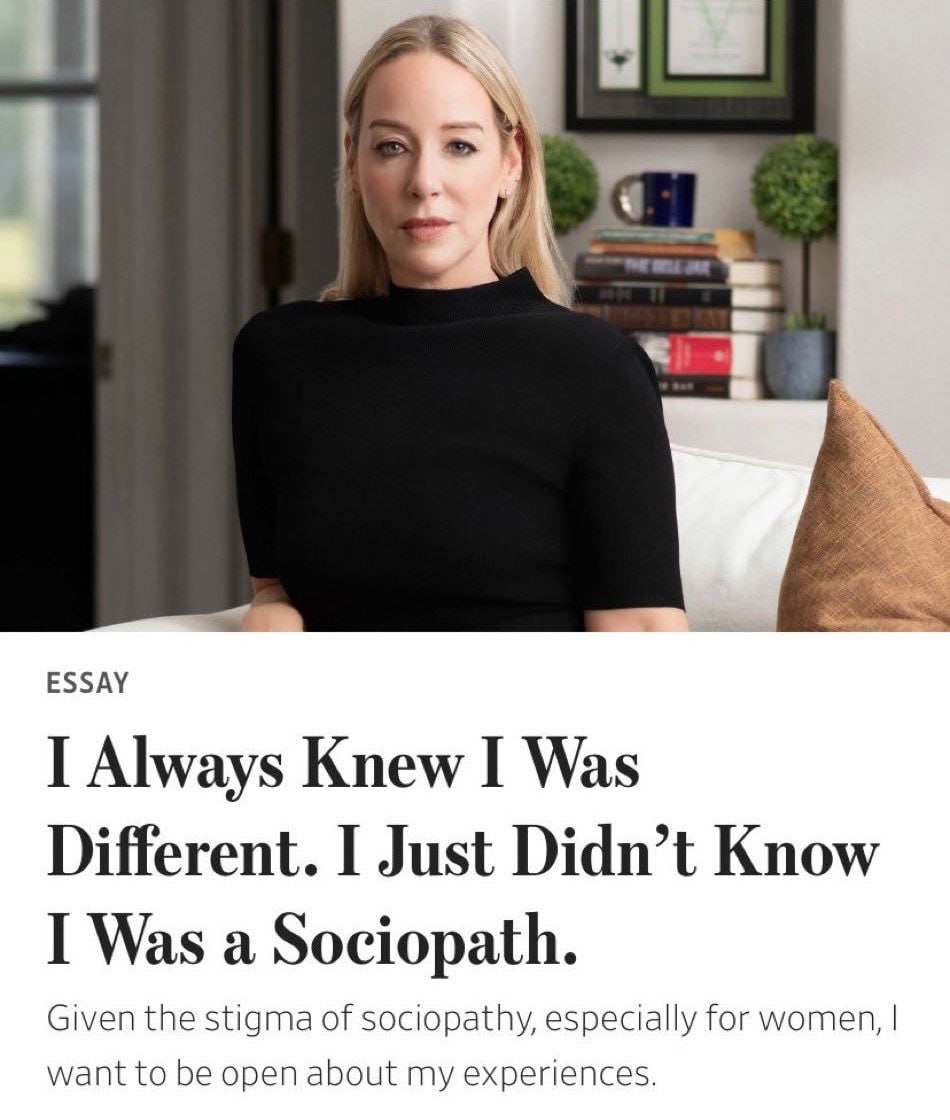
The image in this post comes from a first-person Wall Street Journal essay by Patric Gagne, published in March 2024. It concerns her account of living with traits she describes as sociopathy. The original accompanying headline’s claim that the newspaper is stigmatising people is an interpretation, not a clinical finding or a fact established by the screenshot.

Personal experience and clinical language
A memoir can help readers understand how one person describes their emotions and behaviour. It does not establish what every person with a similar diagnosis experiences. Nor does a portrait, headline or a reader’s reaction provide enough information to diagnose the author or anyone else.
“Sociopath” is widely used in public discussion, sometimes as an insult. Clinical guidance is more specific: antisocial personality disorder involves an enduring pattern of difficulties that can include disregard for others’ rights, impulsivity and irresponsibility. Assessment requires a qualified professional to examine a person’s history and circumstances, rather than match them to a few dramatic traits online.
The original post contrasted sociopaths and psychopaths as if they formed two cleanly separated personality types. That simple division is not an adequate basis for understanding an individual or deciding what care they need. Labels should clarify a discussion, not turn a complex person into a stereotype.
Accountability without exclusion
Avoiding stigma does not mean excusing deception, abuse or other harmful conduct. Behaviour can be described and addressed directly, with attention to the safety and rights of people affected. At the same time, a mental-health label should not be used as shorthand for being evil or beyond help.
NICE advises that people with antisocial personality disorder should not be excluded from health or social-care services because of their diagnosis or history. It recommends constructive engagement and care for associated conditions, while acknowledging limitations in the treatment evidence.
The useful conversation prompted by this essay is therefore about language, lived experience and responsible care. Readers can question a writer’s account and a newspaper’s framing without assuming that everyone described by the same label thinks, feels or behaves alike.
References
- Patric Gagne: first-person Wall Street Journal essay, March 14, 2024
- South London and Maudsley NHS Foundation Trust: antisocial personality disorder
- NICE CG77: antisocial personality disorder recommendations
