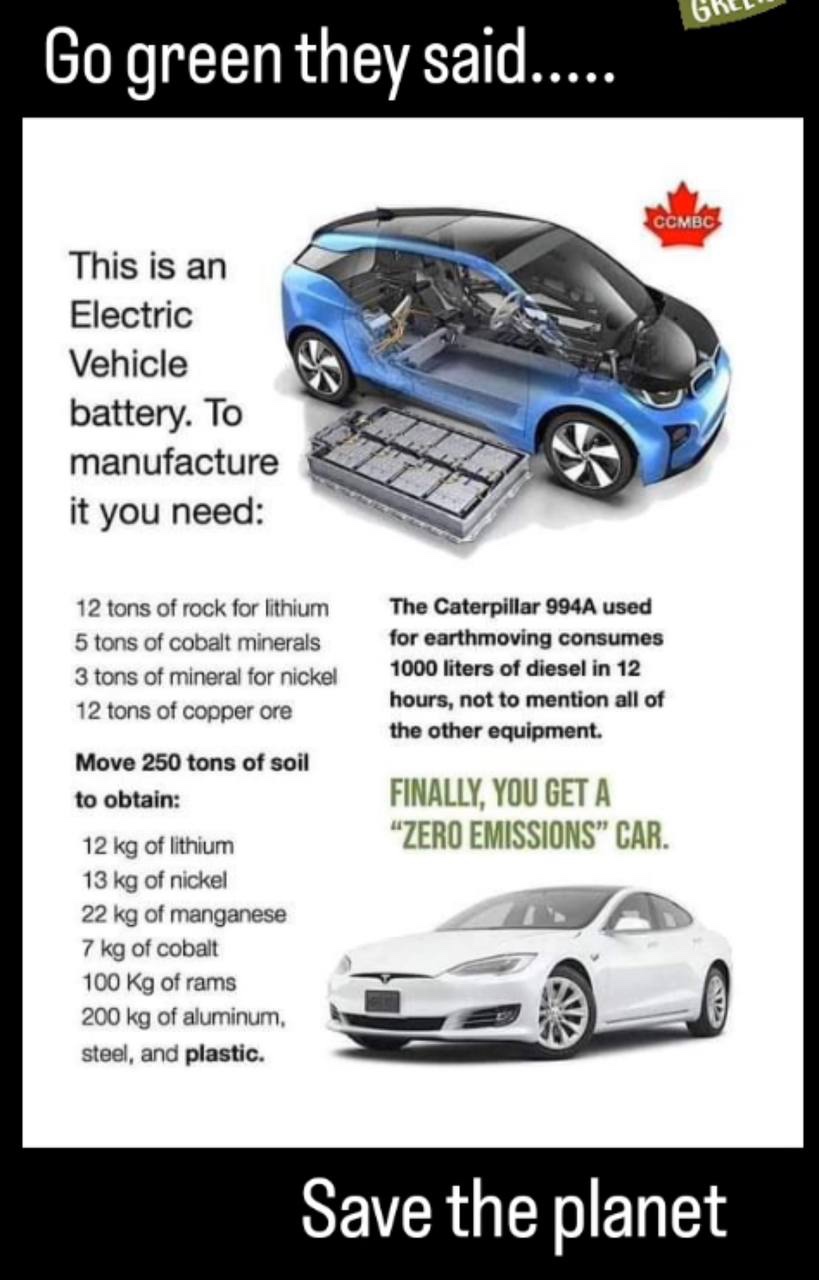
The image accompanying this post argues that electric cars are environmentally misleading because manufacturing batteries involves mining and diesel-powered machinery. The underlying concern is real: batteries require materials and energy. But a list of extraction quantities cannot, on its own, establish that a combustion-engine car has the smaller environmental impact.
There is no single battery recipe
The graphic lists fixed amounts of rock, soil and metals without identifying a battery capacity, mine, ore grade or calculation method. Those missing details matter. The amount of material moved depends on the deposit and extraction process; the materials in a battery depend on its chemistry and size.
For example, the International Energy Agency distinguishes nickel-based chemistries from lithium iron phosphate batteries. The latter contain no cobalt, so a fixed cobalt requirement cannot describe every electric-car battery. A small vehicle and a large, long-range vehicle also should not be treated as if their packs have identical resource needs.
Compare the whole vehicle life
“Zero emissions” is often used to describe the absence of exhaust emissions from a battery-electric vehicle while driving. It does not mean the vehicle was manufactured without emissions, that its electricity is always carbon-free or that mining has no environmental consequences.
A fair greenhouse-gas comparison includes manufacturing, battery production, electricity generation or fuel supply, driving and end-of-life treatment. The IEA’s life-cycle work includes these stages and finds that electric cars can deliver substantial emissions reductions. Results vary with factors such as the electricity mix, vehicle efficiency, battery size and lifetime distance.
The comparison also needs to count oil extraction, refining, transport and repeated fuel combustion for the alternative vehicle. Counting upstream impacts for only one option creates an uneven comparison.
Take the genuine trade-offs seriously
Climate emissions are not the only concern. Material sourcing, local pollution, water use, working conditions and recycling deserve scrutiny in their own right. They call for better supply chains and transparent evidence, rather than an assumption that any mined product is automatically worse than continued fossil-fuel use.
For a useful comparison, identify the actual vehicles and the conditions in which they would be used. The original meme does not supply enough information to validate its universal quantities or its conclusion. Its strongest point is a reminder to ask about manufacturing; its limitation is leaving the rest of the comparison unfinished.
Original media
Original battery-mining graphic retained for context. Its numerical claims lack an identified methodology and should not be read as universal specifications.

References
- IEA: Global EV Outlook 2026, Electric vehicle batteries
- IEA: Global EV Outlook 2024, Outlook for emissions reductions
- IEA: EV Battery Supply Chain Sustainability
