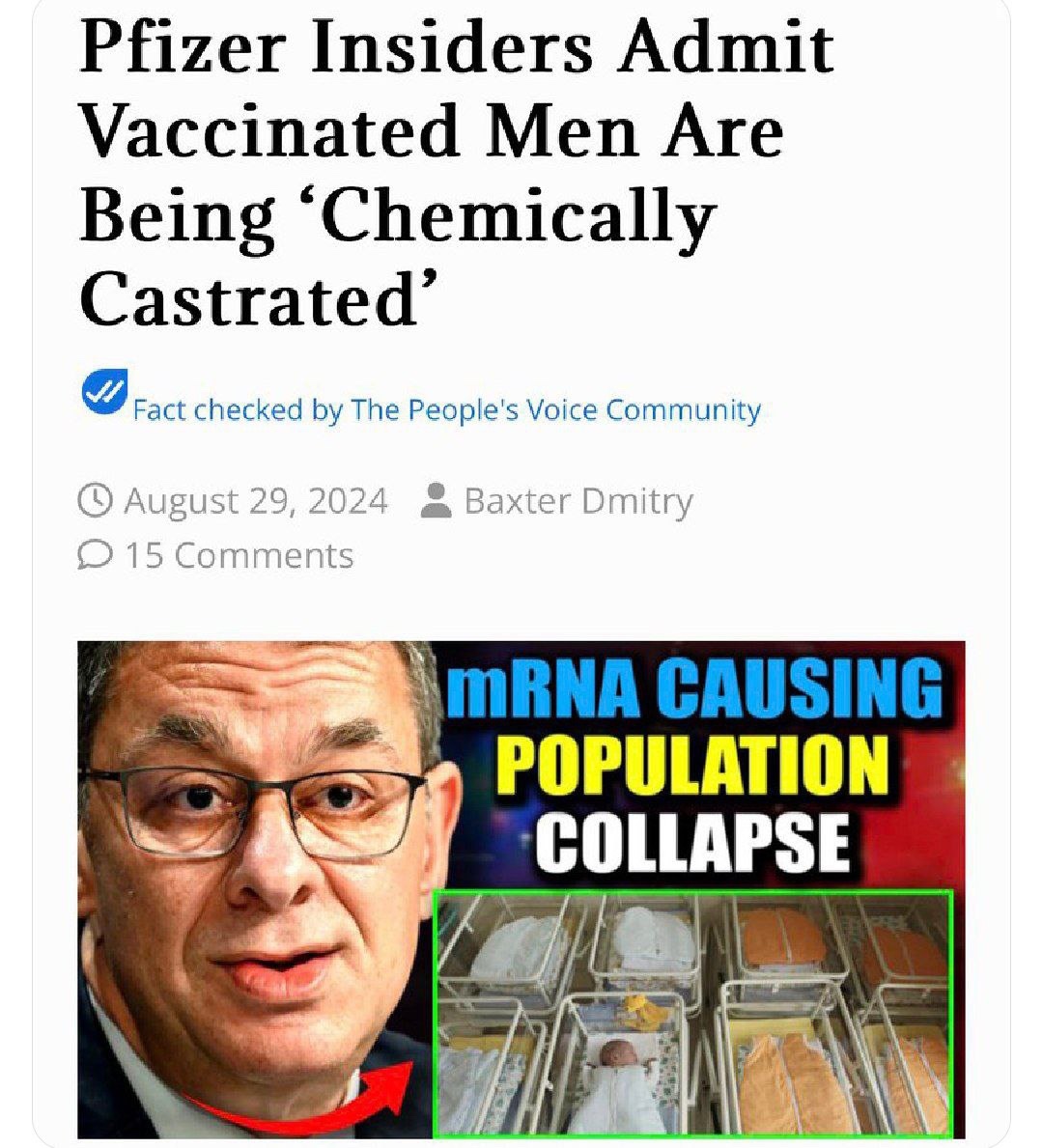
Evidence update: The original screenshot alleges that vaccinated men are being chemically castrated. The original headline also promised unspecified groundbreaking research about sperm. Neither the screenshot nor the post identifies a clinical study establishing that claim. Published studies of semen and conception do not support a conclusion that COVID-19 vaccination causes widespread male infertility.

Original screenshot retained for context: The People’s Voice, Baxter Dmitry, August 29, 2024. The claims shown are not established by the research cited below.
What the original material actually provides
The image is a screenshot of a People’s Voice article credited to Baxter Dmitry and dated August 29, 2024. Its alarming description is a claim from that publication, not a laboratory result. It supplies no study methods, participant numbers, comparison group, or measurements of fertility that a reader can assess. References to unnamed insiders cannot replace those missing details.
What semen studies have found
Semen analysis measures several different features, including volume, sperm concentration, movement and the total number of moving sperm. Those measures are informative, but a result from one sample does not by itself establish whether someone can father a child. Repeated measurements and actual reproductive outcomes help distinguish a temporary change from persistent impairment.
A prospective study of 101 vaccinated men compared semen results before and after vaccination and did not find an overall detrimental pattern. Some measured values increased and semen volume decreased. That mixed pattern illustrates why individual statistically significant changes should not automatically be described as either infertility or an improvement in fertility.
Evidence should also include results that do not fit a simple reassurance narrative. A 2022 study of 37 semen donors reported reduced sperm concentration and total motile count at an intermediate follow-up after Pfizer vaccination. Later samples showed recovery, and sperm motility and semen volume were not impaired. The researchers described a temporary change; their study did not establish permanent infertility or chemical castration. It also involved a small, selected donor population rather than all vaccinated men.
Conception is a more direct outcome than a semen measurement alone. In the PRESTO cohort of couples trying for pregnancy, vaccination of the male partner was not meaningfully associated with lower chances of conception. The study suggested a possible short-term reduction following recent male infection, although the estimate was imprecise. This underscores the importance of separating infection from vaccination and reporting uncertainty when interpreting reproductive concerns.
A proportionate response
The evidence supports taking persistent reproductive symptoms seriously without adopting the screenshot’s conclusion. Anyone worried about fertility can discuss their history, recent illnesses, medicines and whether repeat semen testing is appropriate with a clinician. A claim that applies to vaccinated men worldwide needs consistent, reproducible evidence of lasting harm. The supplied material does not provide it, and the studies cited here do not establish it.
References
- Stigliani et al., prospective semen study after mRNA or viral-vector vaccination (2022)
- Gat et al., temporary semen-parameter changes and later recovery (2022)
- Wesselink et al., prospective study of vaccination, infection and fertility (2022)
