Seeing “HbA1c” on a blood report can leave you wondering what the letters mean and whether your number is something to worry about. Start with this: HbA1c helps you and your healthcare team understand your blood sugar over time. Read it alongside your health history, symptoms and other test results.
What exactly is HbA1c?
HbA1c, also called A1C or glycated hemoglobin, is a blood test that reflects your average blood sugar over roughly the past 2 to 3 months.
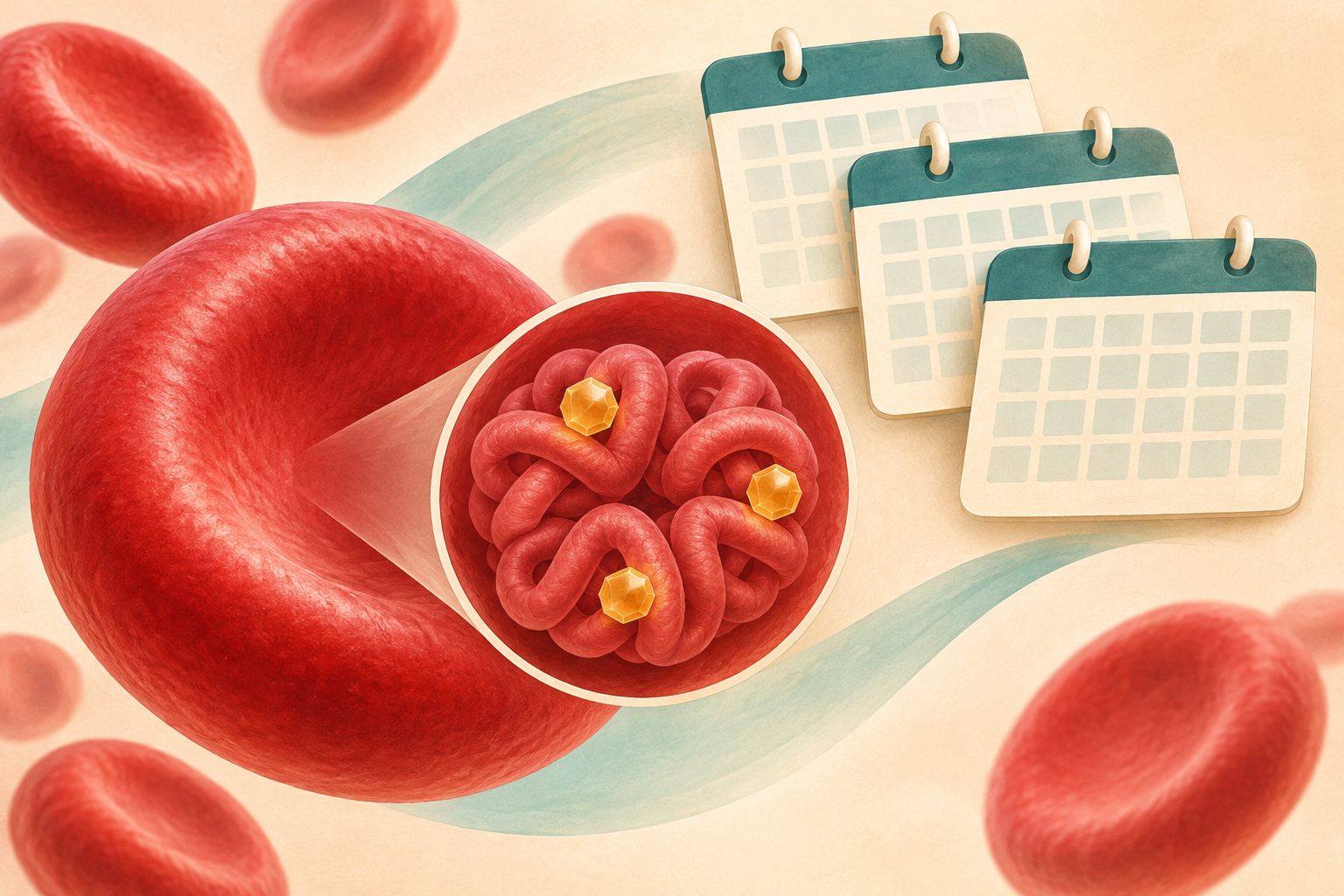
Hemoglobin is a protein inside red blood cells. It carries oxygen around your body. Sugar in your blood attaches to some of that hemoglobin. When blood sugar stays higher, more hemoglobin usually has sugar attached.
The test measures the proportion of hemoglobin with sugar attached. A result of 6% means approximately 6% of the hemoglobin measured is glycated. It does not mean that your blood is 6% sugar. American Diabetes Association: Understanding A1C
Why does it look back over several months?
Red blood cells circulate for about four months, and your body keeps replacing them. Testing a mixture of older and newer cells gives a longer-term picture of blood sugar.
The months do not contribute equally. Blood sugar during the most recent month has a greater influence than blood sugar in earlier months. One unusually healthy meal before the test will not erase the previous weeks. Equally, one meal does not explain the whole result. NIDDK: The A1C Test & Diabetes
What do the numbers mean?
For screening and diagnosis outside pregnancy, these are commonly used ranges:
- Below 5.7%: below 39 mmol/mol. Below the prediabetes threshold.
- 5.7% to 6.4%: 39 to 47 mmol/mol. The prediabetes range, indicating an increased risk of developing type 2 diabetes.
- 6.5% or higher: 48 mmol/mol or higher. The diabetes range, which needs clinical assessment and usually confirmation. ADA: 2026 Diagnostic Standards
These are diagnostic categories, not personal treatment targets. Prediabetes does not mean diabetes is inevitable, and a result below the threshold does not rule out every blood sugar problem. ADA: Diabetes Diagnosis
Some reports use percentages; others use mmol/mol. Both describe HbA1c, but they use different scales. Do not confuse mmol/mol for HbA1c with mmol/L for a glucose reading. Unit conversions are rounded, so avoid interpreting a borderline result by converting it yourself. NGSP: HbA1c Unit Conversion
Can one result diagnose diabetes?
Usually, an abnormal result needs confirmation. This may involve another HbA1c measurement or a different glucose test, such as fasting plasma glucose or an oral glucose tolerance test.
Confirmation may not be needed when blood sugar is unmistakably high, such as classic symptoms together with a diagnostic glucose result. Your clinician decides whether those criteria are met. Do not diagnose yourself from a highlighted number: diagnosis requires an appropriate laboratory method and a clinician’s interpretation of the full picture. ADA: Diabetes Diagnosis
Do I need to fast?
You usually do not need to fast for HbA1c alone. However, another blood test ordered at the same appointment may require fasting. Follow the instructions from your clinic or laboratory rather than changing your meals or routine yourself. CDC: A1C Test for Diabetes and Prediabetes
What if I already have diabetes?
Your HbA1c helps your care team review how your diabetes plan is working over time.
For many nonpregnant adults with diabetes, a common target is below 7%, equivalent to below 53 mmol/mol. This is not a universal goal. Your target may be higher or lower depending on your age, health conditions, risk of low blood sugar and individual circumstances.
Ask, “What is a safe HbA1c target for me, and why?” A result should guide a conversation, rather than become a reason to blame yourself. ADA: Blood Glucose Testing and Targets
A result below the diabetes diagnostic threshold while you are receiving treatment does not, by itself, mean diabetes has gone away. Do not stop or change prescribed medicines because of one report. CDC: Understanding A1C Results
What can HbA1c miss?
An average can hide ups and downs. Two people with similar HbA1c results may have very different daily patterns: one may have relatively steady readings, while another has high spikes and low dips.
HbA1c cannot tell you your blood sugar right now or reliably identify short episodes of low blood sugar, called hypoglycemia. If your care team recommends a glucose meter or continuous glucose monitor, HbA1c does not replace it. ADA: Understanding A1C
When can the result be misleading?
Anything that changes hemoglobin or how long red blood cells survive can affect interpretation. Tell your clinician about:
- Anemia: iron deficiency can raise HbA1c, while conditions that destroy red blood cells faster can lower it.
- Recent blood loss or a blood transfusion: these can change the result independently of your usual blood sugar.
- Hemoglobin variants: inherited differences, including sickle cell trait, can affect certain testing methods.
- Kidney disease: especially advanced disease, dialysis, anemia or treatments affecting red blood cell production.
The effect depends on the condition and test method. Your clinician may use another test or glucose measurements when HbA1c is unreliable. NGSP: Factors That Interfere With HbA1c
Pregnancy also needs special interpretation. HbA1c is not the standard test for diagnosing gestational diabetes; pregnancy-specific glucose testing is used. Tell your care team if you are pregnant. NIDDK: A1C and Pregnancy
Your next appointment: three useful questions
- Does this result need confirmation or another type of test?
- Could anything in my medical history affect its accuracy?
- What target and retesting schedule are right for me?
Bring earlier reports and any glucose records your team has asked you to keep. A clear plan is more useful than trying to interpret one number alone.
This article provides general education. It does not replace individual medical advice, diagnosis or treatment.
#HbA1c #UnderstandYourReports #BloodReports #BloodSugar #DiabetesAwareness #Prediabetes #EndYourIllness

1 comment
[…] News HbA1c values may not always be true: why… HbA1c Made Simple: What Your Blood Sugar Report… Understanding Alzheimer’s: Symptoms, Types and When to Seek… When Mental Health Needs […]