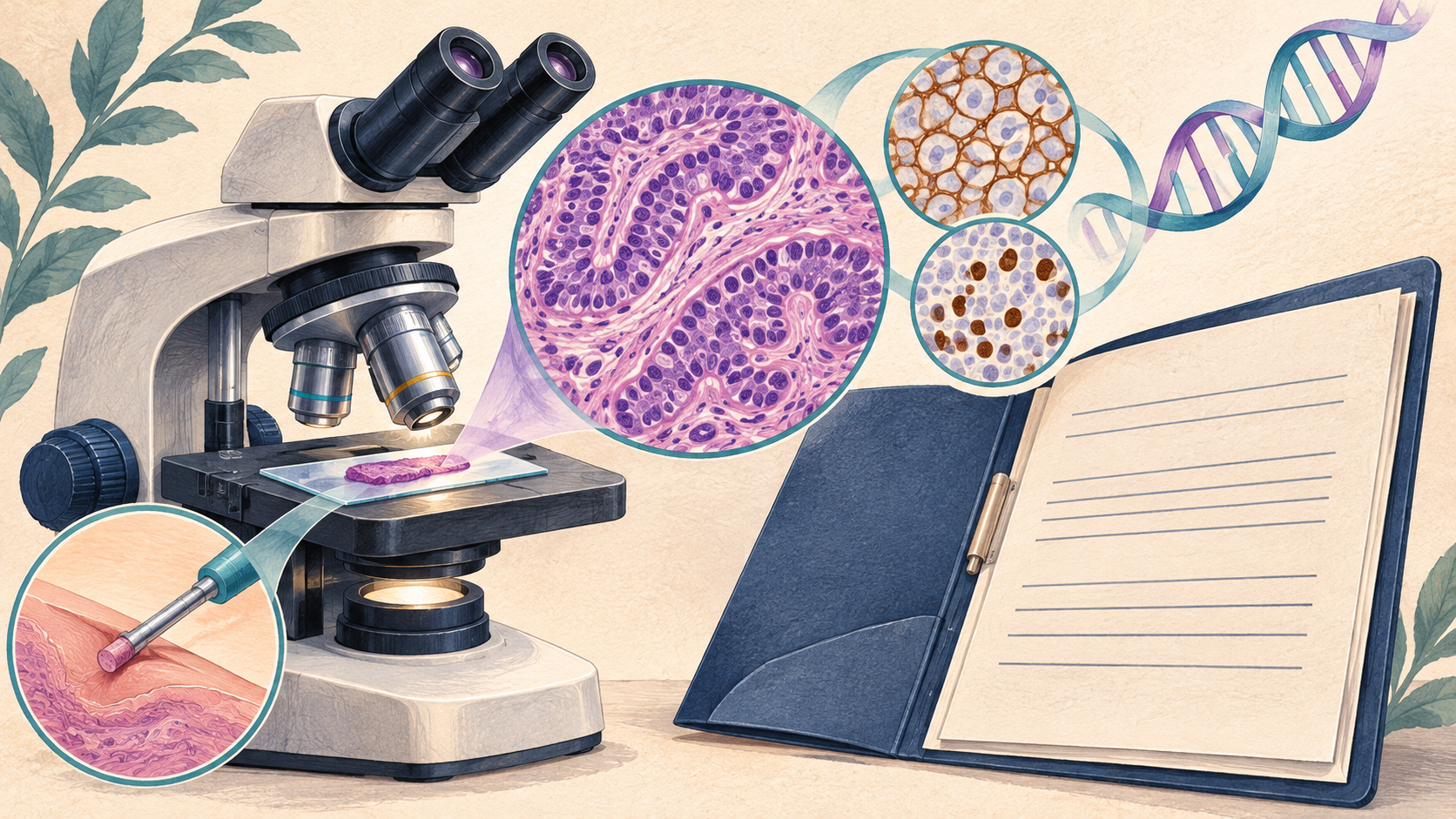
A cancer report can introduce many unfamiliar words at once. Learning what each test asks can make the report easier to discuss with your care team.
Start with the basic terms
Cancer describes diseases in which abnormal cells grow in an uncontrolled way and can invade surrounding tissue or spread elsewhere. Malignant means cancerous. Benign means noncancerous, although a benign growth can still cause problems because of its size or location.
Leukemia starts in blood-forming tissue and often involves bone marrow and blood. Lymphoma begins in lymphocytes, a type of immune cell; it may involve lymph nodes or other organs. Myeloma develops from plasma cells, the immune cells that normally make antibodies. Plasma cells are different from plasma, the liquid part of blood. NCI: What Is Cancer?
Biopsy and pathology
A biopsy removes cells or tissue for examination. A pathologist is a doctor who studies these samples to identify disease. The resulting pathology report may name the cancer type, describe its appearance and include additional test results.
Grade describes features such as how abnormal the cells look and can provide clues about behavior. Stage describes the extent of the cancer. These are different concepts, and the system used depends on the cancer. NCI: Pathology Reports
Tissue biopsy and liquid biopsy
A tissue biopsy, sometimes informally called a “solid biopsy,” samples the abnormal tissue. It can show how cells are arranged as well as what they look like.
A liquid biopsy looks in blood or another body fluid for cancer-related material, such as circulating tumor DNA. In certain settings it helps select treatment or monitor disease. It does not answer every question a tissue sample can answer. A negative result cannot always rule out cancer or a tumor mutation because the sample may contain too little tumor material. An ordinary CBC is not a liquid biopsy. NCI: Diagnosing Cancer and Biomarker Testing
IHC and biomarkers
Immunohistochemistry (IHC) uses specially designed antibodies to highlight particular proteins in a tissue sample. Patterns of staining can help identify a tumor’s origin, classify it or guide treatment. IHC is one laboratory method, not a diagnosis by itself. Royal College of Pathologists: Immunohistochemistry
A biomarker is a measurable feature, such as a protein or gene change, that gives information about a cancer. Some help identify treatments that may work. Finding a biomarker does not guarantee a treatment will help. Tumor testing also differs from testing for an inherited cancer risk, although a tumor result may sometimes prompt genetic counseling. NCI: Biomarker Testing
PD-L1: an immune-related marker
PD-L1 is a protein that can help cancer cells reduce an immune attack. Testing often uses IHC. Depending on the cancer and treatment, the score may consider tumor cells, immune cells or both. Different scoring systems and cutoffs apply. A positive result does not guarantee response to immunotherapy, and a low or negative result does not exclude every immunotherapy option. MedlinePlus: PD-L1 Tests and Jackson Laboratory: Immunotherapy Biomarkers
MMR and MSI: the DNA repair system
Mismatch repair (MMR) corrects certain copying errors in DNA. dMMR means this repair system is deficient; pMMR means it appears proficient on the test. IHC commonly checks the proteins MLH1, PMS2, MSH2 and MSH6. MSI-high describes a related DNA pattern that may result when repair fails. MMR and MSI testing assess related features using different methods.
These findings can affect treatment choices and sometimes lead to evaluation for Lynch syndrome, an inherited cancer-risk condition. A dMMR tumor result alone does not prove that a person has Lynch syndrome. Further testing may be needed. NCI: Genetics of Colorectal Cancer explains this distinction. NCI: Mismatch Repair Deficiency, ASCO: MMR/MSI Testing Guideline and MedlinePlus: Lynch Syndrome
Ask your team: “What does this result change for me? Are any tests pending? Does it suggest a need for inherited-risk testing?”
This article is for general education. It does not diagnose a condition or replace advice from your healthcare team. Your symptoms, examination and test results need to be considered together.
#EYI #CancerEducation #Biomarkers #Pathology #PatientEmpowerment
