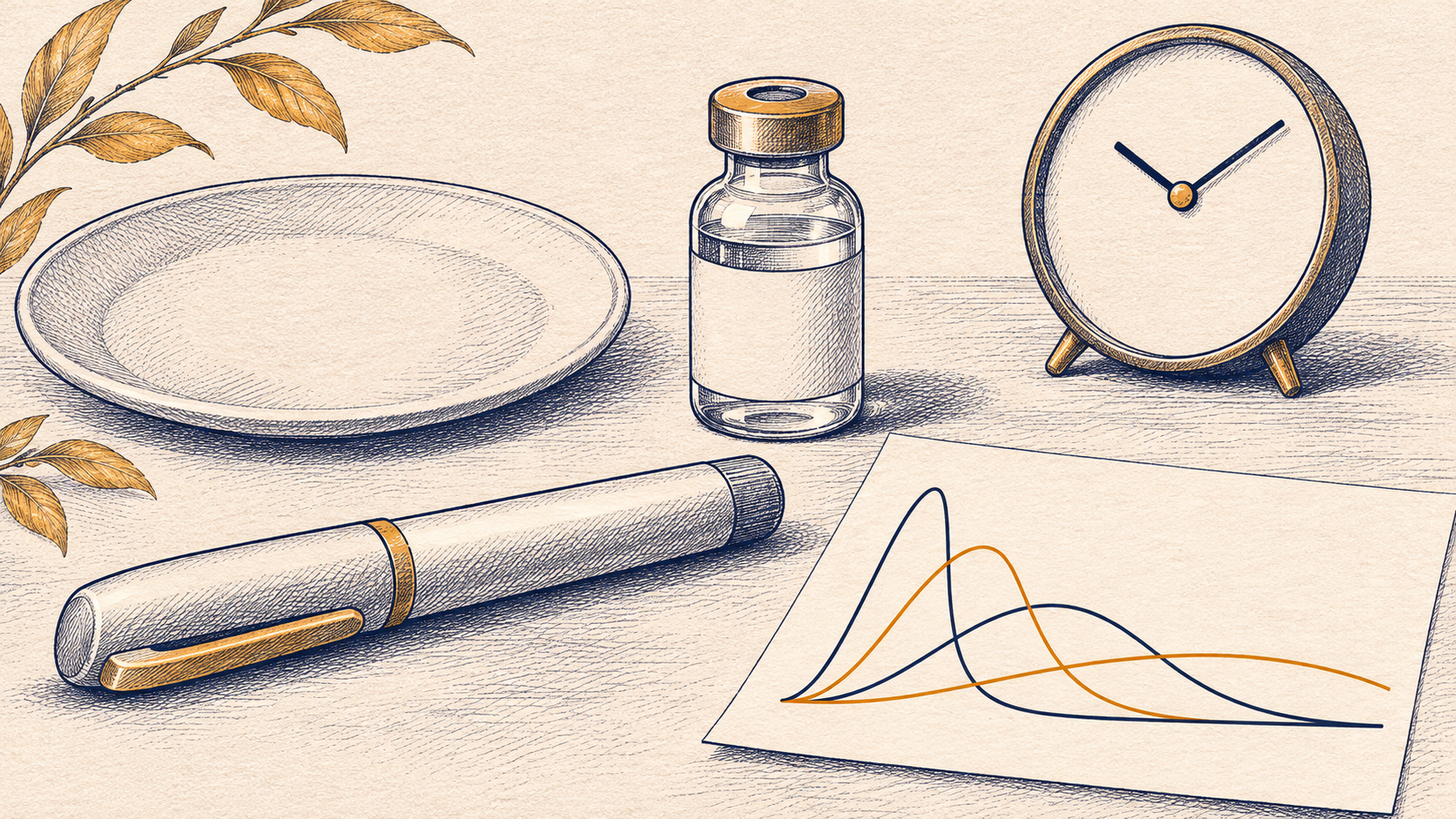
Insulin helps glucose move from the blood into the body’s cells and limits glucose released by the liver. Different insulins are designed to cover different needs: mealtime insulin covers food, while basal insulin provides background cover between meals and overnight. Some treatment plans combine them.
This guide explains the medicines. It is not a prescription or a dose-adjustment plan. Your diabetes team should choose the insulin, dose, device, timing and glucose targets that fit you.
Who may need insulin?
- Type 1 diabetes: Insulin is essential because the body makes little or none. Treatment must cover background and mealtime needs, using injections or a suitable pump. Do not stop insulin because you feel well or are eating less; follow your team’s sick-day plan.
- Type 2 diabetes: Insulin may be needed temporarily or long term, depending on glucose levels, other treatments and health circumstances. Needing insulin is not a personal failure.
- Gestational diabetes: Some people need insulin during pregnancy when the agreed glucose targets are not met with nutrition and activity measures. The maternity and diabetes teams choose the treatment.
Source: NIDDK: insulin and other diabetes treatments.
Three words that explain how insulin works
Onset is when its glucose-lowering action starts. Peak is when that effect is strongest. Duration is how long the effect lasts. These are approximate, not a countdown clock. Dose, product, injection technique, injection site, activity and individual response can change the pattern. A flat profile does not mean there is no risk of low glucose. CDC: types of insulin
Insulin types at a glance
The timings below describe representative products injected under the skin, not every brand in a category. Different reference tables use different measures of onset and duration. Use your own pack leaflet and prescription for treatment decisions.
On a smaller screen, swipe or scroll sideways within the table to see every column.
| Type and purpose | Representative insulin | Approximate onset | Approximate peak | Approximate duration | Illustrative India brand |
|---|---|---|---|---|---|
| Ultra-rapid mealtime | Faster-acting insulin aspart | About 15–20 minutes; earlier initial action than standard aspart | 1–3 hours | 3–5 hours | Fiasp |
| Rapid mealtime | Standard insulin aspart | 10–20 minutes | 1–3 hours | 3–5 hours | NovoRapid |
| Short-acting mealtime | Regular human insulin | About 30 minutes | 1.5–3.5 hours | 7–8 hours | Actrapid |
| Intermediate/background | Isophane human insulin, also called NPH | About 1.5–2 hours | 4–12 hours | Up to about 24 hours | Insulatard |
| Long-acting background | Insulin glargine U-100 | Gradual, around 2–4 hours | No pronounced peak | About 24 hours | Lantus |
| Ultra-long background | Insulin degludec | About 1–2 hours | No pronounced peak | More than 42 hours | Tresiba |
| Longer-acting background | Insulin glargine U-300 | About 6 hours | No pronounced peak | Beyond 24 hours, up to 36 hours | Toujeo |
| Human premix | 30% regular human insulin + 70% NPH | About 30 minutes | Broad combined effect, about 2–8 hours for this example | Up to 24 hours | Mixtard 30 |
| Analogue premix | 30% insulin aspart + 70% protamine-bound insulin aspart | 10–20 minutes | About 1–4 hours for this example | Up to 24 hours | NovoMix 30 |
How to read the table: Fiasp and NovoRapid have overlapping broad timing ranges, but Fiasp has faster early absorption and earlier glucose-lowering action. Appearance of insulin in the bloodstream is not the same measurement as onset of glucose lowering. Glargine U-300 is sometimes grouped with ultra-long insulins. A duration beyond 24 hours does not mean a daily prescription can be taken every other day.
The rapid-acting group also includes insulin lispro and insulin glulisine. Their exact timing differs by formulation. Human insulin and insulin analogues can both be useful; the best choice depends on the prescribed plan, glucose patterns, access and cost.
Timing references: Endotext insulin table, Fiasp product information, NovoRapid medicine information, Actrapid product information, Insulatard product information, Merck insulin action table, Tresiba product information, Toujeo product information, Mixtard product information, NovoMix 30 product information.
Brands are examples, not endorsements or an exhaustive list. India listings were checked on 6 November 2026 using Sanofi India’s product catalogue and Tata 1mg’s Novo Nordisk India catalogue. A catalogue listing does not confirm current local stock. International product information supports the educational comparisons; the current Indian pack leaflet governs use of the product supplied to you.
Match the injection to the meal
- Faster aspart: Fiasp’s product information allows administration immediately before a meal, with a limited after-meal window in specified circumstances. This is not permission to delay every dose or to use the same timing for another insulin.
- Standard rapid analogues: Often used shortly before eating. The exact interval depends on the product and your care plan.
- Regular human insulin: Typically injected about 30 minutes before food.
- Premixes: Human premix is generally taken about 30 minutes before a meal. Analogue premixes are usually taken closer to eating. Regular meal timing and an agreed carbohydrate pattern are particularly important because the two components cannot be adjusted separately.
- Daily basal insulin: Follow the prescribed schedule. It is not a substitute for a mealtime dose or a quick correction of high glucose. Weekly basal insulin has a separate schedule, described below.
Have food available before a mealtime injection. If you are not sure you can eat, are vomiting, plan to fast, or have missed a dose, follow your written plan or contact your diabetes team rather than guessing. Do not double a dose. Sources: the product information above and NHS: taking rapid-acting insulin.
What does a premix ratio mean?
Mixtard 30 contains 30% regular human insulin and 70% NPH. NovoMix 30 contains 30% rapid aspart and 70% protamine-bound aspart. These products are not interchangeable just because both contain “30”. Ratios such as 25/75, 30/70 or 50/50 describe ingredients, not the number of units to inject. Read the component names because the order used in a product name can differ.
Conventional NPH-containing and protamine-containing premixes are cloudy suspensions. They need gentle resuspension exactly as the device leaflet directs. Do not shake vigorously. A clear insulin that unexpectedly looks cloudy or contains particles should not be used until checked.
Some combination insulins are different: Ryzodeg contains 70% degludec and 30% aspart in a clear solution. Do not apply cloudy-premix handling instructions to it. EMA: Ryzodeg product information
Is there a maximum insulin dose?
There is no single maximum daily dose that is safe or suitable for everyone. Needs vary with the type of diabetes, insulin resistance, food, activity, illness, pregnancy, kidney or liver function and other medicines. A pen’s maximum dial setting is a device limit, not a universal maximum treatment dose.
Use only your prescribed dose or a dose calculated using the adjustment plan your diabetes team has taught you. Do not change brands, concentrations, premix ratios or frequency by yourself. Repeated high or low readings need review, including a check of injection technique and insulin storage. NHS: long-acting insulin dosing
Concentration is a safety check, not a dose instruction
U-40 means 40 units/mL; U-100 means 100 units/mL. Both occur in India. The insulin syringe must match the vial’s concentration. Concentrated products, such as U-200 or U-300 preparations, must be used with the correct prescribed device. Do not calculate a new dose from the concentration, transfer insulin from a pen into a syringe, or identify insulin by pen colour alone. Check the name, concentration and dose before every injection. ICMR: type 2 diabetes guidelines, insulin administration, NHS: long-acting insulin strengths
Better technique means more predictable absorption
- Inject into the fatty layer under the skin using the areas and technique your diabetes educator has demonstrated. Avoid muscle injection.
- Rotate injection spots systematically. Do not inject into lumps, thickened skin, scars or inflamed areas.
- If you have been injecting into a lump, tell your team before changing to normal skin: absorption can improve and low glucose can follow, so monitoring and dose review may be needed.
- Use a new needle each time. Never share pens, needles or syringes, even with family members or after changing the needle.
- Ask for a technique review if injections leak or hurt, or glucose becomes unexpectedly variable. Heat, activity and injection technique can change absorption; do not massage the injection site.
Source: FITTER India injection recommendations and the product leaflets above.
Protect insulin from heat and freezing
Unopened insulin is usually stored in a refrigerator at 2–8°C, away from the freezer compartment. Never freeze it or put it directly against ice packs. Keep it out of direct sunlight and hot vehicles.
The permitted temperature and expiry after opening differ by insulin and device. “All insulin lasts 28 days outside the fridge” is not a safe rule. Mark the opening date, check the leaflet and ask a pharmacist about travel, power cuts or heat exposure. In Indian summer temperatures, an ordinary room may be warmer than the product’s permitted storage limit. Do not use insulin that has frozen, expired or changed appearance. ADA: insulin storage and syringe safety, Royal Children’s Hospital: insulin storage
Know what to do if glucose falls too low
Shaking, sweating, hunger, palpitations, dizziness or confusion can signal low glucose. Some people have few warning symptoms.
For a conscious adult who can swallow safely, a glucose reading below 70 mg/dL (3.9 mmol/L) needs prompt treatment:
- Take 15 g of fast-acting carbohydrate, such as glucose tablets or glucose gel providing 15 g according to the pack. Do not use chocolate as the first treatment because fat slows absorption.
- Wait 15 minutes, then check again. Repeat if still below 70 mg/dL.
- Once recovered, follow your care plan about a snack or meal and further checks. Tell your team about recurrent lows.
If someone is unconscious, having a seizure or unable to swallow safely, give nothing by mouth. Seek emergency medical help immediately. A trained person should give prescribed glucagon if available. Children may need a smaller amount of carbohydrate; use their individual plan. CDC: treating low blood sugar
A newer weekly option
Once-weekly insulin icodec, Awiqli, was launched in India in July 2026. It is a separate basal-insulin option requiring a product-specific prescription and careful training. Never take a weekly insulin daily or convert a daily prescription yourself. It does not remove the need for mealtime insulin when that is prescribed. Reuters: India launch of Awiqli
Your next clinic visit
Bring your insulin and device, glucose readings and a list of medicines. Ask: “What is my insulin’s name and strength? When should I take it? What should I do if a meal or dose is missed? What is my low-glucose and sick-day plan? How long can this exact product stay out of the fridge?”
Know your insulin. Check your label. Follow your personal plan.
Educational information only. This guide does not replace advice from your treating clinician or the current product leaflet.
#EYI #DiabetesEducation #InsulinAwareness #KnowYourInsulin #Type1Diabetes #Type2Diabetes #DiabetesCareIndia #HypoglycemiaAwareness
Sources and further reading
- NIDDK: insulin and other diabetes treatments
- CDC: types of insulin
- Endotext insulin table
- Fiasp product information
- NovoRapid medicine information
- Actrapid product information
- Insulatard product information
- Merck insulin action table
- Tresiba product information
- Toujeo product information
- Mixtard product information
- NovoMix 30 product information
- Sanofi India’s product catalogue
- Tata 1mg’s Novo Nordisk India catalogue
- NHS: taking rapid-acting insulin
- EMA: Ryzodeg product information
- NHS: long-acting insulin dosing
- ICMR: type 2 diabetes guidelines, insulin administration
- FITTER India injection recommendations
- ADA: insulin storage and syringe safety
- Royal Children’s Hospital: insulin storage
- CDC: treating low blood sugar
- Reuters: India launch of Awiqli
