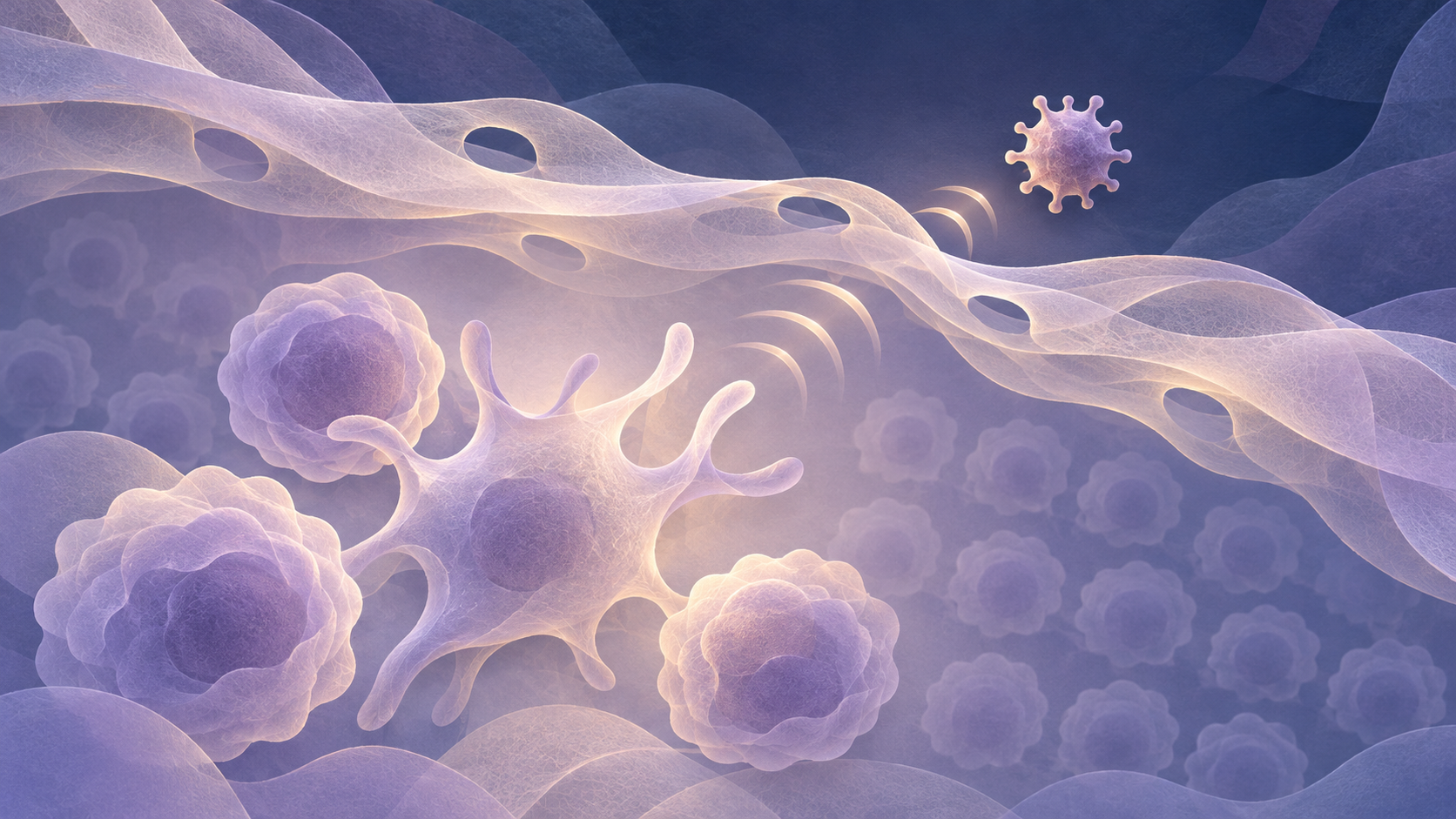
Your immune system works every day, often without you noticing. It helps keep microbes out, responds when they get in and remembers some of the threats it has met before. It also needs to recognise when to stop responding and leave healthy tissue alone.
Understanding that balance helps explain why vaccines work, why a baby can receive temporary protection from its mother, and why hives and autoimmune diseases are not simply signs of “weak immunity.”
Innate and adaptive immunity: two connected systems
Innate immunity: the defences you start life with
Innate immunity is your built-in system for detecting and responding to danger. It includes skin and mucous membranes, protective chemicals, and cells that recognise common features of microbes or damaged tissue. Some cells engulf microbes; others send signals that recruit help. These responses can begin immediately or within hours, without a previous encounter with that particular germ. Public Health Agency of Canada: Basic immunology and vaccinology
You may hear innate immunity described as “inborn” or “inherited.” Inborn is the clearer everyday term. The instructions for building our immune systems are influenced by inherited genes, but genetic influences are not limited to innate immunity. Both innate and adaptive immune systems are present at birth and continue developing. A baby receiving its mother’s antibodies is a different process: passive immunity. Immune Deficiency Foundation: How your immune system works
Adaptive immunity: a response that learns specific targets
Adaptive immunity, also called acquired immunity, develops targeted responses to particular antigens, the molecular features recognised by immune cells and antibodies.
- B cells can develop into plasma cells that produce antibodies. These proteins bind specific targets and can help block infection or mark a microbe for removal.
- T cells have several jobs. Some coordinate other immune cells; others destroy infected cells.
- Memory B and T cells can remain after a response and help the body respond more quickly to a later encounter.
A first adaptive response generally takes longer to build than an innate response. The two systems communicate and work together throughout an infection. NIH: What is the immune system?
Active and passive immunity: who makes the antibodies?
Another useful distinction is how protection is acquired.
Active immunity means your own immune system develops the response.
- After infection: exposure to a pathogen can produce immune memory. This is often called naturally acquired active immunity.
- After vaccination: a vaccine introduces an antigen, or instructions for making one, so the immune system can learn to recognise the target. This is vaccine-induced active immunity.
Active immunity takes time to develop and can last a long time, although its duration varies. Infection carries the risks of the disease itself; deliberately becoming infected is not a safe way to build protection. Vaccination provides a way to prepare the immune system without undergoing the corresponding natural infection. CDC: Immunity types NIH: What is the immune system?
Passive immunity means receiving antibodies made elsewhere.
- Maternal protection: antibodies cross the placenta during pregnancy. Breast milk also supplies antibodies that help protect an infant, particularly at mucosal surfaces such as the gut.
- Medical protection: immune globulin or certain monoclonal antibodies can provide targeted protection in specific circumstances.
Passive protection can act quickly but fades as the transferred antibodies break down. Receiving those antibodies does not, by itself, create lasting immune memory in the recipient. Maternal antibodies are transferred proteins, not inherited genes. CDC: Principles of vaccination Human milk and local immune protection
How an immune response unfolds
An immune response is often taught in phases. These are useful descriptions of overlapping activities, rather than a fixed set of stages that every illness follows on the same timetable.
- Recognition: barriers and immune sensors detect a problem. Cells such as dendritic cells can collect material from microbes and help alert adaptive immune cells.
- Activation and expansion: chemical messages recruit help. B and T cells that recognise the relevant target become activated and multiply.
- Control and clearance: immune cells, antibodies and other defence proteins work to contain the threat and remove microbes or infected cells.
- Resolution and repair: as the threat is controlled, signals reduce the response and tissues begin recovering. This regulation helps limit damage to healthy tissue.
- Memory: some adaptive immune cells persist, allowing a faster, more targeted response to a later encounter.
The timing depends on the pathogen, the part of the body affected and the person’s immune history and health. Memory can reduce the chance or severity of illness, but it does not guarantee that reinfection will never happen. Introduction to the immune response A guide to adaptive immune memory
Allergies and hives: when a response causes symptoms
An allergen is a substance that triggers an allergic response in a susceptible person. Examples include particular foods, pollen and insect venom. In many immediate allergic reactions, an antibody called IgE helps activate mast cells. These cells release histamine and other substances that can cause itching, swelling and other symptoms. AAAAI: Anaphylaxis
Hives, also called urticaria, are raised, itchy welts. Mast-cell release of histamine makes small blood vessels leak fluid into the skin and stimulates itch-sensitive nerves. Individual welts typically disappear within 24 hours, even when new ones keep appearing. Primary Care Dermatology Society: Chronic spontaneous urticaria
Not every episode of hives is an allergy. Infections, medicines, heat, cold or pressure can also be involved. Hives that recur for more than six weeks are classified as chronic urticaria. In chronic spontaneous urticaria, the welts arise without a clear external trigger and are usually not caused by a food or environmental allergy. Some cases involve autoimmune mechanisms that activate mast cells; others have no clearly established cause. Having hives does not, on its own, establish an autoimmune disease. AAAAI: Hives and angioedema
Seek medical advice if hives keep returning, interfere with sleep or daily life, or occur with other concerning symptoms. A clinician can assess the pattern and discuss appropriate treatment rather than assuming that extensive allergy testing or cutting out foods will solve the problem.
Recognise anaphylaxis
Sudden trouble breathing, throat or tongue swelling, fainting or signs of collapse after a possible allergic exposure may be anaphylaxis, a medical emergency. It can occur without hives. Use prescribed epinephrine (adrenaline) immediately as directed and call your local emergency number. Do not wait for an antihistamine to work or for symptoms to settle. AAAAI: Anaphylaxis symptoms and emergency treatment
Autoimmune disease: when healthy tissue becomes a target
The immune system normally has safeguards that help it tolerate the body’s own tissues. In autoimmune disease, those safeguards fail and immune responses mistakenly target healthy cells or tissues. Different diseases affect different parts of the body. Examples include rheumatoid arthritis, lupus and type 1 diabetes. NIH: Autoimmune diseases
An allergy generally involves a response to something outside the body. Autoimmunity involves a response to the body’s own components. They are distinct processes, although immune pathways can overlap, as some forms of chronic spontaneous urticaria illustrate.
Support normal function, rather than chase a “boost”
A healthy immune system needs an appropriate response, a clear target and effective brakes. More immune activity is not always beneficial.
Adequate nutrition supports normal immune function, and correcting a documented deficiency may help. But a product labelled an “immune booster” is not proof that it prevents infection or treats allergy or autoimmunity. Evidence for many such supplements is limited, and supplements can interact with medicines. Discuss them with a healthcare professional, especially if you have an immune-related condition or take regular medication. NIH Office of Dietary Supplements: Immune function NCCIH: Using dietary supplements wisely
Remember: innate defences act rapidly, adaptive responses learn specific targets, active immunity is made by your own body, and passive immunity provides borrowed antibodies. Healthy immunity also depends on regulation and on recognising which tissues should be left alone.
This article provides general education and does not diagnose symptoms or replace personalised medical care.
#EYI #ImmunityExplained #ImmuneSystem #InnateImmunity #AdaptiveImmunity #ImmuneMemory #Hives #AutoimmuneAwareness #HealthEducation
Sources and further reading
- Public Health Agency of Canada: Basic immunology and vaccinology
- Immune Deficiency Foundation: How your immune system works
- NIH: What is the immune system?
- CDC: Immunity types
- CDC: Principles of vaccination
- Human milk and local immune protection
- Introduction to the immune response
- A guide to adaptive immune memory
- AAAAI: Anaphylaxis
- Primary Care Dermatology Society: Chronic spontaneous urticaria
- AAAAI: Hives and angioedema
- NIH: Autoimmune diseases
- NIH Office of Dietary Supplements: Immune function
- NCCIH: Using dietary supplements wisely
