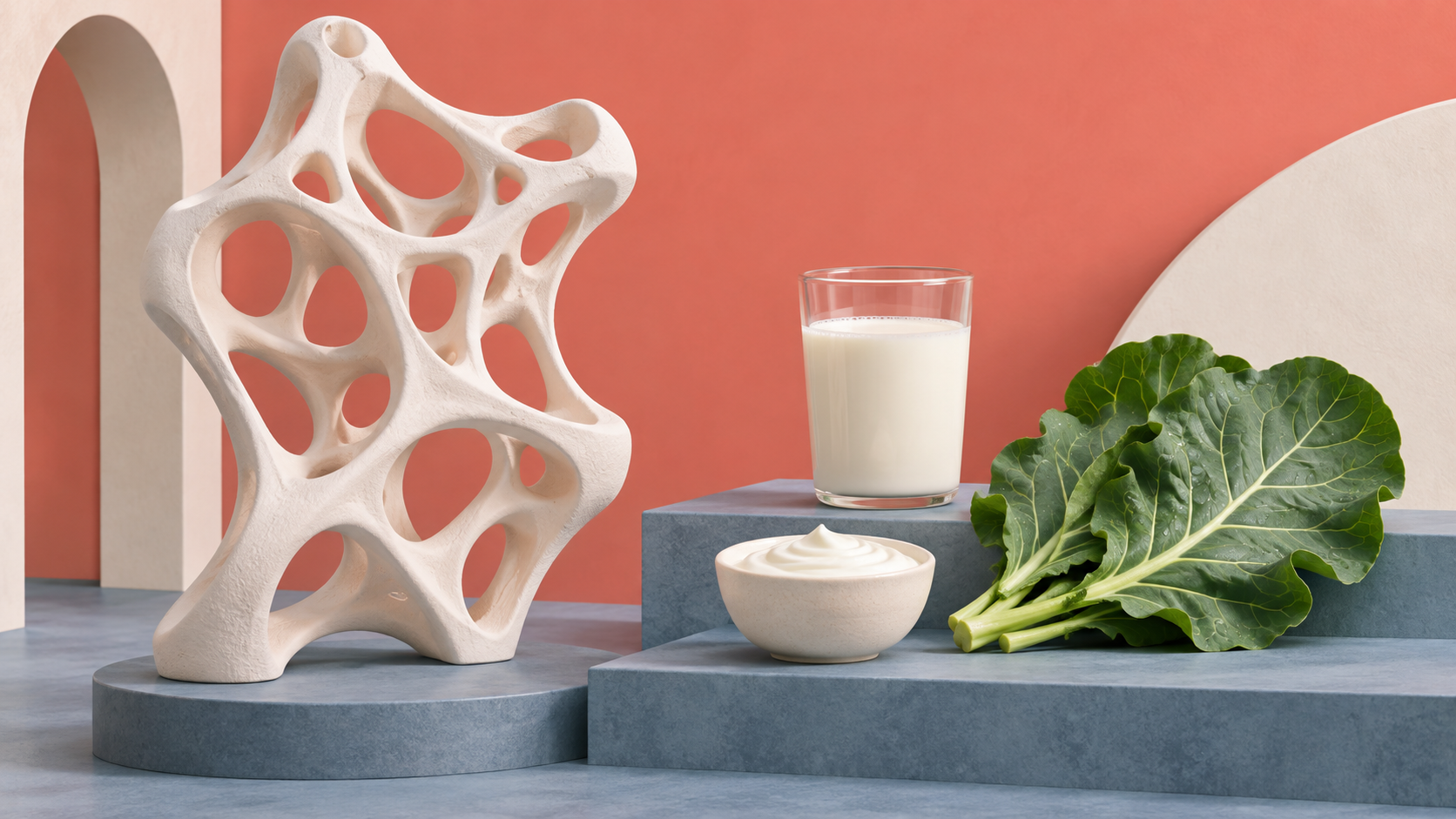
Build strong bones. Get enough, without taking too much.
Calcium supports bones, teeth, muscles and nerves. Our bones also act as a calcium store: the body can draw from them to keep blood calcium steady. Over time, an inadequate intake can weaken bones, even when a blood test looks normal. International Osteoporosis Foundation
How much calcium do we need?
The amounts below refer to total daily intake from food and supplements combined, not a tablet dose. Recommendations differ between countries and should not be mixed into one chart.
Indian reference values: ICMR-NIN 2020
| Age or life stage | Calcium per day |
|---|---|
| Infants, birth to 6 months | 300 mg* |
| Infants, 6–12 months | 300 mg |
| Children, 1–3 years | 500 mg |
| Children, 4–6 years | 550 mg |
| Children, 7–9 years | 650 mg |
| Boys and girls, 10–12 years | 850 mg |
| Boys and girls, 13–15 years | 1,000 mg |
| Boys and girls, 16–18 years | 1,050 mg |
| Adults | 1,000 mg |
| Pregnancy | 1,000 mg |
| Breastfeeding | 1,200 mg |
The birth-to-6-month value is an adequate intake. Neither infant value is an instruction to give supplements. Feeding and supplementation in babies need a paediatric plan.
Sources: ICMR-NIN’s official summary confirms the adult values; this peer-reviewed Indian review reproduces the age-specific ICMR-NIN 2020 values.
After menopause and in older age: needs and fracture risk deserve individual review. ICMR-NIN’s postmenopausal recommendation is 1,200 mg/day, as discussed in this Indian endocrinology review.
Why online charts may look different: US recommendations use 1,300 mg/day for ages 9–18, 1,200 mg for women aged 51–70, and 1,200 mg for everyone aged 71 or older. These are US values, not the Indian childhood values above. A clinician can help choose the appropriate target for your situation. US reference values
Start with food
Build regular meals around calcium sources you enjoy:
- Milk, curd/yogurt and cheese.
- Calcium-fortified plant drinks and calcium-set tofu. Check the label; not all varieties contain much calcium.
- Sardines or other suitable fish eaten with their soft, edible bones.
- Broccoli, kale and bok choy.
For perspective, roughly 240 mL milk provides about 275–300 mg calcium; a similar amount of fortified soy drink may provide about 300 mg. Product and portion sizes matter. Spinach contains calcium, but its oxalate makes much of that calcium difficult to absorb. NIH calcium food guidance
Indian options also include ragi and sesame as part of a varied diet. Their calcium content does not mean every milligram is absorbed, and a small sprinkle is not a replacement for an adequate meal plan. ICMR-NIN Dietary Guidelines for Indians, 2024
Where vitamin D3 fits
Vitamin D helps the intestine absorb calcium. Vitamin D3, also called cholecalciferol, is one form used in supplements; D2 is another. Having enough vitamin D matters, but taking extra D3 does not make unlimited calcium safe. Bone Health & Osteoporosis Foundation
Do you need a calcium supplement?
Not automatically. Estimate food intake first. Supplements can fill a shortfall or support prescribed care, such as osteoporosis treatment. Age alone does not decide the need.
If a supplement is advised:
- Check elemental calcium, the amount actually supplied, and serving size.
- Fill the gap: a 1,000 mg daily target does not mean a 1,000 mg tablet on top of meals.
- Divide larger amounts. Around 500 mg elemental calcium or less per supplement dose is usually absorbed better.
- Take calcium carbonate with food. Calcium citrate can be taken with or without food.
- Report troublesome constipation, bloating or nausea rather than simply increasing the dose.
Too little calcium and low blood calcium are different problems
A long-term dietary shortfall can contribute to weak bones. Severe calcium or vitamin D deficiency can cause rickets in children or soft bones, called osteomalacia. Osteoporosis and fractures have several causes, so calcium alone is not complete prevention or treatment.
Low calcium in the blood, called hypocalcaemia, can also result from kidney, parathyroid, magnesium or vitamin D problems, and some medicines. Tingling or cramps alone cannot diagnose it. NIH calcium guidance, Merck Manual: hypocalcaemia
Too much can also be harmful
Excess calcium supplements, calcium-containing antacids and excessive vitamin D can cause problems. Count all products together. High blood calcium, called hypercalcaemia, may also signal a medical condition such as an overactive parathyroid gland; it should not simply be blamed on food.
Possible symptoms include constipation, vomiting, unusual thirst, frequent urination, weakness or confusion. Some people have no symptoms. Persistent hypercalcaemia can damage the kidneys and cause stones. MedlinePlus
For context, US upper limits for total calcium are 2,500 mg/day at ages 19–50 and 2,000 mg/day from age 51. An upper limit is a safety boundary for the generally healthy population, not a goal or a guarantee of safety for someone with kidney disease. Children have different limits. NIH upper limits
Calcium, kidney stones and the heart
Kidney stones: do not cut out calcium-rich foods on your own. For many people with calcium-oxalate stones, appropriate calcium with meals helps bind oxalate in the gut. Stone type, fluid intake and salt intake also matter. Supplements need individual advice, particularly after recurrent stones. NIDDK kidney-stone nutrition guidance
Arteries and heart disease: calcium deposits in arteries are a real finding, but they do not prove that a person’s calcium-rich diet caused them. Some observational studies associate calcium supplements with coronary calcification or heart events. Other studies, including randomised trials and their pooled analyses, have produced mixed findings. A definite causal claim that calcium supplements cause heart attacks is not established. The sensible approach is food first, avoiding unnecessary high-dose supplements, and individual assessment rather than fear. Endocrine Society of India consensus, 2026
Kidney disease needs special care: impaired kidneys can disturb calcium, phosphorus and vitamin D balance. Mineral buildup can affect blood vessels as well as bones. Do not start calcium or vitamin D on your own if you have chronic kidney disease. NIDDK: mineral and bone disorder
What should be checked before supplementing?
Start with a review of diet, medicines, existing supplements and medical history. A normal serum calcium result does not prove that dietary calcium is adequate. NIH assessment guidance
If symptoms or medical risks warrant investigation, a clinician may check:
- Blood calcium interpreted alongside albumin, sometimes using an albumin-adjusted value, or directly measured ionised calcium. Correction formulas can be unreliable in some situations.
- Kidney function and, when relevant, phosphorus, magnesium or parathyroid hormone.
- 25-hydroxyvitamin D, written as 25(OH)D, when there is a clinical reason to assess vitamin D status.
The choice of tests depends on the problem. A bone-density scan measures bone density and helps assess fracture risk when indicated; it does not measure yesterday’s calcium intake. Endotext: assessment of high calcium
Healthy people do not all need vitamin D blood tests before eating calcium-rich foods or following standard nutrition guidance. Routine 25(OH)D screening is not recommended for generally healthy adults. Endocrine Society guideline
Check medicine timing
Calcium can reduce absorption of levothyroxine, some antibiotics and some HIV medicines. Lithium and thiazide medicines can also affect calcium balance. Ask a pharmacist for a schedule matched to your exact medicines. Levothyroxine is commonly separated from calcium supplements by at least four hours. NIH medicine interactions, MedlinePlus
When to get urgent help
Seek urgent medical care for new confusion, severe weakness, repeated vomiting with dehydration, severe muscle spasms, seizures, fainting or a concerning abnormal heartbeat. These symptoms have many possible causes, including serious calcium disturbances; do not try to correct them with extra supplements. Hypercalcaemia guidance, hypocalcaemia guidance
Take-home message: choose calcium-rich foods regularly, ensure appropriate vitamin D intake, and use supplements only to meet an identified need. If calcium was prescribed, discuss changes with the treating clinician.
General education, not a personal diagnosis or treatment plan. Pregnancy, infancy, kidney disease and osteoporosis may require specific guidance.
#EYI #Calcium #BoneHealth #FoodFirst #VitaminD #HealthyAgeing #NutritionAwareness
Sources and further reading
- International Osteoporosis Foundation
- ICMR-NIN’s official summary confirms the adult values
- this peer-reviewed Indian review reproduces the age-specific ICMR-NIN 2020 values
- Indian endocrinology review
- NIH calcium food guidance
- ICMR-NIN Dietary Guidelines for Indians, 2024
- Bone Health & Osteoporosis Foundation
- NIH calcium guidance
- Merck Manual: hypocalcaemia
- MedlinePlus
- NIDDK kidney-stone nutrition guidance
- Endocrine Society of India consensus, 2026
- NIDDK: mineral and bone disorder
- Endotext: assessment of high calcium
- Endocrine Society guideline
