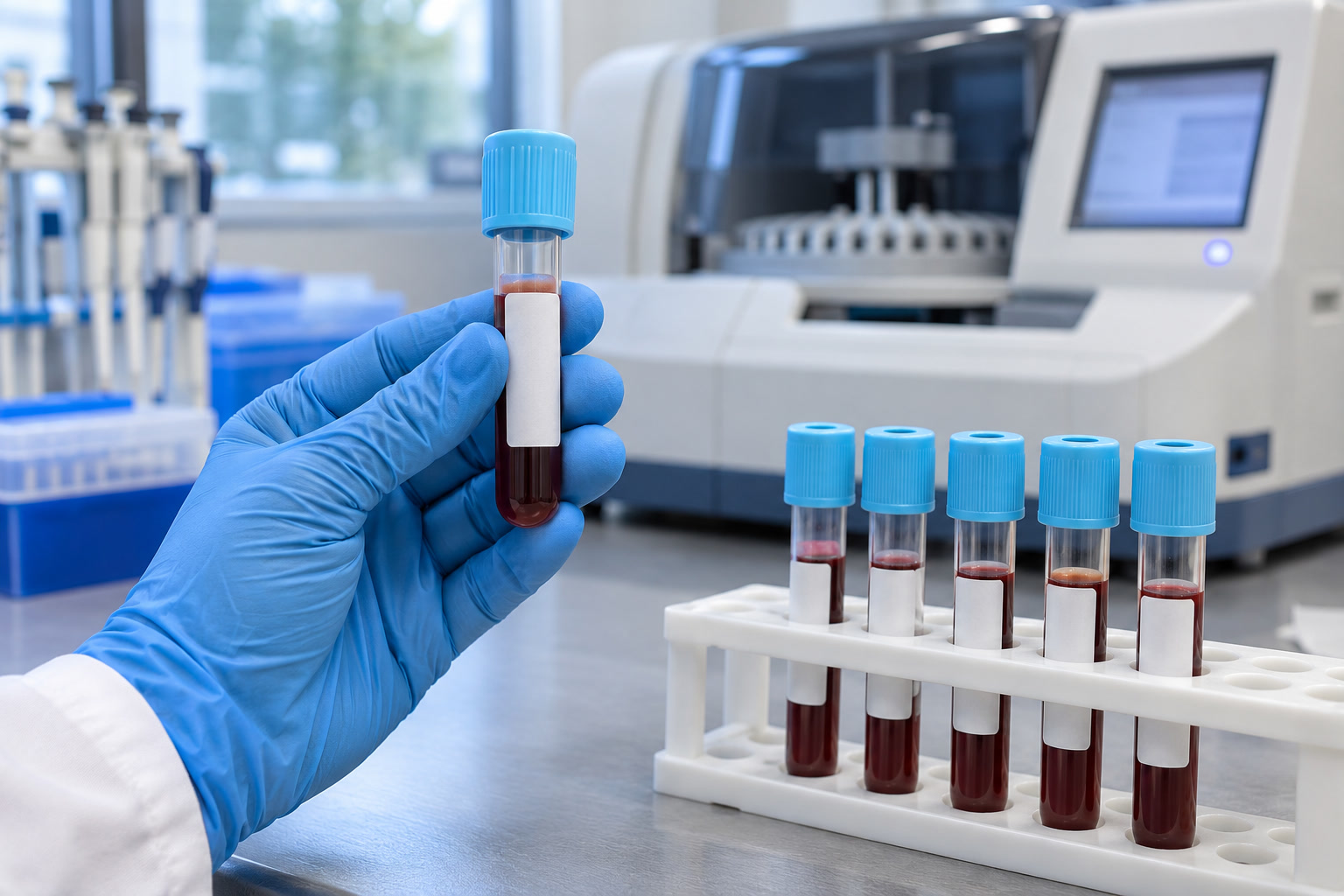
Image: PT, aPTT and INR help assess parts of the blood-clotting system. AI-generated illustrative laboratory image.
Being asked to repeat a blood test every two or three days can be worrying. With clotting tests, the reason is often to follow a changing treatment or medical condition closely. The timing depends on the medicine, the latest result and the person’s health.
PT and aPTT measure how long a blood sample takes to clot under laboratory conditions. INR is a standardized calculation based on PT. They help assess parts of the clotting system, but they do not measure platelet numbers or give a complete picture of bleeding risk.
How the body stops bleeding
When a blood vessel is injured, several parts of the body work together:
- The blood vessel narrows to reduce blood loss.
- Platelets, tiny cell fragments in the blood, stick to the damaged area and to one another, making an initial plug.
- Clotting factors, proteins in the blood, work together to produce fibrin. This forms a mesh that strengthens the plug.
A problem with platelets, clotting factors or blood vessels can cause abnormal bleeding. This is why clinicians often need several tests rather than one. The American Society of Hematology’s guide to bleeding disorders explains how platelets and clotting factors work together.
What does each test measure?
PT: prothrombin time
PT reports the time, in seconds, for a clot to form after specific substances are added to the liquid part of the blood, called plasma. It checks one group of clotting factors and can help investigate unexplained bleeding, vitamin K deficiency or liver-related clotting problems.
INR: international normalized ratio
INR is calculated from PT to make results more comparable between laboratories. Its main monitoring role is in people taking warfarin.
For someone taking warfarin, an INR above their prescribed target can mean a greater bleeding risk. An INR below their target can mean less protection against harmful clots. The target depends on why warfarin was prescribed. An INR of about 1 may be normal without warfarin, but may be too low for someone whose treatment requires a higher target.
INR is not a platelet count or a measurement of how physically “thick” the blood is. See MedlinePlus: PT and INR.
aPTT: activated partial thromboplastin time
aPTT also measures clotting time in seconds, but examines a different, partly overlapping group of clotting factors. It can help investigate conditions such as hemophilia and certain clotting-factor inhibitors. It is often reported as PTT. See MedlinePlus: PTT testing.
aPTT is also used to monitor unfractionated heparin, particularly an intravenous infusion. Some hospitals use a test called anti-Xa instead, depending on the circumstances and local protocol.
Why are these tests ordered?
Clinicians may request them to:
- Investigate unusual bruising, repeated nosebleeds, heavy menstrual bleeding or prolonged bleeding after dental work or surgery.
- Assess a suspected clotting-factor disorder, including an inherited condition.
- Monitor particular anticoagulant medicines.
- Investigate clotting abnormalities associated with liver disease or serious illness.
- Assess bleeding concerns before a procedure when the medical history or planned treatment makes testing appropriate.
They are interpreted alongside symptoms, family history, medicines and other blood tests. PT and aPTT alone cannot diagnose or exclude a blood clot in a leg or lung, and normal results do not rule out every bleeding disorder.
Why might testing be repeated every two or three days?
There is no standard rule that everyone needs PT, aPTT and INR together every two or three days. Often, only the test relevant to the treatment needs repeating.
Warfarin is being started or adjusted
Warfarin’s effect develops over several days. Repeated INR tests help the care team follow the response and keep treatment within the prescribed range. Early checks may be daily or every few days. Testing every two or three days can therefore be part of an individual plan. The NHS warfarin guide describes this early monitoring.
Something may have changed the response to treatment
A new medicine, missed doses, an illness, or substantial changes in diet or alcohol intake can affect warfarin control. An unexpected INR may also need closer follow-up. The schedule depends on the result and the clinical situation, rather than a fixed interval. See NHS Specialist Pharmacy Service: warfarin monitoring.
The medical condition is changing
During significant bleeding or serious illness, clinicians may repeat clotting tests to follow changes and the response to treatment. Sometimes a new sample is needed because a result was unexpected or there was a problem with sample collection or handling.
Some people need testing much sooner than two or three days. When an intravenous unfractionated-heparin infusion is started or adjusted, checks are often needed after about six hours. Once stable, the interval may become longer. South Tees Hospitals’ heparin guidance describes this approach.
Conversely, people with stable warfarin treatment may be tested several weeks apart. Some monitoring services allow intervals of up to 12 weeks for suitable patients. Follow the date set by your own care team.
What is the connection with platelets?
Platelets and clotting factors support the same process, but their tests answer different questions:
- Platelet count, usually included in a complete blood count or full blood count, measures how many platelets are present.
- Platelet function tests assess how well platelets work.
- PT/INR and aPTT assess parts of the clotting-factor system.
A person can have a low platelet count and normal PT and aPTT results. A normal platelet count also does not guarantee normal platelet function. MedlinePlus: platelet tests explains the distinction.
Medicines such as aspirin and clopidogrel affect platelet function. Their effects are not routinely monitored with PT/INR or aPTT. Someone with a platelet problem or von Willebrand disease may still have normal routine clotting times. Persistent bleeding symptoms deserve assessment even when initial tests look reassuring.
What can cause an abnormal result?
A prolonged clotting time means the sample took longer to clot in the laboratory. Possible explanations include:
- The effect of an anticoagulant medicine.
- Too little vitamin K or reduced production of clotting factors in liver disease.
- An inherited clotting-factor deficiency, such as hemophilia.
- An antibody that interferes with clotting factors or the laboratory test.
- Serious conditions that consume clotting factors and platelets, such as disseminated intravascular coagulation, or DIC.
- A sample-related problem that affects the accuracy of testing.
A longer result does not always mean a greater tendency to bleed. For example, a lupus anticoagulant can prolong aPTT in the laboratory while being associated with an increased risk of blood clots in the body. Further testing is needed to understand the cause. ARUP Consult’s clotting-test guidance explains these different patterns.
Laboratory reference ranges vary. A result should be compared with the laboratory’s range, any prescribed treatment target and the person’s clinical situation.
Not every “blood thinner” needs these tests
PT/INR is used for warfarin monitoring. aPTT or anti-Xa may be used for unfractionated heparin.
Direct oral anticoagulants, including apixaban, rivaroxaban, edoxaban and dabigatran, are not routinely adjusted using INR or aPTT. Normal results do not reliably exclude an effect from these medicines. Low-molecular-weight heparins, such as enoxaparin, are also not routinely monitored with aPTT. Other blood tests or specialized drug tests may be needed in particular circumstances. The Royal College of Pathologists of Australasia’s anticoagulant-monitoring guide describes these differences.
Bleeding symptoms that need urgent help
Do not wait for the next blood test if there is serious bleeding.
Seek emergency care for bleeding that will not stop, vomiting blood, black tar-like stools, or a sudden severe headache with weakness, confusion or difficulty speaking. Fainting, severe breathlessness or chest pain also need emergency assessment. If taking an anticoagulant, seek urgent medical assessment after a head injury, even if you initially feel well.
Blood in the urine, recurrent bleeding or unusually heavy menstrual bleeding should also be reported promptly. See the NHS advice on anticoagulant side effects.
What to ask your care team
- Which test am I having, and what is it monitoring?
- Do I have a treatment target, and is my result within it?
- Why is my next test needed on this date?
- Could a new medicine, supplement or illness affect the result?
- Who should I contact about an unexpected result or bleeding?
PT, aPTT and INR are useful because they help clinicians investigate bleeding problems and monitor specific treatments. Platelet tests provide different information, and the results make most sense when considered together.
Do not change, skip or stop an anticoagulant because of this article or an isolated test result. Contact the prescribing team for instructions. This article provides general education and does not replace individual medical advice.
Sources and further reading
- MedlinePlus: Prothrombin Time Test and INR
- MedlinePlus: Partial Thromboplastin Time Test
- MedlinePlus: Platelet Tests
- American Society of Hematology: Bleeding Disorders
- NHS: Warfarin
- NHS Specialist Pharmacy Service: Warfarin Monitoring
- South Tees Hospitals NHS Foundation Trust: Unfractionated Heparin
- ARUP Consult: Prolonged Clotting Time Evaluation
- Merck Manual: Overview of Coagulation Disorders
- Merck Manual: Platelet Dysfunction
- Royal College of Pathologists of Australasia: Anticoagulant Monitoring
- NHS: Anticoagulant Side Effects
Hashtags
#PTTest #aPTT #INR #BloodTests #BloodClotting #BleedingDisorders #Platelets #Warfarin #Anticoagulation #PatientEducation #EndYourIllness
