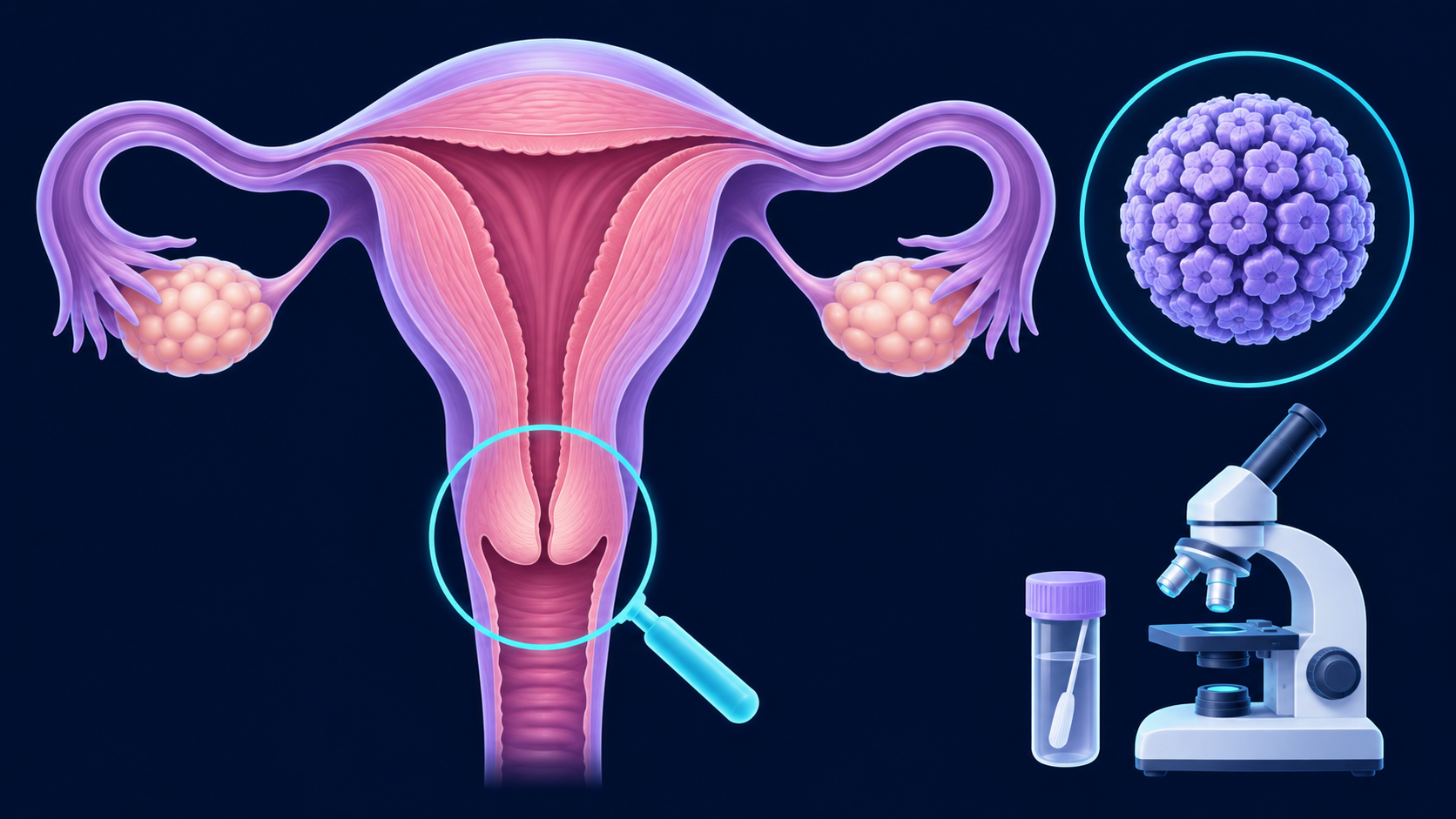
Cervical cancer begins in the cervix, the lower part of the womb that opens into the vagina. It often develops over years, giving screening and treatment of precancerous changes a chance to prevent it. Early cervical cancer may cause no symptoms. This guide explains what to look out for and what different tests can tell you. It cannot diagnose an individual’s symptoms or test results. National Cancer Institute: what cervical cancer is
What causes cervical cancer?
Persistent infection with certain high-risk types of human papillomavirus, or HPV, causes almost all cervical cancers. HPV is very common and passes through intimate skin-to-skin sexual contact. Most infections are controlled by the immune system within one or two years. A high-risk infection that remains for years can cause abnormal cervical cells, some of which may eventually become cancer.
Having HPV does not mean that cancer is inevitable. National Cancer Institute: causes and risk factors
A positive HPV result can also occur when an older infection becomes active again. It cannot establish when HPV was acquired and should not be used to make assumptions about a partner or relationship. National Cancer Institute: understanding HPV results
What increases the risk?
Factors linked to a higher risk include:
- Persistent high-risk HPV infection.
- Smoking.
- A weakened immune system, including from HIV or medicines that suppress immunity.
- A history of several pregnancies or long-term oral contraceptive use.
- Missed screening or difficulty accessing follow-up and treatment.
These factors do not mean someone will develop cancer. Do not stop prescribed medicines or contraception because of a risk-factor list; ask a clinician about your own benefits and risks. National Cancer Institute: risk factors, WHO: prevention and access to care
Symptoms that deserve a check
Precancer and early cancer often have no symptoms. When symptoms occur, they can include:
- Bleeding after sex or between periods.
- Any vaginal bleeding after menopause.
- Periods that become unusually heavy or prolonged.
- New or persistent watery, blood-stained or unusual-smelling vaginal discharge.
- Pelvic pain or pain during sex.
More advanced disease can cause back pain, leg swelling, urinary or bowel problems, and tiredness. These symptoms have many possible explanations and cannot show whether cancer is present or what stage it is. National Cancer Institute: symptoms
What else can cause these symptoms?
Common alternatives include vaginal dryness, hormonal contraception, infections, cervical polyps, fibroids, or cervical ectropion, a usually harmless change in the cells on the cervix’s surface. Bleeding after menopause can arise from thinning tissues or polyps, but it can also indicate disease in the womb. A clinician may investigate more than the cervix.
Get unusual bleeding assessed rather than assuming it is cancer or dismissing it as “just hormones.” Even a small amount of bleeding after menopause, or a single episode, should be checked. NHS: bleeding between periods or after sex, NHS: bleeding after menopause
When is it urgent?
Seek emergency care for heavy vaginal bleeding with faintness, collapse, difficulty breathing or severe pelvic pain. If pregnancy is possible and you have unusual bleeding with abdominal or pelvic pain, obtain urgent assessment because an ectopic pregnancy is one possible cause. These are urgent warning signs, not specific signs of cervical cancer. NHS: pelvic pain, NHS: unusual vaginal bleeding
Screening and diagnosis answer different questions
Screening checks people without symptoms for HPV or cell changes that might need follow-up. Diagnostic assessment investigates symptoms, a concerning examination, or an abnormal screening result.
A positive HPV test or abnormal Pap result does not by itself diagnose cancer. A tissue sample examined in a laboratory is usually needed to confirm it. American Cancer Society: tests for cervical cancer
Do not wait for the next screening invitation if symptoms develop, even if your last screening result was normal. Screening-age cutoffs do not apply to deciding whether new symptoms deserve assessment.
The tests, explained simply
HPV test
This looks for high-risk HPV in a collected sample. It tests for a virus associated with cervical cancer risk, rather than proving that cancer is present. The next step depends on the HPV type, any cell changes, previous results and personal history. CDC: HPV testing
Pap test or cervical cytology
A sample of cells from the cervix is examined for abnormal changes. An abnormal result may reflect HPV-related changes, inflammation or other causes. Follow-up might mean a repeat test, colposcopy or treatment, depending on risk. Not every positive HPV test needs an immediate biopsy. CDC: Pap results, National Cancer Institute: follow-up
What do CIN and AIS mean?
CIN stands for cervical intraepithelial neoplasia. It describes abnormal surface cells found on biopsy, graded from 1 to 3. CIN grades are not cancer stages. Even CIN 3 is not invasive cancer, but it needs specialist management. AIS means adenocarcinoma in situ, a glandular precancer. Keep the recommended follow-up appointment even when you feel well. National Cancer Institute: abnormal HPV, Pap and biopsy results
Colposcopy
A clinician uses a speculum to see the cervix and a lighted magnifying instrument that stays outside the body. A dilute vinegar solution helps highlight abnormal areas. A small biopsy may be taken. Colposcopy guides assessment; the appearance alone does not establish a cancer diagnosis. American Cancer Society: colposcopy
Cervical biopsy and histology
A pathologist examines a piece of cervical tissue under a microscope. This examination, called histology, can distinguish normal tissue, precancer and invasive cancer.
A punch biopsy removes a small sample. A LEEP/LLETZ or cone biopsy removes a larger area when more information or treatment is needed. These procedures are chosen for a particular reason; they are not tests everyone needs. Ask about pain relief, aftercare and any implications for future pregnancy. National Cancer Institute: diagnosis
Endocervical curettage, or ECC
ECC collects tissue from inside the cervical canal, which cannot always be seen fully during colposcopy. It may be recommended when the relevant area is not visible or other findings raise concern. It can cause cramps. ECC is not performed during pregnancy, so tell your clinician if you are pregnant or might be. ASCCP: guidance on ECC
If cancer is found, what type is it?
The pathology report identifies the cell type:
- Squamous cell carcinoma: the most common type, arising in the flat cells on the outer cervix.
- Adenocarcinoma: arising in glandular cells, usually within the cervical canal.
- Adenosquamous carcinoma: showing features of both.
Other types are uncommon. The type and the stage are different pieces of information, both relevant to treatment planning. National Cancer Institute: types of cervical cancer
What does staging involve?
Staging describes the cancer’s size and extent, including whether it has reached nearby tissues, lymph nodes or distant organs. A specialist combines examination and pathology with selected investigations, which may include pelvic MRI, CT or PET-CT. Not everyone needs every scan. Blood tests may assess general health and organ function.
Scans help assess the extent of a diagnosed cancer; they do not replace tissue diagnosis. A routine ultrasound or blood test alone cannot rule out cervical cancer. National Cancer Institute: diagnosis and staging
Prevention and the India context
HPV vaccination works best before exposure to the virus. It prevents new vaccine-covered infections; it does not treat an existing HPV infection or cancer. Vaccinated people still need screening according to the applicable guidance. Avoiding smoking and completing recommended follow-up also matter. CDC: prevention, WHO: cervical cancer prevention
India update, checked 6 November 2026: India launched its nationwide free HPV vaccination programme on 28 February 2026 for eligible 14-year-old girls, using a single dose of quadrivalent Gardasil-4. Government guidance says vaccination continues on routine immunization days after the initial campaign. Confirm current eligibility and availability with the local government health facility. Vaccination options outside this programme, and schedules for people with weakened immunity, require individual advice. Ministry of Health and Family Welfare: national HPV vaccination update
India’s public screening programme includes VIA, or visual inspection with acetic acid, for women aged 30–65 at Ayushman Arogya Mandirs and other facilities. VIA is a visual screening examination, not a biopsy or confirmation of cancer. Ministry of Health and Family Welfare: cervical screening
There is no single screening timetable suitable for everyone worldwide. Country guidance, test type, age, prior abnormal results, treatment history and immune status affect the plan. Ask which test and interval apply to you. Symptoms require assessment at any age.
A useful next step
If you are well, check when your next screening is due and whether HPV vaccination is appropriate. If you have symptoms, book a clinical assessment. If you have an abnormal result, ask: “What exactly was found, what is the next step, and when should it happen?”
Most abnormal screening results are not cancer. Following up gives you the chance to understand the result and, when needed, treat changes before they become more serious.
This article provides general health education, not individual medical advice, diagnosis or treatment.
#EYI #CervicalCancerAwareness #CervicalHealth #HPVAwareness #HPVVaccination #CervicalScreening #WomensHealth #HealthLiteracy
