Understanding the safety findings: The conditions named in the original post do not all have the same evidence, frequency or relationship to every COVID-19 vaccine. Some vaccine adverse effects are established, while other associations remain uncertain or depend on the product and dose. A list of diagnoses examined by a safety study is not automatically a list of injuries that study proved were caused by vaccination.

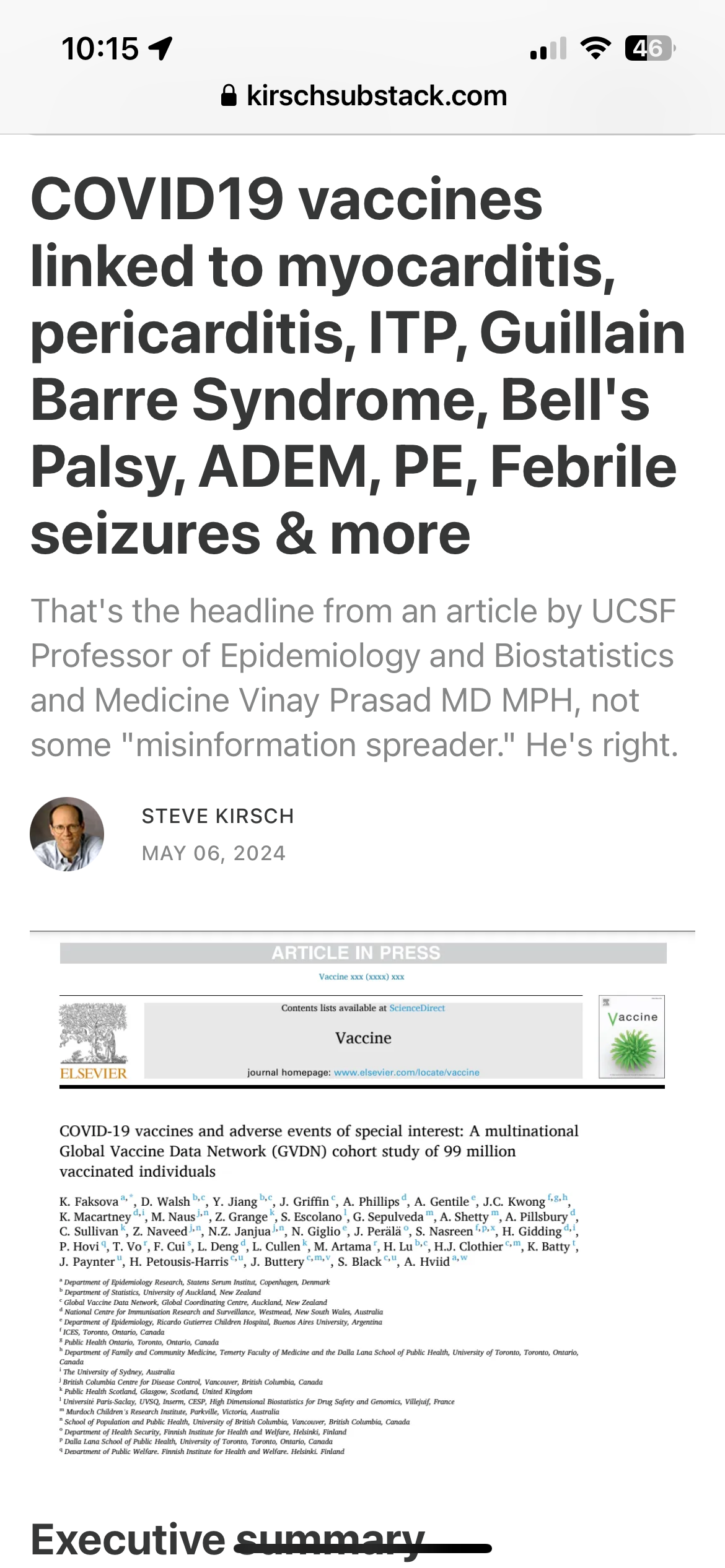
Original screenshot retained: Steve Kirsch’s Substack, May 6, 2024. It references Vinay Prasad’s commentary and displays the Faksova study; the primary research is linked below.
What the underlying study examined
The original screenshot discusses Faksova and colleagues’ 2024 multinational analysis of approximately 99 million vaccinated people. Researchers compared recorded events with historically expected rates. The study reinforced previously recognised safety signals and identified additional patterns for further investigation. It did not establish every condition named in the original headline as a causal effect of every vaccine.
A safety signal is a reason to investigate. It can become stronger when different research methods and populations show a consistent pattern. It can also weaken when better comparisons account for infection, background illness, diagnostic practices or other differences. Treating all signals as proven harm would overstate the evidence; dismissing all signals as meaningless would undermine safety monitoring.
Established risks and uncertain findings need different wording
The analysis also reinforced previously recognised safety signals for Guillain–Barré syndrome and cerebral venous sinus thrombosis after a first AstraZeneca dose. These product-specific findings should be acknowledged without treating every monitored diagnosis as vaccine-caused.
Myocarditis means inflammation of heart muscle, while pericarditis affects the surrounding sac. CDC’s clinical review recognises a causal association between these uncommon conditions and mRNA vaccination. Cases have occurred particularly in adolescent and young adult males after a second dose, although other groups and doses are also represented. This is a documented risk that deserves clear discussion, rather than denial or extrapolation to everyone vaccinated.
ADEM illustrates why follow-up matters. This inflammatory neurological condition appeared as a possible signal in the large multinational analysis. A separate English self-controlled study found a small increased risk after a first AstraZeneca dose, estimating about 0.39 attributable cases per million doses. It did not find a significant increase with other products or doses. The researchers recommended further verification. That product-specific result cannot be converted into a universal claim about mRNA vaccines.
The other diagnoses in the original headline likewise require their own analyses. A paper’s inclusion of Bell’s palsy, immune thrombocytopenia, pulmonary embolism or febrile seizures among monitored outcomes does not settle causation. Readers need the actual result, its uncertainty, the affected population and the comparator, not simply the presence of a medical term in a table.
Keep the clinical question specific
For an individual, the useful questions concern the particular product, dose, timing and symptoms, alongside the expected benefit in that person’s circumstances. New chest pain, shortness of breath or palpitations warrant medical assessment. Population research can inform that assessment, but a headline cannot diagnose the cause of an individual’s illness or calculate their personal risk.
References
- Faksova et al., multinational vaccine safety study; primary abstract hosted by Public Health Scotland
- CDC, clinical considerations on myocarditis and pericarditis after vaccination
- Stowe et al., ADEM after vaccination in England, self-controlled case-series study (2024)
