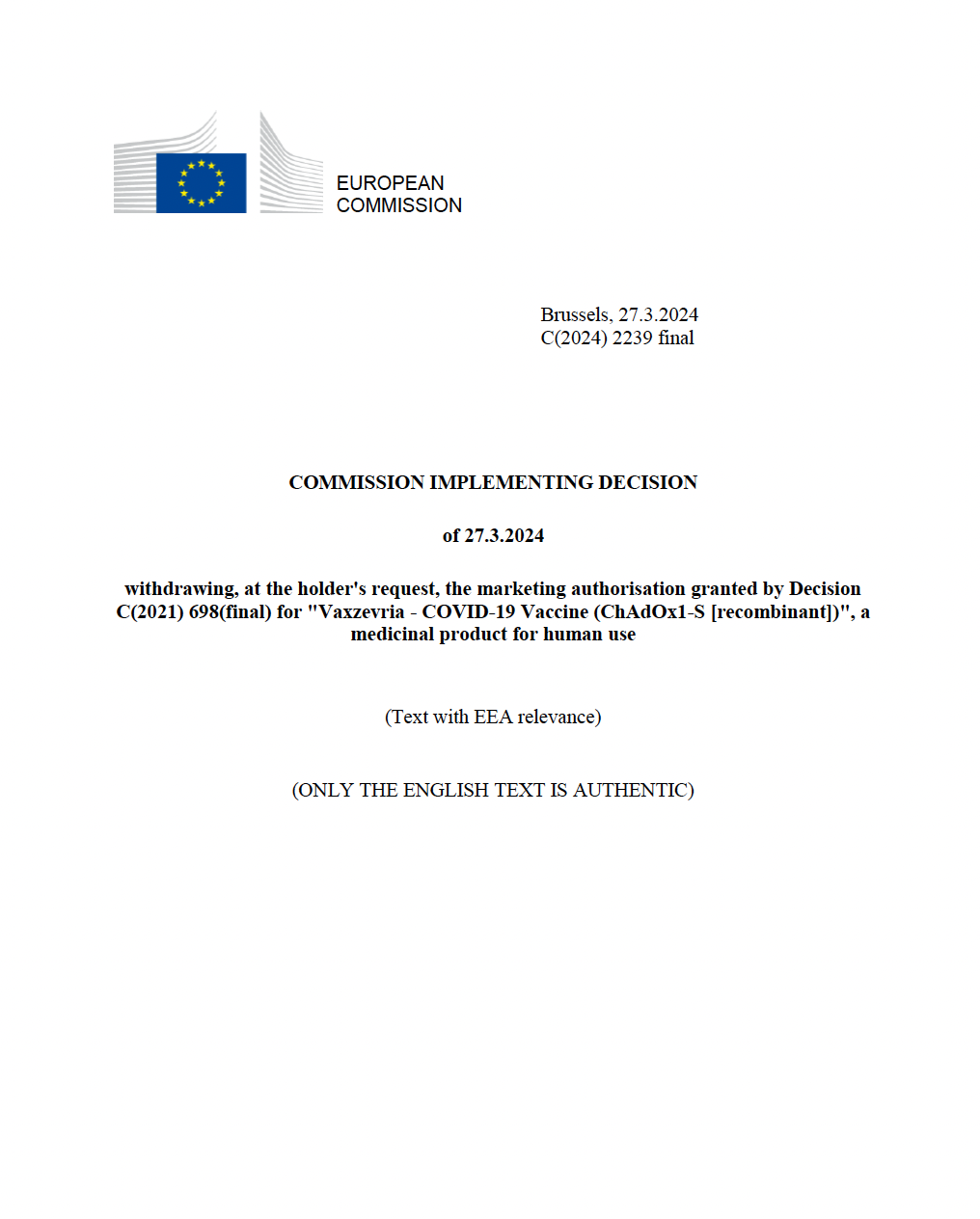
Regulatory context: AstraZeneca’s Vaxzevria marketing authorisation was withdrawn in the European Union at the company’s request for commercial reasons. That is the reason recorded by the European Medicines Agency. A separate, very rare clotting disorder associated with this vaccine had already been publicly recognised in 2021. The withdrawal does not, on its own, establish the broader accusations or predictions in the original headline.

Original document image retained: European Commission, implementing decision C(2024) 2239 final, March 27, 2024.
What the European decision says
The document reproduced here is a European Commission decision dated March 27, 2024. Its own heading says the authorisation is being withdrawn at the holder’s request. EMA’s public record identifies AstraZeneca AB’s decision to discontinue marketing for commercial reasons. A later regulatory assessment distinguishes the March decision from the withdrawal taking effect on May 7, 2024.
This matters because a company-requested commercial withdrawal and a regulator-imposed safety suspension are different actions. The official record should be described using its stated basis. The fact that litigation or public controversy occurred around the same period does not show that it caused the regulatory decision.
The clotting risk was real and publicly documented
On April 7, 2021, EMA announced that unusual blood clots accompanied by low platelet counts should be listed as a very rare adverse effect of Vaxzevria. This combination is known as thrombosis with thrombocytopenia syndrome, or TTS. Cases could be serious or fatal and required prompt recognition and treatment. Acknowledging that risk is important; describing it as a secret first revealed in 2024 is inaccurate.
The timing and type of event also matter. TTS is a particular syndrome assessed in relation to a recent dose, not a label for every blood clot that occurs at any later point in a vaccinated person’s life. An individual’s suspected vaccine injury deserves clinical investigation, while population-level claims require evidence about rates and relevant comparison groups.
What cannot be inferred about other vaccines
AstraZeneca’s vaccine uses an adenovirus-vector platform. Pfizer-BioNTech and Moderna products use mRNA. A safety finding or commercial decision for one product cannot simply be transferred to another. Other products have their own documented risks, including myocarditis and pericarditis associated with mRNA vaccination, which must be evaluated using their own evidence and affected populations.
The original headline’s reference to court admissions is not a substitute for a court judgment about a specific claimant, nor does it establish a future outcome for other manufacturers. This review relies on the public regulatory documents linked below rather than treating an unlinked account of litigation as a verified ruling.
The useful conclusion is precise: the EU authorisation ended following AstraZeneca’s request, and a rare, important clotting risk was already on the public record. Both facts can be reported without minimising affected patients or extending the evidence into unsupported claims about millions of people.
References
- EMA, Vaxzevria authorisation and withdrawal record
- EMA, Vaxzevria periodic safety assessment, including withdrawal dates
- EMA, April 7, 2021 public announcement of very rare clotting with low platelets
- Faksova et al., multinational COVID-19 vaccine safety study (2024)
