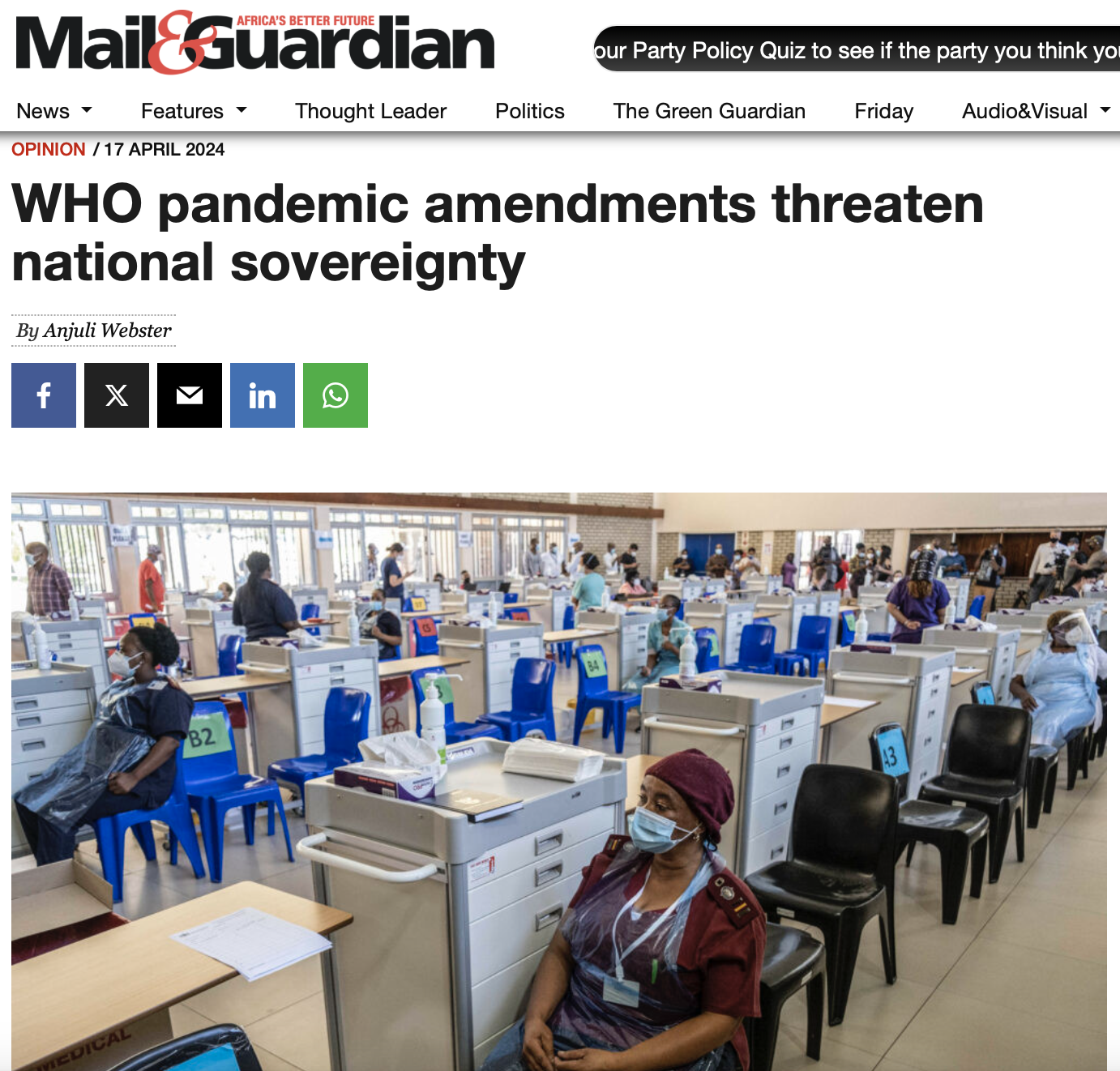
The original post highlighted a debate in South Africa about pandemic preparedness, national decision-making and the role of the World Health Organization. Its image reproduces Anjuli Webster’s Mail & Guardian opinion article, “WHO pandemic amendments threaten national sovereignty,” published on 17 April 2024. That article referred back to Webster’s 22 March piece, “Pandemic preparations are unhealthy.”
Keep the criticism attached to its date
Webster questioned whether proposed international health rules would concentrate power and draw resources away from other health priorities. Those are policy arguments worth examining. However, the article discussed proposals under negotiation in 2024. A proposed clause is not proof that the same language appeared in the adopted instrument, and an author’s interpretation should be clearly attributed.
For countries facing multiple health burdens, sensible scrutiny includes the cost of surveillance and preparedness, the effect on routine healthcare, and whether promised access to medicines can be delivered. Claims that a particular budget must be diverted from malaria, tuberculosis or another service require evidence about actual funding decisions. That outcome cannot simply be assumed from the existence of an international agreement.
Two instruments, different legal stages
The International Health Regulations and the Pandemic Agreement are separate instruments. The 2024 IHR amendments introduced changes to international coordination and emergency alerts. Their consolidated text retains the distinction between binding state obligations and WHO’s non-binding recommendations, as well as recognition of states’ authority over their health legislation.
The Pandemic Agreement was adopted in May 2025. Its text explicitly says it does not give WHO authority to direct domestic laws or impose measures such as vaccination mandates or lockdowns. That does not make every concern about accountability or implementation irrelevant; it does rule out presenting those powers as something the adopted agreement grants.
Adoption also did not immediately bring the agreement into force. The Swiss Federal Office of Public Health explains that the pathogen-access and benefit-sharing annex must be completed before signature. Its current account records a May 2026 decision to seek a final negotiated outcome for May 2027. WHO’s September 2026 update likewise described continuing negotiations.
Readers can therefore ask practical questions about participation, financing, parliamentary scrutiny and implementation while using the correct version of each document. Accurate criticism is stronger when it separates an earlier proposal, the final wording, and a country’s actual legal commitments.
Source credit: Anjuli Webster and Mail & Guardian for the opinion article shown in the original image. Photograph credit visible in the source article: Emmanuel Croset/AFP. This is an independent explanation and update, not a reproduction of that opinion.

References
- Anjuli Webster, Mail & Guardian: original 17 April 2024 opinion
- WHO: consolidated International Health Regulations
- WHO: Pandemic Agreement, adopted May 2025
- Swiss Federal Office of Public Health: agreement status and national process
- WHO: PABS negotiations update, 18 September 2026
