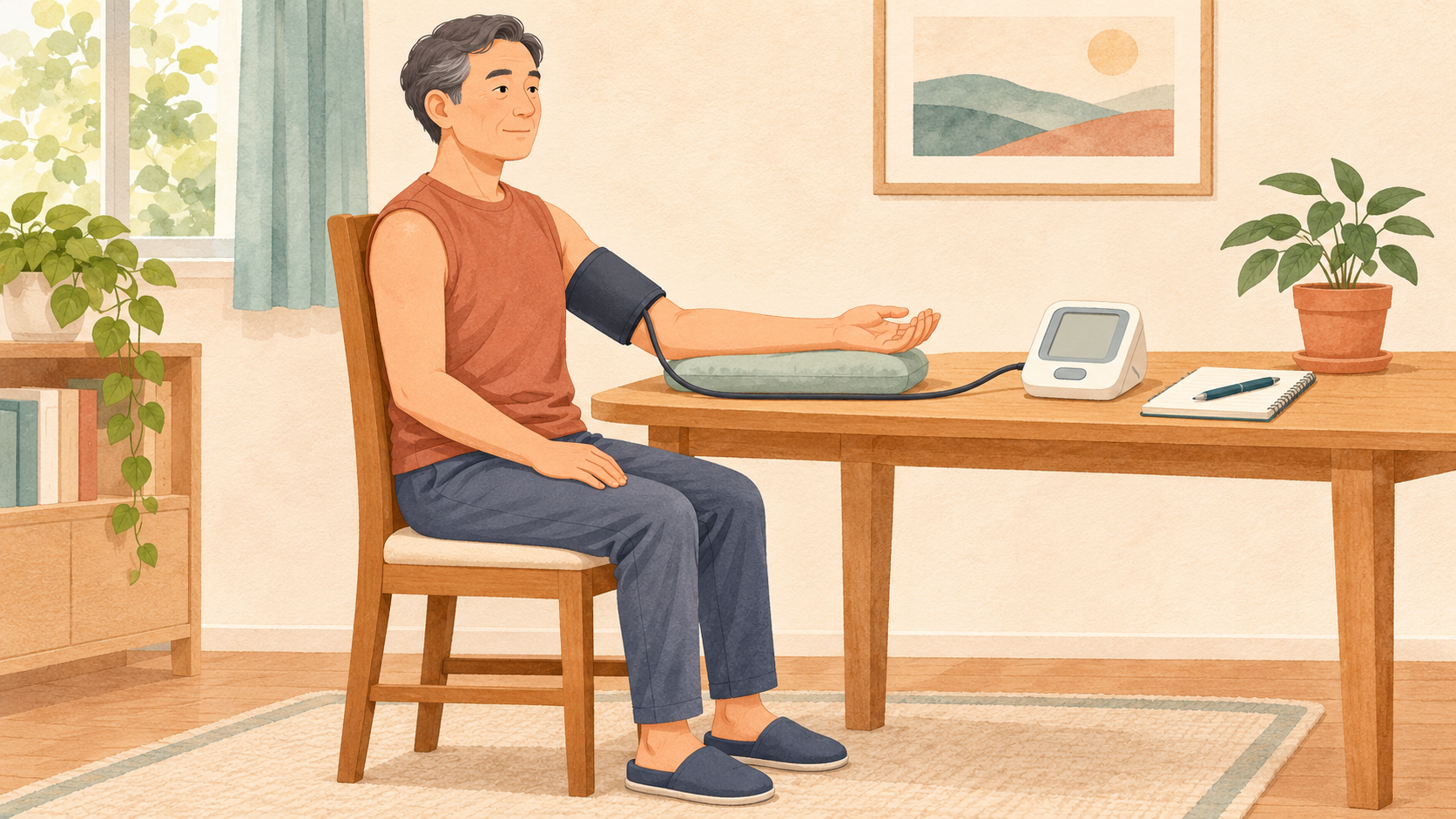
A useful blood pressure record starts with the right technique, not just a number on a screen. This guide explains how to measure, which readings to keep, and how age affects the conversation with your healthcare professional.
If you have chest pain, severe breathlessness, new weakness, trouble speaking or sudden vision changes, call your local emergency number now. Do not delay to finish a blood pressure check.
Understand the two numbers
Blood pressure is written as two numbers, such as 128/78 mmHg:
- Systolic, the top number: pressure when your heart contracts.
- Diastolic, the bottom number: pressure between heartbeats.
Record both. The pulse shown by many monitors is your heart rate, not a third blood pressure reading. High blood pressure often has no symptoms, so feeling well does not tell you whether it is controlled. NHS: Blood pressure tests
Choose a suitable monitor
Use a validated automatic upper-arm monitor with a cuff that fits your arm. Measure your upper-arm circumference and check the manufacturer’s cuff-size range. A cuff that is too small or too large can give misleading results.
Ask a pharmacist or clinician to help you choose one and check your technique. Take the monitor to an appointment so its readings can be checked. For children or pregnancy, make sure the device is validated for that group. American Heart Association: Home monitoring
Measure correctly, step by step
- Prepare: avoid smoking, caffeine and exercise for at least 30 minutes beforehand. Empty your bladder.
- Rest: sit quietly for at least five minutes before starting.
- Sit properly: support your back, keep your legs uncrossed and place both feet flat on the floor.
- Position your arm: rest it on a table or support, with the cuff at heart level. Put the cuff on bare skin, following the monitor’s instructions.
- Stay still and quiet: do not talk, use your phone or move during the measurement.
- Repeat: take two readings at least one minute apart. Keep both results.
Use the same arm and similar times each day, following any instructions your clinician has given. AHA: Home monitoring; CDC: Measuring your blood pressure
Which readings should you record?
Record both readings from each session, not just the lower one. A simple notebook or the monitor’s memory is useful.
For each session, note:
- Date and time.
- First reading: systolic/diastolic.
- Second reading: systolic/diastolic.
- Pulse, if displayed.
- Any symptoms, such as dizziness or headache.
- Medicines taken and their timing, including whether the check was before or after your usual dose.
- Anything unusual, such as pain, recent activity or a missed dose.
For example: “Monday, 8 am: 138/86, then 135/84; pulse 72; no symptoms; measured before my usual morning medicine.” This is an example of a record, not a target or instruction to change medication timing.
For a diagnostic record, NICE recommends two readings each morning and evening for at least four days, ideally seven. Its diagnostic average excludes day one. Keep all original readings for your clinician, including day one; never discard a high result to improve the average. Follow your clinician’s schedule for ongoing monitoring. NICE: Hypertension recommendations
Which numbers need attention?
Either number can be too high. You do not need both numbers to cross a threshold. For example, 155/75 has a high top number, while 118/95 has a high bottom number.
Guidelines use different definitions, so check which one your healthcare team follows:
- UK guidance: a home average of 135 systolic or 85 diastolic or higher needs assessment for hypertension. The usual clinic threshold is 140 systolic or 90 diastolic or higher. NHS: Understanding your result
- US AHA categories: normal is below 120 and below 80. Elevated blood pressure is 120–129 systolic with diastolic below 80. Stage 1 hypertension is 130–139 systolic or 80–89 diastolic; stage 2 is 140 systolic or 90 diastolic or higher. When the numbers fall into different categories, the higher category matters. AHA: Understanding blood pressure readings
These are not interchangeable treatment targets. A clinician confirms a diagnosis from an appropriate assessment and repeated measurements. Share a persistently high average or an upward trend, even if you feel well. Do not rely on a single lower result to cancel out repeated high readings.
When a high reading needs urgent help
For adults who are not pregnant, take action if the top number is 180 or higher, or the bottom number is 120 or higher:
- With chest pain, breathlessness, new weakness or numbness, trouble speaking, vision changes or other serious new symptoms: call your local emergency number immediately, such as 999 in the UK or 911 in the US. Do not wait for another reading or for the pressure to fall.
- Without those symptoms: remain seated and repeat the measurement after at least one minute. If it is still this high, contact a healthcare professional promptly for urgent advice. Do not wait to finish a seven-day record.
Serious symptoms can be an emergency even when your blood pressure is below those numbers. AHA: When to seek emergency help
Does the “normal” reading change with age?
High blood pressure should not be dismissed as normal ageing. Targets depend on health and treatment tolerance.
For many adults already being treated for hypertension, NICE uses these home-average treatment targets:
- Under 80: below 135/85 mmHg.
- 80 and over: below 145/85 mmHg.
These are treatment targets, not diagnostic cut-offs. Other guidelines or conditions may require different goals. Care should be individualised for frailty or multiple conditions. People aged 80 and over, or with dizziness on standing, may need standing pressure checked; a significant drop can change their treatment plan. NICE: Monitoring and treatment targets
Children need a separate assessment. Younger children’s readings are interpreted using age, sex and height, with an appropriately sized cuff. Do not use an adult chart to decide whether a child’s reading is safe. Ask their clinician for the right range and monitoring plan. AHA: Blood pressure in children and teens
Pregnancy and after birth: do not use the adult emergency threshold
Pregnancy has different limits. If pregnant, contact your maternity team promptly about a reading of 140 systolic or 90 diastolic or higher, or follow their more specific plan. A reading of 160 systolic or 110 diastolic or higher needs urgent assessment. Do not wait for 180/120. NHS: High blood pressure in pregnancy
During pregnancy or in the weeks after birth, severe persistent headache, vision changes, pain below the ribs, sudden swelling or feeling very unwell need immediate medical advice, regardless of the reading. Contact your maternity unit or urgent medical service. These can be signs of pre-eclampsia. NHS: Pre-eclampsia
What about low blood pressure?
A reading below 90/60 mmHg is generally described as low blood pressure, but it is not automatically harmful. Symptoms and your usual readings matter. Repeated dizziness, fainting, blurred vision or weakness should be discussed with a clinician, particularly if they happen on standing. NHS: Low blood pressure
Take your record, not a guess, to your appointment
Bring the full record and ask: “What is my personal home blood pressure target, and which results should make me call you?”
Do not stop, double, skip or otherwise change prescribed blood pressure medicine based on home readings without professional advice. Home monitoring supports care; it does not replace it. AHA: Home monitoring
General educational information, not a diagnosis or an individual treatment plan. Sources checked November 2026.
#BloodPressure #KnowYourNumbers #HomeBloodPressure #Hypertension #HeartHealth #HealthyAgeing #EndYourIllness
Sources and further reading
- NHS: Blood pressure tests
- American Heart Association: Home monitoring
- CDC: Measuring your blood pressure
- NICE: Hypertension recommendations
- AHA: Understanding blood pressure readings
- AHA: When to seek emergency help
- NICE: Monitoring and treatment targets
- AHA: Blood pressure in children and teens
- NHS: High blood pressure in pregnancy
- NHS: Pre-eclampsia
- NHS: Low blood pressure
